LEADER 04216nam a22006015i 4500
001 806664
003 TR_AnAIT
005 20260127002546
007 cr nn 008mamaa
008 100301s2008 gw | s |||| 0|eng d
020 |a9783540720478|9978-3-540-72047-8
024 7 |a10.1007/978-3-540-72047-8|2doi
041 |aeng
049 |aTürk Tarih Kurumu Kütüphanesi
050 4|aK3820-3836
072 7|aLBBM|2bicssc
072 7|aLAW051000|2bisacsh
072 7|aLBBM|2thema
082 04|a343.07|223
090 |aDK/7958
100 1 |aWhite, Paul.|eauthor.|4aut|4http://id.loc.gov/vocabulary/relators/aut
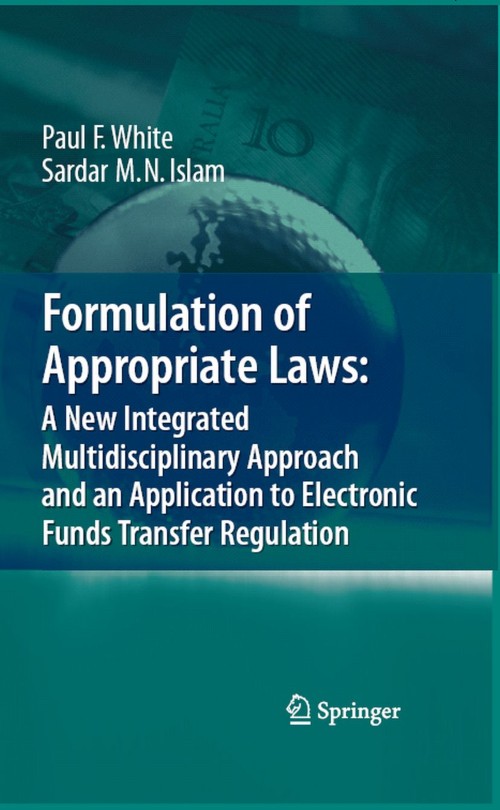
245 10|aFormulation of Appropriate Laws: A New Integrated Multidisciplinary Approach and an Application to Electronic Funds Transfer Regulation|h[electronic resource] /|cby Paul White, Sardar M. N. Islam.
250 |a1st ed. 2008.
264 1|aBerlin, Heidelberg :|bSpringer Berlin Heidelberg :|bImprint: Springer,|c2008.
300 |aXXI, 178 p.|bonline resource.
336 |atext|btxt|2rdacontent
337 |acomputer|bc|2rdamedia
338 |aonline resource|bcr|2rdacarrier
347 |atext file|bPDF|2rda
505 0 |aThe EFT System and Regulatory Framework -- An Integrated Multi-Disciplinary Approach -- Comparative Analysis of Substantive Regulations -- Multi-disciplinary Analysis of EFT Regulation: Economic, Ethical and Other Considerations -- An Efficient or Optimal Regulatory Framework -- Summary and Conclusions.
520 |aFormulation of Appropriate Laws: A New Multidisciplinary Modelling Approach and an Application to Electronic Funds Transfer Regulation. Efficient laws have profound positive social, economic, political and welfare effects. As a consequence, the formulation of efficient laws is a central issue in the study, practice and implementation of laws. Fragmented approaches to the formulation of laws such as ‘comparative law analysis’ and ‘welfare economic analysis of laws’ exist in the current literature; they even occasionally rear their heads in the practice and implementation of laws. However, what these authors offer and what is needed, is an integrated approach to help formulate efficient and socially desirable laws – an approach that not only incorporates ‘comparative law analysis’ and ‘welfare economic analysis of laws,’ but also takes into consid- ation other various dimensions of human welfare that are affected by new laws and legal reform. This book presents such an approach using the Electronic Funds Transfer (EFT) regulation in Australia as its vehicle of analysis. The two-pronged approach offered in this book can be applied to formulate efficient laws that maximise the social welfare of the country, irrespective of social, political and economic organisations of the country under study. As such, this book makes several distinct contributions to the literature in law as it: 1. develops a new integrated multi-disciplinary approach using quantitative methods to formulate appropriate laws; 2. applies recent developments in welfare economics; 3.
650 0|aInternational law.
650 0|aTrade regulation.
650 0|aLaw and economics.
650 0|aLaw|xPhilosophy.
650 0|aLaw|xHistory.
650 0|aPrivate international law.
650 0|aConflict of laws.
650 0|aComparative law.
650 0|aPolitical science.
650 14|aInternational Economic Law, Trade Law.
650 24|aLaw and Economics.
650 24|aTheories of Law, Philosophy of Law, Legal History.
650 24|aPrivate International Law, International and Foreign Law, Comparative Law.
650 24|aPolitical Science.
700 1 |aIslam, Sardar M. N.|eauthor.|0(orcid)0000-0001-9451-7390|1https://orcid.org/0000-0001-9451-7390|4aut|4http://id.loc.gov/vocabulary/relators/aut
710 2 |aSpringerLink (Online service)
773 0 |tSpringer Nature eBook
776 08|iPrinted edition:|z9783540720461
776 08|iPrinted edition:|z9783540848295
776 08|iPrinted edition:|z9783642091230
856 40|uhttps://doi.org/10.1007/978-3-540-72047-8
912 |aZDB-2-SHU
912 |aZDB-2-SXLC
950 |aHumanities, Social Sciences and Law (SpringerNature-11648)
950 |aLaw and Criminology (R0) (SpringerNature-43727)