LEADER 04160nam a22004815i 4500
001 806681
003 TR_AnAIT
005 20260127002608
007 cr nn 008mamaa
008 140805s2014 ne | s |||| 0|eng d
020 |a9789462096592|9978-94-6209-659-2
024 7 |a10.1007/978-94-6209-659-2|2doi
041 |aeng
049 |aTürk Tarih Kurumu Kütüphanesi
050 4|aL1-991
072 7|aJN|2bicssc
072 7|aEDU000000|2bisacsh
072 7|aJN|2thema
082 04|a370|223
090 |aDK/7975
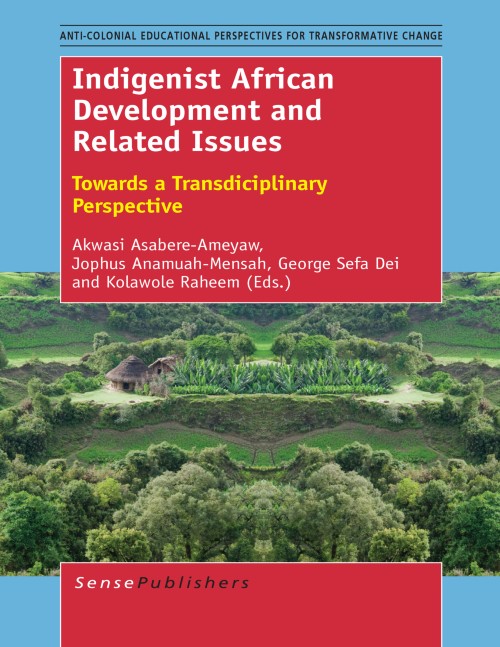
245 10|aIndigenist African Development and Related Issues|h[electronic resource] :|bTowards a Transdisciplinary Perspective /|cedited by Akwasi Asabere-Ameyaw, Jophus Anamuah-Mensah, George Sefa Dei, Kolawole Raheem.
250 |a1st ed. 2014.
264 1|aRotterdam :|bSensePublishers :|bImprint: SensePublishers,|c2014.
300 |aX, 256 p.|bonline resource.
336 |atext|btxt|2rdacontent
337 |acomputer|bc|2rdamedia
338 |aonline resource|bcr|2rdacarrier
347 |atext file|bPDF|2rda
490 1 |aAnti-colonial Educational Perspectives for Transformative Change
520 |aThere is no term so heavily contested in social science literature/nomenclature than ‘Development’. This book brings Indigenous perspectives to African develop¬ment. It is argued that contrary to development as we know it not working, a greater part of the problem is that conventional development approaches that work have in fact not truly been followed to the letter and hence the quagmire. All this is ironic since everything we do about our world is development. So, how come there is “difficult knowledge” when it comes to learning from what we know, i.e., what local peoples do and have done for centuries as a starting point to recon¬structing and reframing ‘development’? In getting our heads around this paradox, we are tempted to ask more questions. How do we as African scholars and research¬ers begin to develop “home-grown solutions” to our problems? How do we pioneer new analytical systems for understanding our communities and offer a pathway to genuine African development, i.e., Indigenist African development? (see also Yankah, 2004). How do we speak of Indigenist development mindful of global developments and entanglements around us? Can we afford to pursue development still mired in a “catch up” scenario? Are we in a race with the development world and where do we see this race ending or where do we define as the ‘finishing line’? A Publication of the Centre for School and Community Science and Technology Studies [SACOST], University of Education, Winneba, Ghana.
532 8 |aAccessibility summary: This PDF eBook is produced by a third-party. We have requested that the file be made accessible and compliant with the European Accessibility Act (EAA). However, we have not been able to fully verify its compliance with recognized accessibility standards (such as PDF/UA or WCAG). For detailed accessibility information, please refer to the original publisher’s website. If you require an accessible version of this content, please contact accessibilitysupport@springernature.com. We are committed to improving accessibility and will work with the publisher to meet your needs wherever possible.
532 8 |aPublisher contact for further accessibility information: accessibilitysupport@springernature.com
650 0|aEducation.
650 14|aEducation.
700 1 |aAsabere-Ameyaw, Akwasi.|eeditor.|4edt|4http://id.loc.gov/vocabulary/relators/edt
700 1 |aAnamuah-Mensah, Jophus.|eeditor.|4edt|4http://id.loc.gov/vocabulary/relators/edt
700 1 |aDei, George Sefa.|eeditor.|4edt|4http://id.loc.gov/vocabulary/relators/edt
700 1 |aRaheem, Kolawole.|eeditor.|4edt|4http://id.loc.gov/vocabulary/relators/edt
710 2 |aSpringerLink (Online service)
773 0 |tSpringer Nature eBook
830 0|aAnti-colonial Educational Perspectives for Transformative Change
856 40|uhttps://doi.org/10.1007/978-94-6209-659-2
912 |aZDB-2-SHU
912 |aZDB-2-SXED
950 |aHumanities, Social Sciences and Law (SpringerNature-11648)
950 |aEducation (R0) (SpringerNature-43721)