

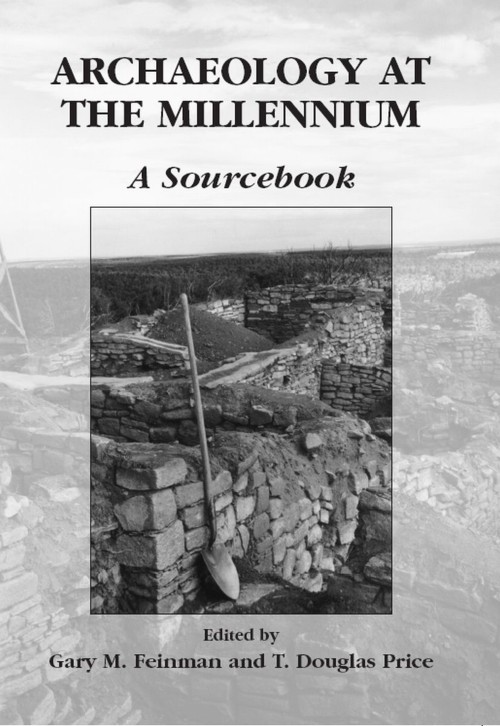
Archaeology at the Millennium [electronic resource] : A Sourcebook / edited by Gary M. Feinman, T. Douglas Price.
Erişim Adresi
ISBN
9780387726113
Dil Kodu
İngilizce
Yer Numarası
DK/8026
Basım Bildirimi
1st ed. 2001.
Yayın Bilgisi
New York, NY : Springer US : Imprint: Springer, 2001.
Fiziksel Niteleme
XX, 508 p. online resource.
İçindekiler Notu
Archaeology at the Millennium: Of Paradigms and Practice -- An Aspect of Archaeology's Recent Past and Its Relevance in the New Millennium -- First Hominids to Complex Hunter–Gatherers -- Paleoanthropology at the Millennium -- Fully Modern Humans -- Holocene Hunter–Gatherers -- The Transition from Hunter–Gatherers to Agricultural Villages -- The Transition to Food Production -- Richman, Poorman, Beggarman, Chief: The Dynamics of Social Inequality -- Craft Production Systems -- Warfare and the Evolution of Culture -- The Rise of Archaic States -- Understanding Ancient State Societies in the Old World -- State Formation in the New World -- Classical Archaeology and Anthropological Archaeology in North America: A Meeting of Minds at the Millennium? -- Empires -- Conclusion -- The Archaeology of the Future.
Özet, vb.
`...this important and well-compiled source book... With its comprehensive and up-to-date bibliographies, many techical terms, and sophisticated intellectual explorations...it is an invaluable source for all archaeologists (including Classicists), and is a graduate student's treasure. This volume will become a staple of graduate seminars for years to come, and, to use the oft-used cliché, really does belong on every archaeologist's bookshelf.' Cambridge Archaeological Journal `The editors are to be congratulated for obtaining a set of papers with such consistent high quality from a diverse cast of authors. Since the research standing behind the chapters is of high quality, the chapters may serve as an annotated bibliography and guide to the literature for one's own independent research. I consider this a very important contribution to our literature and a fine book for use by both undergraduates and graduate students, not to mention professionals.' Journal of Anthropological Research Intended as a comprehensive handbook and showcase for archaeology, Archaeology at the Millennium outlines where the discipline has been and where it is going at the turn of the twenty-first century. An internationally distinguished roster of prominent archaeologists makes a meaningful statement regarding the place and contribution of archaeology in the sciences and humanities. The topics of the chapters include the major questions in archaeology. Each chapter considers the history of research on the subject and the direction in which future work may go. The volume begins with a foreword by Patty Jo Watson, setting the stage for the essays to follow. The sourcebook is divided into four substantive sections, each of which is introduced by a summary statement outlining the chapters in the section. Part I deals with the history of archaeology and the advance ofarchaeological theory. Part II ranges over the first four million years of our evolution as a cultural species and covers the first hominids to complex hunter-gatherers. Part III concerns the origins of agriculture and features discussions of such issues as craft production, the division of labor, warfare, and the rise of social inquality. Part IV analyzes the rise of states and empired in both the Old and New World; the archaeology of the classical Mediterranean states is also included in this section. A final chapter portends the future of archaeology. The sourcebook provides an in-depth and up-to-date statement on the condition and direction of one of the most dynamic of the social sciences. The field of archaeology is growing in strength and stature as a means of understanding where humans came from as well as the historical processes that have led us to where we are today. This volume defines the intellectual state of this discipline, which is central to understanding the human career. .
Konu
Archaeology.
Anthropology.
Archaeology.
Anthropology.
Anthropology.
Archaeology.
Anthropology.
Diğer Yazarlar
Kurum Adı
Eseri Alıntıla
Referansları kullanmadan önce gözden geçirmeniz ve varsa gerekli düzeltmeleri yapmanız önerilir.
Dijital Kaynak
MARC Görünümü
LEADER 05391nam a22004935i 4500
001 806732
003 TR_AnAIT
005 20260127002709
007 cr nn 008mamaa
008 100301s2001 xxu| s |||| 0|eng d
020 |a9780387726113|9978-0-387-72611-3
024 7 |a10.1007/978-0-387-72611-3|2doi
041 |aeng
049 |aTürk Tarih Kurumu Kütüphanesi
050 4|aCC1-960
072 7|aHD|2bicssc
072 7|aSOC003000|2bisacsh
072 7|aNK|2thema
082 04|a930.1|223
090 |aDK/8026
245 10|aArchaeology at the Millennium|h[electronic resource] :|bA Sourcebook /|cedited by Gary M. Feinman, T. Douglas Price.
250 |a1st ed. 2001.
264 1|aNew York, NY :|bSpringer US :|bImprint: Springer,|c2001.
300 |aXX, 508 p.|bonline resource.
336 |atext|btxt|2rdacontent
337 |acomputer|bc|2rdamedia
338 |aonline resource|bcr|2rdacarrier
347 |atext file|bPDF|2rda
505 0 |aArchaeology at the Millennium: Of Paradigms and Practice -- An Aspect of Archaeology's Recent Past and Its Relevance in the New Millennium -- First Hominids to Complex Hunter–Gatherers -- Paleoanthropology at the Millennium -- Fully Modern Humans -- Holocene Hunter–Gatherers -- The Transition from Hunter–Gatherers to Agricultural Villages -- The Transition to Food Production -- Richman, Poorman, Beggarman, Chief: The Dynamics of Social Inequality -- Craft Production Systems -- Warfare and the Evolution of Culture -- The Rise of Archaic States -- Understanding Ancient State Societies in the Old World -- State Formation in the New World -- Classical Archaeology and Anthropological Archaeology in North America: A Meeting of Minds at the Millennium? -- Empires -- Conclusion -- The Archaeology of the Future.
520 |a `...this important and well-compiled source book... With its comprehensive and up-to-date bibliographies, many techical terms, and sophisticated intellectual explorations...it is an invaluable source for all archaeologists (including Classicists), and is a graduate student's treasure. This volume will become a staple of graduate seminars for years to come, and, to use the oft-used cliché, really does belong on every archaeologist's bookshelf.' Cambridge Archaeological Journal `The editors are to be congratulated for obtaining a set of papers with such consistent high quality from a diverse cast of authors. Since the research standing behind the chapters is of high quality, the chapters may serve as an annotated bibliography and guide to the literature for one's own independent research. I consider this a very important contribution to our literature and a fine book for use by both undergraduates and graduate students, not to mention professionals.' Journal of Anthropological Research Intended as a comprehensive handbook and showcase for archaeology, Archaeology at the Millennium outlines where the discipline has been and where it is going at the turn of the twenty-first century. An internationally distinguished roster of prominent archaeologists makes a meaningful statement regarding the place and contribution of archaeology in the sciences and humanities. The topics of the chapters include the major questions in archaeology. Each chapter considers the history of research on the subject and the direction in which future work may go. The volume begins with a foreword by Patty Jo Watson, setting the stage for the essays to follow. The sourcebook is divided into four substantive sections, each of which is introduced by a summary statement outlining the chapters in the section. Part I deals with the history of archaeology and the advance ofarchaeological theory. Part II ranges over the first four million years of our evolution as a cultural species and covers the first hominids to complex hunter-gatherers. Part III concerns the origins of agriculture and features discussions of such issues as craft production, the division of labor, warfare, and the rise of social inquality. Part IV analyzes the rise of states and empired in both the Old and New World; the archaeology of the classical Mediterranean states is also included in this section. A final chapter portends the future of archaeology. The sourcebook provides an in-depth and up-to-date statement on the condition and direction of one of the most dynamic of the social sciences. The field of archaeology is growing in strength and stature as a means of understanding where humans came from as well as the historical processes that have led us to where we are today. This volume defines the intellectual state of this discipline, which is central to understanding the human career. .
650 0|aArchaeology.
650 0|aAnthropology.
650 14|aArchaeology.
650 24|aAnthropology.
700 1 |aFeinman, Gary M.|eeditor.|4edt|4http://id.loc.gov/vocabulary/relators/edt
700 1 |aPrice, T. Douglas.|eeditor.|4edt|4http://id.loc.gov/vocabulary/relators/edt
710 2 |aSpringerLink (Online service)
773 0 |tSpringer Nature eBook
776 08|iPrinted edition:|z9780306464522
776 08|iPrinted edition:|z9780387726106
776 08|iPrinted edition:|z9781489944061
856 40|uhttps://doi.org/10.1007/978-0-387-72611-3
912 |aZDB-2-SHU
912 |aZDB-2-SXS
912 |aZDB-2-BAE
950 |aHumanities, Social Sciences and Law (SpringerNature-11648)
950 |aSocial Sciences (R0) (SpringerNature-43726)
001 806732
003 TR_AnAIT
005 20260127002709
007 cr nn 008mamaa
008 100301s2001 xxu| s |||| 0|eng d
020 |a9780387726113|9978-0-387-72611-3
024 7 |a10.1007/978-0-387-72611-3|2doi
041 |aeng
049 |aTürk Tarih Kurumu Kütüphanesi
050 4|aCC1-960
072 7|aHD|2bicssc
072 7|aSOC003000|2bisacsh
072 7|aNK|2thema
082 04|a930.1|223
090 |aDK/8026
245 10|aArchaeology at the Millennium|h[electronic resource] :|bA Sourcebook /|cedited by Gary M. Feinman, T. Douglas Price.
250 |a1st ed. 2001.
264 1|aNew York, NY :|bSpringer US :|bImprint: Springer,|c2001.
300 |aXX, 508 p.|bonline resource.
336 |atext|btxt|2rdacontent
337 |acomputer|bc|2rdamedia
338 |aonline resource|bcr|2rdacarrier
347 |atext file|bPDF|2rda
505 0 |aArchaeology at the Millennium: Of Paradigms and Practice -- An Aspect of Archaeology's Recent Past and Its Relevance in the New Millennium -- First Hominids to Complex Hunter–Gatherers -- Paleoanthropology at the Millennium -- Fully Modern Humans -- Holocene Hunter–Gatherers -- The Transition from Hunter–Gatherers to Agricultural Villages -- The Transition to Food Production -- Richman, Poorman, Beggarman, Chief: The Dynamics of Social Inequality -- Craft Production Systems -- Warfare and the Evolution of Culture -- The Rise of Archaic States -- Understanding Ancient State Societies in the Old World -- State Formation in the New World -- Classical Archaeology and Anthropological Archaeology in North America: A Meeting of Minds at the Millennium? -- Empires -- Conclusion -- The Archaeology of the Future.
520 |a `...this important and well-compiled source book... With its comprehensive and up-to-date bibliographies, many techical terms, and sophisticated intellectual explorations...it is an invaluable source for all archaeologists (including Classicists), and is a graduate student's treasure. This volume will become a staple of graduate seminars for years to come, and, to use the oft-used cliché, really does belong on every archaeologist's bookshelf.' Cambridge Archaeological Journal `The editors are to be congratulated for obtaining a set of papers with such consistent high quality from a diverse cast of authors. Since the research standing behind the chapters is of high quality, the chapters may serve as an annotated bibliography and guide to the literature for one's own independent research. I consider this a very important contribution to our literature and a fine book for use by both undergraduates and graduate students, not to mention professionals.' Journal of Anthropological Research Intended as a comprehensive handbook and showcase for archaeology, Archaeology at the Millennium outlines where the discipline has been and where it is going at the turn of the twenty-first century. An internationally distinguished roster of prominent archaeologists makes a meaningful statement regarding the place and contribution of archaeology in the sciences and humanities. The topics of the chapters include the major questions in archaeology. Each chapter considers the history of research on the subject and the direction in which future work may go. The volume begins with a foreword by Patty Jo Watson, setting the stage for the essays to follow. The sourcebook is divided into four substantive sections, each of which is introduced by a summary statement outlining the chapters in the section. Part I deals with the history of archaeology and the advance ofarchaeological theory. Part II ranges over the first four million years of our evolution as a cultural species and covers the first hominids to complex hunter-gatherers. Part III concerns the origins of agriculture and features discussions of such issues as craft production, the division of labor, warfare, and the rise of social inquality. Part IV analyzes the rise of states and empired in both the Old and New World; the archaeology of the classical Mediterranean states is also included in this section. A final chapter portends the future of archaeology. The sourcebook provides an in-depth and up-to-date statement on the condition and direction of one of the most dynamic of the social sciences. The field of archaeology is growing in strength and stature as a means of understanding where humans came from as well as the historical processes that have led us to where we are today. This volume defines the intellectual state of this discipline, which is central to understanding the human career. .
650 0|aArchaeology.
650 0|aAnthropology.
650 14|aArchaeology.
650 24|aAnthropology.
700 1 |aFeinman, Gary M.|eeditor.|4edt|4http://id.loc.gov/vocabulary/relators/edt
700 1 |aPrice, T. Douglas.|eeditor.|4edt|4http://id.loc.gov/vocabulary/relators/edt
710 2 |aSpringerLink (Online service)
773 0 |tSpringer Nature eBook
776 08|iPrinted edition:|z9780306464522
776 08|iPrinted edition:|z9780387726106
776 08|iPrinted edition:|z9781489944061
856 40|uhttps://doi.org/10.1007/978-0-387-72611-3
912 |aZDB-2-SHU
912 |aZDB-2-SXS
912 |aZDB-2-BAE
950 |aHumanities, Social Sciences and Law (SpringerNature-11648)
950 |aSocial Sciences (R0) (SpringerNature-43726)
Materyaller
Depodan talep edilen materyal sadece kütüphane içerisinde kullanılmaktadır.
Materyal dışarıya ödünç verilmemektedir.
Materyal dışarıya ödünç verilmemektedir.
