

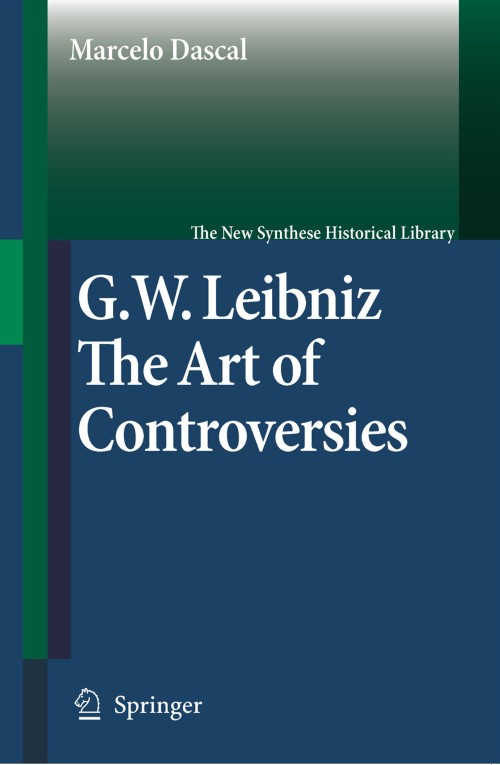
Gottfried Wilhelm Leibniz [electronic resource] : The Art of Controversies / by Marcelo Dascal.
Erişim Adresi
ISBN
9781402052286
Dil Kodu
İngilizce
Yer Numarası
DK/8029
Yazar
Basım Bildirimi
1st ed. 2006.
Yayın Bilgisi
Dordrecht : Springer Netherlands : Imprint: Springer, 2006.
Fiziksel Niteleme
LXXII, 520 p. online resource.
Dizi
The New Synthese Historical Library, Texts and Studies in the History of Philosophy, 2352-2585 ; 60
İçindekiler Notu
Vices of Mingled Disputes -- The Controversy of Controversies -- The Religion of a Peasant -- The Elements of Thinking -- The Balance of Law -- Can there be an Obligation to Believe? -- Controversies on Sacred Matters -- The Judge of Controversies -- Towards a Heuristics for Litigation -- The Method of Jurists and the Method of Doctors -- Interpretation and Argumentation in Law -- Towards a Heuristics for Discovery -- Estimating the Uncertain -- Towards a Numerical Universal Language -- The Encyclopedia and the Method of Discovery -- Towards a Heuristics for Persuading -- The Other’s Place -- Persuading a Skeptic -- On Controversies -- On Principles -- Two Prefaces to the General Science -- to a Secret Encyclopedia -- On the Creation of a New Logic -- New Openings -- Theology and the Principle of Contradiction -- Changing Religion -- Methods of Reunion -- An Ars Characteristica for the Rational Sciences -- ‘Characterizing’ Definitions and Demonstrating Propositions -- Advancing the Art of Discovery -- Correspondence with the Hamburg Jungians -- The Philosophical Sin Controversy -- Confronting the Catholic Hardliners -- Defining what Pertains to Faith -- Judgment of a Catholic Doctor -- Presumptions and Fictions in Legal Argumentation -- The ‘Method of Establishments’ -- The Achievements of Logic and Beyond -- Pacts, Contracts, and Natural Law -- Approaching the Church of England -- Dialectic Principles and their Application -- The History and Tasks of Logic -- Bold Conjectures -- The Dynamics of Formulating and Expounding the System -- The Use of Logic Against Skepticism.
Özet, vb.
Leibniz is known to the wide public and to many scholars mainly as a logician and mathematician, and as the creator of a fascinating but strange metaphysical system. In these, as well as in other fields, his remarkable innovations were achieved through painstaking efforts to establish a fruitful critical dialogue with the leading contemporary thinkers. He was no less important, however, in his practical endeavor to bring opponents to negotiate reasonable solutions to key political and religious conflicts of his time. Both his theoretical and practical activities were informed by a philosophical mind that sought in all circumstances the most general underlying principles; by a juridical mind that sought to bring order and structure to human interaction, without sacrificing the necessary flexibility; by an argumentative mind that knows that persuading is often more important than proving; by a scientific mind eager to organize past and present knowledge so as not to miss any bit of information capable of pointing the way to new discoveries; by a theologian mind that refuses to admit that religious conflicts between true believers are irresolvable; and by an ethical and political mind whose major concern is to direct all our intellectual work towards improving the well-being of humankind. All these perspectives (and more) are united in what this book identifies as his Art of Controversies, which might also be called an Art of Dialectical Cooperation. For it is based on the idea that knowledge production, acquisition, and evolution is not a one-man affair, but the result of the cooperation of many, coming from different perspectives; whence it follows that not only tolerance vis-à-vis the other, but also valuing the other’s contribution and integrating it – whether it stems from another age, continent, culture, discipline, religion, or individual – is indispensable. This dialectical Leibniz that emerges from the selected texts heretranslated, commented, and interpreted in the light of their context, isn’t for sure the familiar one. Yet, perhaps surprisingly, it is capable of shedding light on that old, familiar, yet incomplete image of Leibniz, and of adding thus a further reason for cherishing and cultivating the heritage of a truly great man.
Konu
Philosophy __ History.
Linguistics.
Social sciences.
Law __ Philosophy.
Religion __ Philosophy.
History of Philosophy.
Linguistics.
Society.
Philosophy of Law.
Philosophy of Religion.
Linguistics.
Social sciences.
Law __ Philosophy.
Religion __ Philosophy.
History of Philosophy.
Linguistics.
Society.
Philosophy of Law.
Philosophy of Religion.
Kurum Adı
Eseri Alıntıla
Referansları kullanmadan önce gözden geçirmeniz ve varsa gerekli düzeltmeleri yapmanız önerilir.
Dijital Kaynak
MARC Görünümü
LEADER 05969nam a22005775i 4500
001 806735
003 TR_AnAIT
005 20260127002712
007 cr nn 008mamaa
008 100301s2006 ne | s |||| 0|eng d
020 |a9781402052286|9978-1-4020-5228-6
024 7 |a10.1007/1-4020-5228-6|2doi
041 |aeng
049 |aTürk Tarih Kurumu Kütüphanesi
050 4|aB1-5802
072 7|aHPC|2bicssc
072 7|aPHI009000|2bisacsh
072 7|aQDH|2thema
082 04|a109|223
090 |aDK/8029
100 1 |aDascal, Marcelo.|eauthor.|4aut|4http://id.loc.gov/vocabulary/relators/aut
245 10|aGottfried Wilhelm Leibniz|h[electronic resource] :|bThe Art of Controversies /|cby Marcelo Dascal.
250 |a1st ed. 2006.
264 1|aDordrecht :|bSpringer Netherlands :|bImprint: Springer,|c2006.
300 |aLXXII, 520 p.|bonline resource.
336 |atext|btxt|2rdacontent
337 |acomputer|bc|2rdamedia
338 |aonline resource|bcr|2rdacarrier
347 |atext file|bPDF|2rda
490 1 |aThe New Synthese Historical Library, Texts and Studies in the History of Philosophy,|x2352-2585 ;|v60
505 0 |aVices of Mingled Disputes -- The Controversy of Controversies -- The Religion of a Peasant -- The Elements of Thinking -- The Balance of Law -- Can there be an Obligation to Believe? -- Controversies on Sacred Matters -- The Judge of Controversies -- Towards a Heuristics for Litigation -- The Method of Jurists and the Method of Doctors -- Interpretation and Argumentation in Law -- Towards a Heuristics for Discovery -- Estimating the Uncertain -- Towards a Numerical Universal Language -- The Encyclopedia and the Method of Discovery -- Towards a Heuristics for Persuading -- The Other’s Place -- Persuading a Skeptic -- On Controversies -- On Principles -- Two Prefaces to the General Science -- to a Secret Encyclopedia -- On the Creation of a New Logic -- New Openings -- Theology and the Principle of Contradiction -- Changing Religion -- Methods of Reunion -- An Ars Characteristica for the Rational Sciences -- ‘Characterizing’ Definitions and Demonstrating Propositions -- Advancing the Art of Discovery -- Correspondence with the Hamburg Jungians -- The Philosophical Sin Controversy -- Confronting the Catholic Hardliners -- Defining what Pertains to Faith -- Judgment of a Catholic Doctor -- Presumptions and Fictions in Legal Argumentation -- The ‘Method of Establishments’ -- The Achievements of Logic and Beyond -- Pacts, Contracts, and Natural Law -- Approaching the Church of England -- Dialectic Principles and their Application -- The History and Tasks of Logic -- Bold Conjectures -- The Dynamics of Formulating and Expounding the System -- The Use of Logic Against Skepticism.
520 |aLeibniz is known to the wide public and to many scholars mainly as a logician and mathematician, and as the creator of a fascinating but strange metaphysical system. In these, as well as in other fields, his remarkable innovations were achieved through painstaking efforts to establish a fruitful critical dialogue with the leading contemporary thinkers. He was no less important, however, in his practical endeavor to bring opponents to negotiate reasonable solutions to key political and religious conflicts of his time. Both his theoretical and practical activities were informed by a philosophical mind that sought in all circumstances the most general underlying principles; by a juridical mind that sought to bring order and structure to human interaction, without sacrificing the necessary flexibility; by an argumentative mind that knows that persuading is often more important than proving; by a scientific mind eager to organize past and present knowledge so as not to miss any bit of information capable of pointing the way to new discoveries; by a theologian mind that refuses to admit that religious conflicts between true believers are irresolvable; and by an ethical and political mind whose major concern is to direct all our intellectual work towards improving the well-being of humankind. All these perspectives (and more) are united in what this book identifies as his Art of Controversies, which might also be called an Art of Dialectical Cooperation. For it is based on the idea that knowledge production, acquisition, and evolution is not a one-man affair, but the result of the cooperation of many, coming from different perspectives; whence it follows that not only tolerance vis-à-vis the other, but also valuing the other’s contribution and integrating it – whether it stems from another age, continent, culture, discipline, religion, or individual – is indispensable. This dialectical Leibniz that emerges from the selected texts heretranslated, commented, and interpreted in the light of their context, isn’t for sure the familiar one. Yet, perhaps surprisingly, it is capable of shedding light on that old, familiar, yet incomplete image of Leibniz, and of adding thus a further reason for cherishing and cultivating the heritage of a truly great man.
650 0|aPhilosophy|xHistory.
650 0|aLinguistics.
650 0|aSocial sciences.
650 0|aLaw|xPhilosophy.
650 0|aReligion|xPhilosophy.
650 14|aHistory of Philosophy.
650 24|aLinguistics.
650 24|aSociety.
650 24|aPhilosophy of Law.
650 24|aPhilosophy of Religion.
710 2 |aSpringerLink (Online service)
773 0 |tSpringer Nature eBook
776 08|iPrinted edition:|z9781402052279
776 08|iPrinted edition:|z9781402081903
776 08|iPrinted edition:|z9789048110346
776 08|iPrinted edition:|z9789048117178
830 0|aThe New Synthese Historical Library, Texts and Studies in the History of Philosophy,|x2352-2585 ;|v60
856 40|uhttps://doi.org/10.1007/1-4020-5228-6
912 |aZDB-2-SHU
912 |aZDB-2-SXPR
950 |aHumanities, Social Sciences and Law (SpringerNature-11648)
950 |aPhilosophy and Religion (R0) (SpringerNature-43725)
001 806735
003 TR_AnAIT
005 20260127002712
007 cr nn 008mamaa
008 100301s2006 ne | s |||| 0|eng d
020 |a9781402052286|9978-1-4020-5228-6
024 7 |a10.1007/1-4020-5228-6|2doi
041 |aeng
049 |aTürk Tarih Kurumu Kütüphanesi
050 4|aB1-5802
072 7|aHPC|2bicssc
072 7|aPHI009000|2bisacsh
072 7|aQDH|2thema
082 04|a109|223
090 |aDK/8029
100 1 |aDascal, Marcelo.|eauthor.|4aut|4http://id.loc.gov/vocabulary/relators/aut
245 10|aGottfried Wilhelm Leibniz|h[electronic resource] :|bThe Art of Controversies /|cby Marcelo Dascal.
250 |a1st ed. 2006.
264 1|aDordrecht :|bSpringer Netherlands :|bImprint: Springer,|c2006.
300 |aLXXII, 520 p.|bonline resource.
336 |atext|btxt|2rdacontent
337 |acomputer|bc|2rdamedia
338 |aonline resource|bcr|2rdacarrier
347 |atext file|bPDF|2rda
490 1 |aThe New Synthese Historical Library, Texts and Studies in the History of Philosophy,|x2352-2585 ;|v60
505 0 |aVices of Mingled Disputes -- The Controversy of Controversies -- The Religion of a Peasant -- The Elements of Thinking -- The Balance of Law -- Can there be an Obligation to Believe? -- Controversies on Sacred Matters -- The Judge of Controversies -- Towards a Heuristics for Litigation -- The Method of Jurists and the Method of Doctors -- Interpretation and Argumentation in Law -- Towards a Heuristics for Discovery -- Estimating the Uncertain -- Towards a Numerical Universal Language -- The Encyclopedia and the Method of Discovery -- Towards a Heuristics for Persuading -- The Other’s Place -- Persuading a Skeptic -- On Controversies -- On Principles -- Two Prefaces to the General Science -- to a Secret Encyclopedia -- On the Creation of a New Logic -- New Openings -- Theology and the Principle of Contradiction -- Changing Religion -- Methods of Reunion -- An Ars Characteristica for the Rational Sciences -- ‘Characterizing’ Definitions and Demonstrating Propositions -- Advancing the Art of Discovery -- Correspondence with the Hamburg Jungians -- The Philosophical Sin Controversy -- Confronting the Catholic Hardliners -- Defining what Pertains to Faith -- Judgment of a Catholic Doctor -- Presumptions and Fictions in Legal Argumentation -- The ‘Method of Establishments’ -- The Achievements of Logic and Beyond -- Pacts, Contracts, and Natural Law -- Approaching the Church of England -- Dialectic Principles and their Application -- The History and Tasks of Logic -- Bold Conjectures -- The Dynamics of Formulating and Expounding the System -- The Use of Logic Against Skepticism.
520 |aLeibniz is known to the wide public and to many scholars mainly as a logician and mathematician, and as the creator of a fascinating but strange metaphysical system. In these, as well as in other fields, his remarkable innovations were achieved through painstaking efforts to establish a fruitful critical dialogue with the leading contemporary thinkers. He was no less important, however, in his practical endeavor to bring opponents to negotiate reasonable solutions to key political and religious conflicts of his time. Both his theoretical and practical activities were informed by a philosophical mind that sought in all circumstances the most general underlying principles; by a juridical mind that sought to bring order and structure to human interaction, without sacrificing the necessary flexibility; by an argumentative mind that knows that persuading is often more important than proving; by a scientific mind eager to organize past and present knowledge so as not to miss any bit of information capable of pointing the way to new discoveries; by a theologian mind that refuses to admit that religious conflicts between true believers are irresolvable; and by an ethical and political mind whose major concern is to direct all our intellectual work towards improving the well-being of humankind. All these perspectives (and more) are united in what this book identifies as his Art of Controversies, which might also be called an Art of Dialectical Cooperation. For it is based on the idea that knowledge production, acquisition, and evolution is not a one-man affair, but the result of the cooperation of many, coming from different perspectives; whence it follows that not only tolerance vis-à-vis the other, but also valuing the other’s contribution and integrating it – whether it stems from another age, continent, culture, discipline, religion, or individual – is indispensable. This dialectical Leibniz that emerges from the selected texts heretranslated, commented, and interpreted in the light of their context, isn’t for sure the familiar one. Yet, perhaps surprisingly, it is capable of shedding light on that old, familiar, yet incomplete image of Leibniz, and of adding thus a further reason for cherishing and cultivating the heritage of a truly great man.
650 0|aPhilosophy|xHistory.
650 0|aLinguistics.
650 0|aSocial sciences.
650 0|aLaw|xPhilosophy.
650 0|aReligion|xPhilosophy.
650 14|aHistory of Philosophy.
650 24|aLinguistics.
650 24|aSociety.
650 24|aPhilosophy of Law.
650 24|aPhilosophy of Religion.
710 2 |aSpringerLink (Online service)
773 0 |tSpringer Nature eBook
776 08|iPrinted edition:|z9781402052279
776 08|iPrinted edition:|z9781402081903
776 08|iPrinted edition:|z9789048110346
776 08|iPrinted edition:|z9789048117178
830 0|aThe New Synthese Historical Library, Texts and Studies in the History of Philosophy,|x2352-2585 ;|v60
856 40|uhttps://doi.org/10.1007/1-4020-5228-6
912 |aZDB-2-SHU
912 |aZDB-2-SXPR
950 |aHumanities, Social Sciences and Law (SpringerNature-11648)
950 |aPhilosophy and Religion (R0) (SpringerNature-43725)
Materyaller
Depodan talep edilen materyal sadece kütüphane içerisinde kullanılmaktadır.
Materyal dışarıya ödünç verilmemektedir.
Materyal dışarıya ödünç verilmemektedir.
