

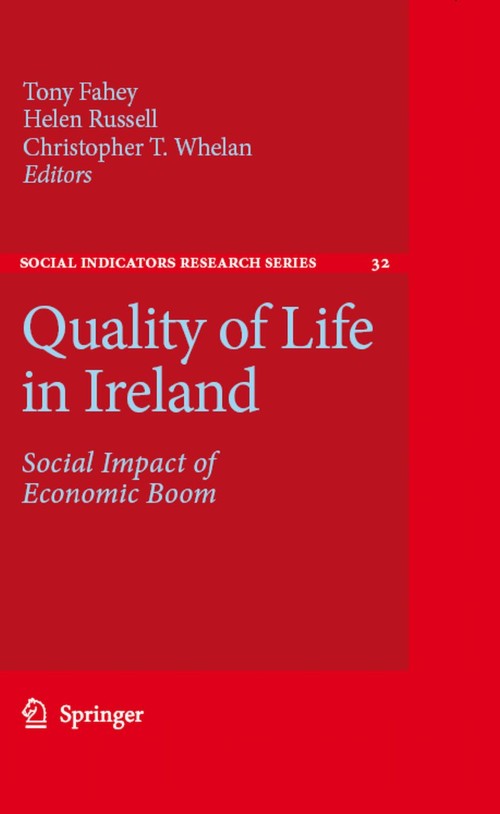
Quality of Life in Ireland [electronic resource] : Social Impact of Economic Boom / edited by Tony Fahey, Helen Russell, Christopher T. Whelan.
Erişim Adresi
ISBN
9781402069819
Dil Kodu
İngilizce
Yer Numarası
DK/8058
Basım Bildirimi
1st ed. 2007.
Yayın Bilgisi
Dordrecht : Springer Netherlands : Imprint: Springer, 2007.
Fiziksel Niteleme
XIII, 316 p. online resource.
Dizi
Social Indicators Research Series, 2215-0099 ; 32
İçindekiler Notu
Quality of Life After the Boom -- How Do We Feel? Economic Boom and Happiness -- Economic Growth and Income Inequality: Setting the Context -- Employment and the Quality of Work -- Opportunities for All in the New Ireland? -- Consistent Poverty and Economic Vulnerability -- Health and Health Care -- The Housing Boom -- Changing Times, Changing Schools? Quality of Life for Students -- Family and Sexuality -- Ties that Bind? The Social Fabric of Daily Life in New Suburbs -- Gender, Work–Life Balance and Quality of Life -- The Impact of Immigration -- Crime and its Consequences -- Soaring in the Best of Times?.
Özet, vb.
The Irish economic boom has caused the economy in Ireland to roar ahead, but what has it done to Irish society? Some see the rising tide as having lifted all boats, while others argue that the benefits have accrued mostly to those who were already well placed. Some highlight how economic growth has raised living standards, while others say that it has imposed strains on family life, eroded values and communities, and created problems in accessing adequate housing, health care and other services. So, are we in Ireland now living in ‘the best of times’, or has increased prosperity come at (too high) a cost? And can the rest of the world draw any lessons from what has happened in Ireland? The purpose of this book, which contains a collection of chapters written by some of Ireland’s leading social researchers, is to bring to bear the latest research and empirical evidence to answer these questions. It is aimed at a general audience and seeks to contribute to public debate in Ireland and abroad, while at the same time striving for rigorous, evidence-based argument. The overall judgment offered by the book is positive, though with qualifications. Ireland still has problems: social inequalities are slow to narrow; the indignities of poverty and hopelessness, though less widespread than before, are still too common; some public services are poor; and traffic congestion frays the nerves. But there is a long list of social fundamentals that are stronger today than before the economic boom arrived. National moral is among the highest in Europe, most people’s economic circumstances have greatly improved, jobs are astonishingly abundant, people are now flocking into the country rather than out of it, and they are marrying and having children at a higher rate than fifteen years ago. These are only some of the positives identified in the book. Together they suggest that even on social grounds the Irisheconomic boom deserves at least two cheers, even if it has far from succeeded in solving all social ills.
Konu
Social sciences.
Quality of life.
Society.
Quality of Life Research.
Quality of life.
Society.
Quality of Life Research.
Diğer Yazarlar
Kurum Adı
Eseri Alıntıla
Referansları kullanmadan önce gözden geçirmeniz ve varsa gerekli düzeltmeleri yapmanız önerilir.
Dijital Kaynak
MARC Görünümü
LEADER 04648nam a22005415i 4500
001 806764
003 TR_AnAIT
005 20260127002749
007 cr nn 008mamaa
008 100301s2007 ne | s |||| 0|eng d
020 |a9781402069819|9978-1-4020-6981-9
024 7 |a10.1007/978-1-4020-6981-9|2doi
041 |aeng
049 |aTürk Tarih Kurumu Kütüphanesi
050 4|aH1-970.9
072 7|aJ|2bicssc
072 7|aJHB|2bicssc
072 7|aSOC000000|2bisacsh
072 7|aJ|2thema
072 7|aJHB|2thema
082 04|a300|223
090 |aDK/8058
245 10|aQuality of Life in Ireland|h[electronic resource] :|bSocial Impact of Economic Boom /|cedited by Tony Fahey, Helen Russell, Christopher T. Whelan.
250 |a1st ed. 2007.
264 1|aDordrecht :|bSpringer Netherlands :|bImprint: Springer,|c2007.
300 |aXIII, 316 p.|bonline resource.
336 |atext|btxt|2rdacontent
337 |acomputer|bc|2rdamedia
338 |aonline resource|bcr|2rdacarrier
347 |atext file|bPDF|2rda
490 1 |aSocial Indicators Research Series,|x2215-0099 ;|v32
505 0 |aQuality of Life After the Boom -- How Do We Feel? Economic Boom and Happiness -- Economic Growth and Income Inequality: Setting the Context -- Employment and the Quality of Work -- Opportunities for All in the New Ireland? -- Consistent Poverty and Economic Vulnerability -- Health and Health Care -- The Housing Boom -- Changing Times, Changing Schools? Quality of Life for Students -- Family and Sexuality -- Ties that Bind? The Social Fabric of Daily Life in New Suburbs -- Gender, Work–Life Balance and Quality of Life -- The Impact of Immigration -- Crime and its Consequences -- Soaring in the Best of Times?.
520 |aThe Irish economic boom has caused the economy in Ireland to roar ahead, but what has it done to Irish society? Some see the rising tide as having lifted all boats, while others argue that the benefits have accrued mostly to those who were already well placed. Some highlight how economic growth has raised living standards, while others say that it has imposed strains on family life, eroded values and communities, and created problems in accessing adequate housing, health care and other services. So, are we in Ireland now living in ‘the best of times’, or has increased prosperity come at (too high) a cost? And can the rest of the world draw any lessons from what has happened in Ireland? The purpose of this book, which contains a collection of chapters written by some of Ireland’s leading social researchers, is to bring to bear the latest research and empirical evidence to answer these questions. It is aimed at a general audience and seeks to contribute to public debate in Ireland and abroad, while at the same time striving for rigorous, evidence-based argument. The overall judgment offered by the book is positive, though with qualifications. Ireland still has problems: social inequalities are slow to narrow; the indignities of poverty and hopelessness, though less widespread than before, are still too common; some public services are poor; and traffic congestion frays the nerves. But there is a long list of social fundamentals that are stronger today than before the economic boom arrived. National moral is among the highest in Europe, most people’s economic circumstances have greatly improved, jobs are astonishingly abundant, people are now flocking into the country rather than out of it, and they are marrying and having children at a higher rate than fifteen years ago. These are only some of the positives identified in the book. Together they suggest that even on social grounds the Irisheconomic boom deserves at least two cheers, even if it has far from succeeded in solving all social ills.
650 0|aSocial sciences.
650 0|aQuality of life.
650 14|aSociety.
650 24|aQuality of Life Research.
700 1 |aFahey, Tony.|eeditor.|4edt|4http://id.loc.gov/vocabulary/relators/edt
700 1 |aRussell, Helen.|eeditor.|4edt|4http://id.loc.gov/vocabulary/relators/edt
700 1 |aWhelan, Christopher T.|eeditor.|4edt|4http://id.loc.gov/vocabulary/relators/edt
710 2 |aSpringerLink (Online service)
773 0 |tSpringer Nature eBook
776 08|iPrinted edition:|z9781402069802
776 08|iPrinted edition:|z9789048119318
776 08|iPrinted edition:|z9789048177820
830 0|aSocial Indicators Research Series,|x2215-0099 ;|v32
856 40|uhttps://doi.org/10.1007/978-1-4020-6981-9
912 |aZDB-2-SHU
912 |aZDB-2-SXS
950 |aHumanities, Social Sciences and Law (SpringerNature-11648)
950 |aSocial Sciences (R0) (SpringerNature-43726)
001 806764
003 TR_AnAIT
005 20260127002749
007 cr nn 008mamaa
008 100301s2007 ne | s |||| 0|eng d
020 |a9781402069819|9978-1-4020-6981-9
024 7 |a10.1007/978-1-4020-6981-9|2doi
041 |aeng
049 |aTürk Tarih Kurumu Kütüphanesi
050 4|aH1-970.9
072 7|aJ|2bicssc
072 7|aJHB|2bicssc
072 7|aSOC000000|2bisacsh
072 7|aJ|2thema
072 7|aJHB|2thema
082 04|a300|223
090 |aDK/8058
245 10|aQuality of Life in Ireland|h[electronic resource] :|bSocial Impact of Economic Boom /|cedited by Tony Fahey, Helen Russell, Christopher T. Whelan.
250 |a1st ed. 2007.
264 1|aDordrecht :|bSpringer Netherlands :|bImprint: Springer,|c2007.
300 |aXIII, 316 p.|bonline resource.
336 |atext|btxt|2rdacontent
337 |acomputer|bc|2rdamedia
338 |aonline resource|bcr|2rdacarrier
347 |atext file|bPDF|2rda
490 1 |aSocial Indicators Research Series,|x2215-0099 ;|v32
505 0 |aQuality of Life After the Boom -- How Do We Feel? Economic Boom and Happiness -- Economic Growth and Income Inequality: Setting the Context -- Employment and the Quality of Work -- Opportunities for All in the New Ireland? -- Consistent Poverty and Economic Vulnerability -- Health and Health Care -- The Housing Boom -- Changing Times, Changing Schools? Quality of Life for Students -- Family and Sexuality -- Ties that Bind? The Social Fabric of Daily Life in New Suburbs -- Gender, Work–Life Balance and Quality of Life -- The Impact of Immigration -- Crime and its Consequences -- Soaring in the Best of Times?.
520 |aThe Irish economic boom has caused the economy in Ireland to roar ahead, but what has it done to Irish society? Some see the rising tide as having lifted all boats, while others argue that the benefits have accrued mostly to those who were already well placed. Some highlight how economic growth has raised living standards, while others say that it has imposed strains on family life, eroded values and communities, and created problems in accessing adequate housing, health care and other services. So, are we in Ireland now living in ‘the best of times’, or has increased prosperity come at (too high) a cost? And can the rest of the world draw any lessons from what has happened in Ireland? The purpose of this book, which contains a collection of chapters written by some of Ireland’s leading social researchers, is to bring to bear the latest research and empirical evidence to answer these questions. It is aimed at a general audience and seeks to contribute to public debate in Ireland and abroad, while at the same time striving for rigorous, evidence-based argument. The overall judgment offered by the book is positive, though with qualifications. Ireland still has problems: social inequalities are slow to narrow; the indignities of poverty and hopelessness, though less widespread than before, are still too common; some public services are poor; and traffic congestion frays the nerves. But there is a long list of social fundamentals that are stronger today than before the economic boom arrived. National moral is among the highest in Europe, most people’s economic circumstances have greatly improved, jobs are astonishingly abundant, people are now flocking into the country rather than out of it, and they are marrying and having children at a higher rate than fifteen years ago. These are only some of the positives identified in the book. Together they suggest that even on social grounds the Irisheconomic boom deserves at least two cheers, even if it has far from succeeded in solving all social ills.
650 0|aSocial sciences.
650 0|aQuality of life.
650 14|aSociety.
650 24|aQuality of Life Research.
700 1 |aFahey, Tony.|eeditor.|4edt|4http://id.loc.gov/vocabulary/relators/edt
700 1 |aRussell, Helen.|eeditor.|4edt|4http://id.loc.gov/vocabulary/relators/edt
700 1 |aWhelan, Christopher T.|eeditor.|4edt|4http://id.loc.gov/vocabulary/relators/edt
710 2 |aSpringerLink (Online service)
773 0 |tSpringer Nature eBook
776 08|iPrinted edition:|z9781402069802
776 08|iPrinted edition:|z9789048119318
776 08|iPrinted edition:|z9789048177820
830 0|aSocial Indicators Research Series,|x2215-0099 ;|v32
856 40|uhttps://doi.org/10.1007/978-1-4020-6981-9
912 |aZDB-2-SHU
912 |aZDB-2-SXS
950 |aHumanities, Social Sciences and Law (SpringerNature-11648)
950 |aSocial Sciences (R0) (SpringerNature-43726)
Materyaller
Depodan talep edilen materyal sadece kütüphane içerisinde kullanılmaktadır.
Materyal dışarıya ödünç verilmemektedir.
Materyal dışarıya ödünç verilmemektedir.
