

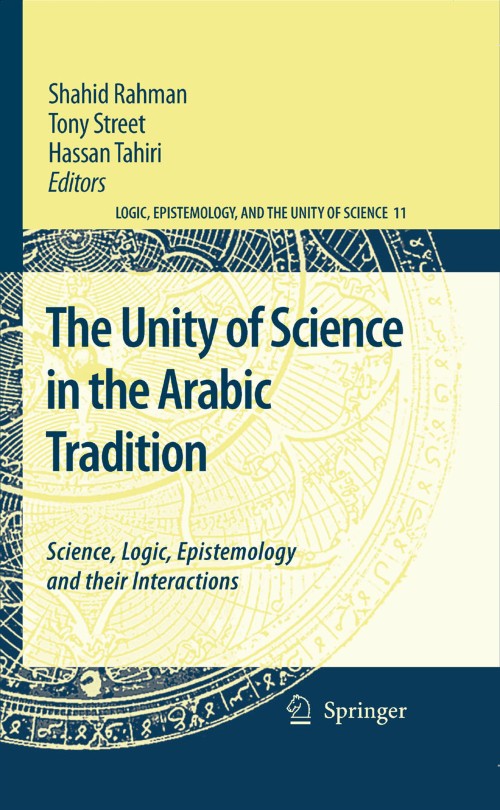
The Unity of Science in the Arabic Tradition [electronic resource] : Science, Logic, Epistemology and their Interactions / edited by Shahid Rahman, Tony Street, Hassan Tahiri.
Erişim Adresi
ISBN
9781402084058
Dil Kodu
İngilizce
Yer Numarası
DK/8062
Basım Bildirimi
1st ed. 2008.
Yayın Bilgisi
Dordrecht : Springer Netherlands : Imprint: Springer, 2008.
Fiziksel Niteleme
XIII, 390 p. online resource.
Dizi
Logic, Epistemology, and the Unity of Science, 2214-9783 ; 11
İçindekiler Notu
Introduction: The Major Breakthrough in Scientific Pratice -- Introduction: The Major Breakthrough in Scientific Pratice -- Epistemology and Philosophy of Science -- Ibn S?:n?’s Philosophy of Mathematics -- Avicenna on Self-Awareness and Knowing that One Knows -- A Conceptual Analysis of Early Arabic Algebra -- Avicenna’s Naturalized Epistemology and Scientific Method* -- The Philosophy of Mathematics -- The Birth of Scientific Controversies The Dynamics of the Arabic Tradition and Its Impact on the Development of Science: Ibn al-Haytham’s Challenge of Ptolemy’s Almagest -- Logic Philosophy and Grammar -- Jiha/Tropos-M?dda/H?l? Distinction in Arabic Logic and its Significance for Avicenna’s Modals -- Islamic Logic? -- Logical Fragments in Ibn Khald?n’s Muqaddimah -- Avicenna on the Quantification of the Predicate (with an Appendix on [Ibn Zur?a]) -- Name (ism), Derived Name (ism mushtaqq) and Description (wa?f) in Arabic Grammar, Muslim Dialectical Theology and Arabic Logic -- Logic and Metaphysics in Avicenna’s Modal Syllogistic.
Özet, vb.
the demise of the logical positivism programme. The answers given to these qu- tions have deepened the already existing gap between philosophy and the history and practice of science. While the positivists argued for a spontaneous, steady and continuous growth of scientific knowledge the post-positivists make a strong case for a fundamental discontinuity in the development of science which can only be explained by extrascientific factors. The political, social and cultural environment, the argument goes on, determine both the questions and the terms in which they should be answered. Accordingly, the sociological and historical interpretation - volves in fact two kinds of discontinuity which are closely related: the discontinuity of science as such and the discontinuity of the more inclusive political and social context of its development. More precisely it explains the discontinuity of the former by the discontinuity of the latter subordinating in effect the history of science to the wider political and social history. The underlying idea is that each historical and - cial context generates scientific and philosophical questions of its own. From this point of view the question surrounding the nature of knowledge and its development are entirely new topics typical of the twentieth-century social context reflecting both the level and the scale of the development of science.
Konu
Science __ History.
Knowledge, Theory of.
Logic.
Philosophy __ History.
Oriental languages.
Philosophy, Medieval.
History of Science.
Epistemology.
Logic.
History of Philosophy.
Oriental or Semitic Languages.
Medieval Philosophy.
Knowledge, Theory of.
Logic.
Philosophy __ History.
Oriental languages.
Philosophy, Medieval.
History of Science.
Epistemology.
Logic.
History of Philosophy.
Oriental or Semitic Languages.
Medieval Philosophy.
Diğer Yazarlar
Kurum Adı
Eseri Alıntıla
Referansları kullanmadan önce gözden geçirmeniz ve varsa gerekli düzeltmeleri yapmanız önerilir.
Dijital Kaynak
MARC Görünümü
LEADER 04732nam a22006135i 4500
001 806768
003 TR_AnAIT
005 20260127002754
007 cr nn 008mamaa
008 100301s2008 ne | s |||| 0|eng d
020 |a9781402084058|9978-1-4020-8405-8
024 7 |a10.1007/978-1-4020-8405-8|2doi
041 |aeng
049 |aTürk Tarih Kurumu Kütüphanesi
050 4|aQ124.6-127.2
072 7|aPDX|2bicssc
072 7|aSCI034000|2bisacsh
072 7|aPDX|2thema
082 04|a509|223
090 |aDK/8062
245 14|aThe Unity of Science in the Arabic Tradition|h[electronic resource] :|bScience, Logic, Epistemology and their Interactions /|cedited by Shahid Rahman, Tony Street, Hassan Tahiri.
250 |a1st ed. 2008.
264 1|aDordrecht :|bSpringer Netherlands :|bImprint: Springer,|c2008.
300 |aXIII, 390 p.|bonline resource.
336 |atext|btxt|2rdacontent
337 |acomputer|bc|2rdamedia
338 |aonline resource|bcr|2rdacarrier
347 |atext file|bPDF|2rda
490 1 |aLogic, Epistemology, and the Unity of Science,|x2214-9783 ;|v11
505 0 |aIntroduction: The Major Breakthrough in Scientific Pratice -- Introduction: The Major Breakthrough in Scientific Pratice -- Epistemology and Philosophy of Science -- Ibn S?:n?’s Philosophy of Mathematics -- Avicenna on Self-Awareness and Knowing that One Knows -- A Conceptual Analysis of Early Arabic Algebra -- Avicenna’s Naturalized Epistemology and Scientific Method* -- The Philosophy of Mathematics -- The Birth of Scientific Controversies The Dynamics of the Arabic Tradition and Its Impact on the Development of Science: Ibn al-Haytham’s Challenge of Ptolemy’s Almagest -- Logic Philosophy and Grammar -- Jiha/Tropos-M?dda/H?l? Distinction in Arabic Logic and its Significance for Avicenna’s Modals -- Islamic Logic? -- Logical Fragments in Ibn Khald?n’s Muqaddimah -- Avicenna on the Quantification of the Predicate (with an Appendix on [Ibn Zur?a]) -- Name (ism), Derived Name (ism mushtaqq) and Description (wa?f) in Arabic Grammar, Muslim Dialectical Theology and Arabic Logic -- Logic and Metaphysics in Avicenna’s Modal Syllogistic.
520 |athe demise of the logical positivism programme. The answers given to these qu- tions have deepened the already existing gap between philosophy and the history and practice of science. While the positivists argued for a spontaneous, steady and continuous growth of scientific knowledge the post-positivists make a strong case for a fundamental discontinuity in the development of science which can only be explained by extrascientific factors. The political, social and cultural environment, the argument goes on, determine both the questions and the terms in which they should be answered. Accordingly, the sociological and historical interpretation - volves in fact two kinds of discontinuity which are closely related: the discontinuity of science as such and the discontinuity of the more inclusive political and social context of its development. More precisely it explains the discontinuity of the former by the discontinuity of the latter subordinating in effect the history of science to the wider political and social history. The underlying idea is that each historical and - cial context generates scientific and philosophical questions of its own. From this point of view the question surrounding the nature of knowledge and its development are entirely new topics typical of the twentieth-century social context reflecting both the level and the scale of the development of science.
650 0|aScience|xHistory.
650 0|aKnowledge, Theory of.
650 0|aLogic.
650 0|aPhilosophy|xHistory.
650 0|aOriental languages.
650 0|aPhilosophy, Medieval.
650 14|aHistory of Science.
650 24|aEpistemology.
650 24|aLogic.
650 24|aHistory of Philosophy.
650 24|aOriental or Semitic Languages.
650 24|aMedieval Philosophy.
700 1 |aRahman, Shahid.|eeditor.|4edt|4http://id.loc.gov/vocabulary/relators/edt
700 1 |aStreet, Tony.|eeditor.|4edt|4http://id.loc.gov/vocabulary/relators/edt
700 1 |aTahiri, Hassan.|eeditor.|4edt|4http://id.loc.gov/vocabulary/relators/edt
710 2 |aSpringerLink (Online service)
773 0 |tSpringer Nature eBook
776 08|iPrinted edition:|z9781402084041
776 08|iPrinted edition:|z9789048119868
776 08|iPrinted edition:|z9789048178704
830 0|aLogic, Epistemology, and the Unity of Science,|x2214-9783 ;|v11
856 40|uhttps://doi.org/10.1007/978-1-4020-8405-8
912 |aZDB-2-SHU
912 |aZDB-2-SXH
950 |aHumanities, Social Sciences and Law (SpringerNature-11648)
950 |aHistory (R0) (SpringerNature-43722)
001 806768
003 TR_AnAIT
005 20260127002754
007 cr nn 008mamaa
008 100301s2008 ne | s |||| 0|eng d
020 |a9781402084058|9978-1-4020-8405-8
024 7 |a10.1007/978-1-4020-8405-8|2doi
041 |aeng
049 |aTürk Tarih Kurumu Kütüphanesi
050 4|aQ124.6-127.2
072 7|aPDX|2bicssc
072 7|aSCI034000|2bisacsh
072 7|aPDX|2thema
082 04|a509|223
090 |aDK/8062
245 14|aThe Unity of Science in the Arabic Tradition|h[electronic resource] :|bScience, Logic, Epistemology and their Interactions /|cedited by Shahid Rahman, Tony Street, Hassan Tahiri.
250 |a1st ed. 2008.
264 1|aDordrecht :|bSpringer Netherlands :|bImprint: Springer,|c2008.
300 |aXIII, 390 p.|bonline resource.
336 |atext|btxt|2rdacontent
337 |acomputer|bc|2rdamedia
338 |aonline resource|bcr|2rdacarrier
347 |atext file|bPDF|2rda
490 1 |aLogic, Epistemology, and the Unity of Science,|x2214-9783 ;|v11
505 0 |aIntroduction: The Major Breakthrough in Scientific Pratice -- Introduction: The Major Breakthrough in Scientific Pratice -- Epistemology and Philosophy of Science -- Ibn S?:n?’s Philosophy of Mathematics -- Avicenna on Self-Awareness and Knowing that One Knows -- A Conceptual Analysis of Early Arabic Algebra -- Avicenna’s Naturalized Epistemology and Scientific Method* -- The Philosophy of Mathematics -- The Birth of Scientific Controversies The Dynamics of the Arabic Tradition and Its Impact on the Development of Science: Ibn al-Haytham’s Challenge of Ptolemy’s Almagest -- Logic Philosophy and Grammar -- Jiha/Tropos-M?dda/H?l? Distinction in Arabic Logic and its Significance for Avicenna’s Modals -- Islamic Logic? -- Logical Fragments in Ibn Khald?n’s Muqaddimah -- Avicenna on the Quantification of the Predicate (with an Appendix on [Ibn Zur?a]) -- Name (ism), Derived Name (ism mushtaqq) and Description (wa?f) in Arabic Grammar, Muslim Dialectical Theology and Arabic Logic -- Logic and Metaphysics in Avicenna’s Modal Syllogistic.
520 |athe demise of the logical positivism programme. The answers given to these qu- tions have deepened the already existing gap between philosophy and the history and practice of science. While the positivists argued for a spontaneous, steady and continuous growth of scientific knowledge the post-positivists make a strong case for a fundamental discontinuity in the development of science which can only be explained by extrascientific factors. The political, social and cultural environment, the argument goes on, determine both the questions and the terms in which they should be answered. Accordingly, the sociological and historical interpretation - volves in fact two kinds of discontinuity which are closely related: the discontinuity of science as such and the discontinuity of the more inclusive political and social context of its development. More precisely it explains the discontinuity of the former by the discontinuity of the latter subordinating in effect the history of science to the wider political and social history. The underlying idea is that each historical and - cial context generates scientific and philosophical questions of its own. From this point of view the question surrounding the nature of knowledge and its development are entirely new topics typical of the twentieth-century social context reflecting both the level and the scale of the development of science.
650 0|aScience|xHistory.
650 0|aKnowledge, Theory of.
650 0|aLogic.
650 0|aPhilosophy|xHistory.
650 0|aOriental languages.
650 0|aPhilosophy, Medieval.
650 14|aHistory of Science.
650 24|aEpistemology.
650 24|aLogic.
650 24|aHistory of Philosophy.
650 24|aOriental or Semitic Languages.
650 24|aMedieval Philosophy.
700 1 |aRahman, Shahid.|eeditor.|4edt|4http://id.loc.gov/vocabulary/relators/edt
700 1 |aStreet, Tony.|eeditor.|4edt|4http://id.loc.gov/vocabulary/relators/edt
700 1 |aTahiri, Hassan.|eeditor.|4edt|4http://id.loc.gov/vocabulary/relators/edt
710 2 |aSpringerLink (Online service)
773 0 |tSpringer Nature eBook
776 08|iPrinted edition:|z9781402084041
776 08|iPrinted edition:|z9789048119868
776 08|iPrinted edition:|z9789048178704
830 0|aLogic, Epistemology, and the Unity of Science,|x2214-9783 ;|v11
856 40|uhttps://doi.org/10.1007/978-1-4020-8405-8
912 |aZDB-2-SHU
912 |aZDB-2-SXH
950 |aHumanities, Social Sciences and Law (SpringerNature-11648)
950 |aHistory (R0) (SpringerNature-43722)
Materyaller
Depodan talep edilen materyal sadece kütüphane içerisinde kullanılmaktadır.
Materyal dışarıya ödünç verilmemektedir.
Materyal dışarıya ödünç verilmemektedir.
