

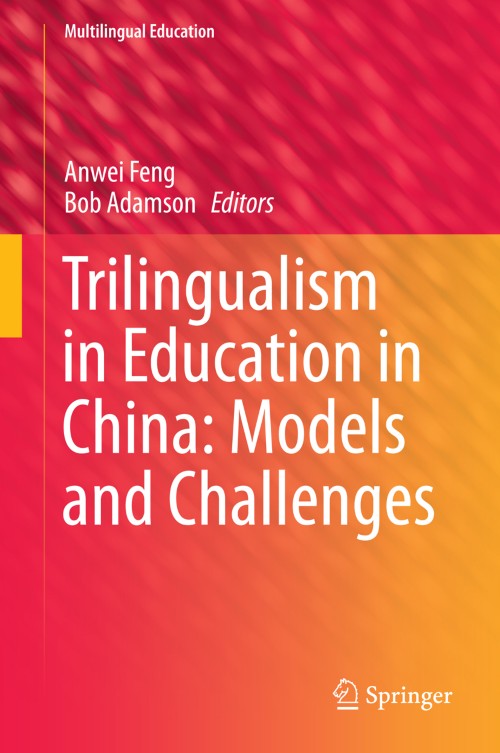
Trilingualism in Education in China: Models and Challenges [electronic resource] / edited by Anwei Feng, Bob Adamson.
Erişim Adresi
ISBN
9789401793520
Dil Kodu
İngilizce
Yer Numarası
DK/8080
Basım Bildirimi
1st ed. 2015.
Yayın Bilgisi
Dordrecht : Springer Netherlands : Imprint: Springer, 2015.
Fiziksel Niteleme
XVII, 258 p. 16 illus., 5 illus. in color. online resource.
Dizi
Multilingual Education, 2213-3216 ; 12
İçindekiler Notu
Preface -- 1. Researching Trilingualism and Trilingual Education in China -- Part 1: Meng-Chao-Xin -- 2. Four Models of Mongolian Nationality Schools in the Inner Mongolian Autonomous Region -- 3.Trilingual Education in China’s Korean Communities -- 4. Language Learning and Empowerment: Languages in Education for Uyghurs in Xinjiang -- Part 2: Qing-Zang-Chuan -- 5. Ethnolinguistic Vitality, Language Attitudes and Language Education in Tibetan Schools in Qinghai -- 6. When English Meets Chinese in Tibetan Schools: Towards an Understanding of Multilingual Education in Tibet -- 7. A Multi-case Investigation into Trilingualism and Trilingual Education in Liangshan Yi Autonomous Prefecture -- Part 3: Yun-Gui-Yue -- 8. A Survey Report on Trilingualism and Trilingual Education in Yunnan -- 9. Emerging Trilingualism among the Dong Minority in Guizhou Province -- 10. Language Attitudes of Secondary School Students in Guangdong -- 11. Trilingualism in Education: Models and Challenges.
Özet, vb.
This book examines language policies and practices in schools in regions of China populated by indigenous minority groups. It focuses on models of trilingual education, i.e. education in the home language, Putonghua (Mandarin Chinese, the national language), and English (the main foreign language). Special attention is given to the study of the vitality of the minority home language in each region and issues relating to and the effects of the teaching and learning of the minority home language on minority students’ acquisition of Mandarin Chinese and English and on their school performance in general. The book also examines the case of Cantonese in Guangdong, where the local Chinese ‘dialect’ is strong but distant from the mainstream language, Putonghua. It takes a new approach to researching sociolinguistic phenomena, and presents a new methodology that emerged from studies of bi/trilingualism in European societies and was then tailored to the trilingual context in China. The methodology encompasses policy analysis and community language profiles, as well as school-based fieldwork, and provides rich data that facilitate multilevel analysis of policy-in-context.
Konu
Language and languages __ Study and teaching.
Applied linguistics.
Language Education.
Applied Linguistics.
Applied linguistics.
Language Education.
Applied Linguistics.
Diğer Yazarlar
Kurum Adı
