

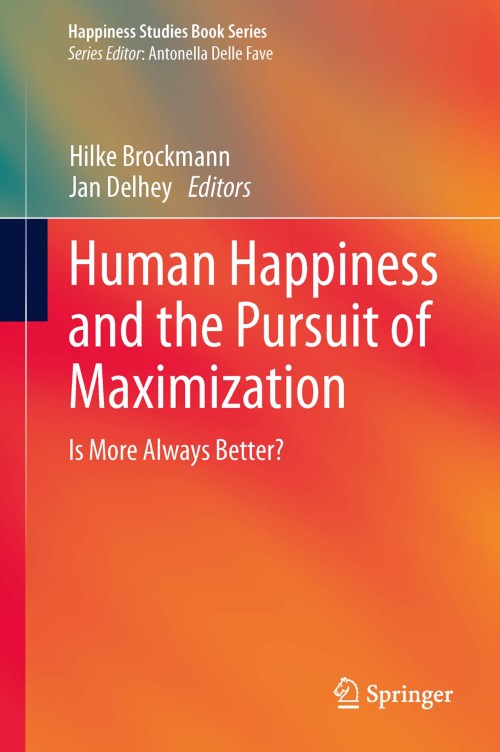
Human Happiness and the Pursuit of Maximization [electronic resource] : Is More Always Better? / edited by Hilke Brockmann, Jan Delhey.
Erişim Adresi
ISBN
9789400766099
Dil Kodu
İngilizce
Yer Numarası
DK/8095
Basım Bildirimi
1st ed. 2013.
Yayın Bilgisi
Dordrecht : Springer Netherlands : Imprint: Springer, 2013.
Fiziksel Niteleme
VIII, 216 p. online resource.
Dizi
Happiness Studies Book Series, 2213-7521
İçindekiler Notu
Chapter 1. Is More Always Better? An Introduction; Hilke Brockmann and Jan Delhey -- Chapter 2. When the Pursuit of More Backfires - The American Experiment; Peter Whybrow -- Chapter 3. More Nonsense and Less Happiness: The Unintended Effects of Artificial Competitions; Mathias Binswanger -- Chapter 4. Happiness by Maximization?; Kurt Bayertz -- Chapter 5. Maximization and the Good; Valerie Tiberius -- Chapter 6. How Wise is Mother Nature? Maximization, Optimization and Short-Sighted Resource Use in Biological Evolution; Hanna Kokko -- Chapter 7. Towards a Neuroscience of Well-being – Implications of Insights from Pleasure Research; Kent C. Berridge and Morten L. Kringelbach -- Chapter 8. From Treating Mental Dysfunction to Neuroenhancement; Michael Koch -- Chapter 9. Do Aspirations and Adaptation Impede the Maximization of Happiness?; Ulrich Schimmack and Hyunji Kim -- Chapter 10. My Car is Bigger than Yours. Consumption, Status Competition, and Happiness in Times of Affluence; Hilke Brockmann and Song Yan -- Chapter 11. Some Lessons from Happiness Economics for Environmental Sustainability; Heinz Welsch -- Chapter 12. Public Policy and Human Happiness: The Welfare State and the Market as Agents of Well-Being; Robert Davidson, Alexander C. Pacek, and Benjamin Radcliff -- Chapter 13 Should the State Care for the Happiness of Its Citizens?; Aloys Prinz -- Chapter 14. A “Happiness Test” for the New Measures of National Well-Being: How Much Better than GDP are they?; Jan Delhey and Christian Kroll.
Özet, vb.
This book tests the critical potential of happiness research to evaluate contemporary high-performance societies. These societies, defined as affluent capitalist societies, emphasize competition and success both institutionally and culturally. Growing affluence improves life in many ways, for a large number of people. We lead longer, safer, and more comfortable lives than previous generations. But we also live faster, and are competition-toughened, like top athletes. As a result, we suspect limits and detect downsides of our high-speed lives. The ubiquitous maximization principle opens up a systematic gateway to the pleasures and pains of contemporary life. Using happiness as a reference point, this book explores the philosophical and empirical limits of the maximization rule. It considers the answer to questions such as: Precisely, why did the idea of (economic) maximization gain so much ground in our Western way of thinking? When, and in which life domains, does maximization work, when does it fail? When do qualities and when do quantities matter? Does maximization yield a different (un)happiness dividend in different species, cultures, and societies?
Konu
Quality of life.
Positive psychology.
Psychobiology.
Human behavior.
Macroeconomics.
Quality of Life Research.
Positive Psychology.
Behavioral Neuroscience.
Macroeconomics and Monetary Economics.
Positive psychology.
Psychobiology.
Human behavior.
Macroeconomics.
Quality of Life Research.
Positive Psychology.
Behavioral Neuroscience.
Macroeconomics and Monetary Economics.
Diğer Yazarlar
Kurum Adı
Eseri Alıntıla
Referansları kullanmadan önce gözden geçirmeniz ve varsa gerekli düzeltmeleri yapmanız önerilir.
Dijital Kaynak
MARC Görünümü
LEADER 04782nam a22005895i 4500
001 806801
003 TR_AnAIT
005 20260127002836
007 cr nn 008mamaa
008 130709s2013 ne | s |||| 0|eng d
020 |a9789400766099|9978-94-007-6609-9
024 7 |a10.1007/978-94-007-6609-9|2doi
041 |aeng
049 |aTürk Tarih Kurumu Kütüphanesi
050 4|aRA407-409.5
050 4|aHN25
072 7|aMBNH|2bicssc
072 7|aMED003000|2bisacsh
072 7|aMBNH|2thema
082 04|a610|223
082 04|a306|223
090 |aDK/8095
245 10|aHuman Happiness and the Pursuit of Maximization|h[electronic resource] :|bIs More Always Better? /|cedited by Hilke Brockmann, Jan Delhey.
250 |a1st ed. 2013.
264 1|aDordrecht :|bSpringer Netherlands :|bImprint: Springer,|c2013.
300 |aVIII, 216 p.|bonline resource.
336 |atext|btxt|2rdacontent
337 |acomputer|bc|2rdamedia
338 |aonline resource|bcr|2rdacarrier
347 |atext file|bPDF|2rda
490 1 |aHappiness Studies Book Series,|x2213-7521
505 0 |aChapter 1. Is More Always Better? An Introduction; Hilke Brockmann and Jan Delhey -- Chapter 2. When the Pursuit of More Backfires - The American Experiment; Peter Whybrow -- Chapter 3. More Nonsense and Less Happiness: The Unintended Effects of Artificial Competitions; Mathias Binswanger -- Chapter 4. Happiness by Maximization?; Kurt Bayertz -- Chapter 5. Maximization and the Good; Valerie Tiberius -- Chapter 6. How Wise is Mother Nature? Maximization, Optimization and Short-Sighted Resource Use in Biological Evolution; Hanna Kokko -- Chapter 7. Towards a Neuroscience of Well-being – Implications of Insights from Pleasure Research; Kent C. Berridge and Morten L. Kringelbach -- Chapter 8. From Treating Mental Dysfunction to Neuroenhancement; Michael Koch -- Chapter 9. Do Aspirations and Adaptation Impede the Maximization of Happiness?; Ulrich Schimmack and Hyunji Kim -- Chapter 10. My Car is Bigger than Yours. Consumption, Status Competition, and Happiness in Times of Affluence; Hilke Brockmann and Song Yan -- Chapter 11. Some Lessons from Happiness Economics for Environmental Sustainability; Heinz Welsch -- Chapter 12. Public Policy and Human Happiness: The Welfare State and the Market as Agents of Well-Being; Robert Davidson, Alexander C. Pacek, and Benjamin Radcliff -- Chapter 13 Should the State Care for the Happiness of Its Citizens?; Aloys Prinz -- Chapter 14. A “Happiness Test” for the New Measures of National Well-Being: How Much Better than GDP are they?; Jan Delhey and Christian Kroll.
520 |aThis book tests the critical potential of happiness research to evaluate contemporary high-performance societies. These societies, defined as affluent capitalist societies, emphasize competition and success both institutionally and culturally. Growing affluence improves life in many ways, for a large number of people. We lead longer, safer, and more comfortable lives than previous generations. But we also live faster, and are competition-toughened, like top athletes. As a result, we suspect limits and detect downsides of our high-speed lives. The ubiquitous maximization principle opens up a systematic gateway to the pleasures and pains of contemporary life. Using happiness as a reference point, this book explores the philosophical and empirical limits of the maximization rule. It considers the answer to questions such as: Precisely, why did the idea of (economic) maximization gain so much ground in our Western way of thinking? When, and in which life domains, does maximization work, when does it fail? When do qualities and when do quantities matter? Does maximization yield a different (un)happiness dividend in different species, cultures, and societies?
650 0|aQuality of life.
650 0|aPositive psychology.
650 0|aPsychobiology.
650 0|aHuman behavior.
650 0|aMacroeconomics.
650 14|aQuality of Life Research.
650 24|aPositive Psychology.
650 24|aBehavioral Neuroscience.
650 24|aMacroeconomics and Monetary Economics.
700 1 |aBrockmann, Hilke.|eeditor.|4edt|4http://id.loc.gov/vocabulary/relators/edt
700 1 |aDelhey, Jan.|eeditor.|4edt|4http://id.loc.gov/vocabulary/relators/edt
710 2 |aSpringerLink (Online service)
773 0 |tSpringer Nature eBook
776 08|iPrinted edition:|z9789400766082
776 08|iPrinted edition:|z9789400766105
776 08|iPrinted edition:|z9789400799592
830 0|aHappiness Studies Book Series,|x2213-7521
856 40|uhttps://doi.org/10.1007/978-94-007-6609-9
912 |aZDB-2-SHU
912 |aZDB-2-SXS
950 |aHumanities, Social Sciences and Law (SpringerNature-11648)
950 |aSocial Sciences (R0) (SpringerNature-43726)
001 806801
003 TR_AnAIT
005 20260127002836
007 cr nn 008mamaa
008 130709s2013 ne | s |||| 0|eng d
020 |a9789400766099|9978-94-007-6609-9
024 7 |a10.1007/978-94-007-6609-9|2doi
041 |aeng
049 |aTürk Tarih Kurumu Kütüphanesi
050 4|aRA407-409.5
050 4|aHN25
072 7|aMBNH|2bicssc
072 7|aMED003000|2bisacsh
072 7|aMBNH|2thema
082 04|a610|223
082 04|a306|223
090 |aDK/8095
245 10|aHuman Happiness and the Pursuit of Maximization|h[electronic resource] :|bIs More Always Better? /|cedited by Hilke Brockmann, Jan Delhey.
250 |a1st ed. 2013.
264 1|aDordrecht :|bSpringer Netherlands :|bImprint: Springer,|c2013.
300 |aVIII, 216 p.|bonline resource.
336 |atext|btxt|2rdacontent
337 |acomputer|bc|2rdamedia
338 |aonline resource|bcr|2rdacarrier
347 |atext file|bPDF|2rda
490 1 |aHappiness Studies Book Series,|x2213-7521
505 0 |aChapter 1. Is More Always Better? An Introduction; Hilke Brockmann and Jan Delhey -- Chapter 2. When the Pursuit of More Backfires - The American Experiment; Peter Whybrow -- Chapter 3. More Nonsense and Less Happiness: The Unintended Effects of Artificial Competitions; Mathias Binswanger -- Chapter 4. Happiness by Maximization?; Kurt Bayertz -- Chapter 5. Maximization and the Good; Valerie Tiberius -- Chapter 6. How Wise is Mother Nature? Maximization, Optimization and Short-Sighted Resource Use in Biological Evolution; Hanna Kokko -- Chapter 7. Towards a Neuroscience of Well-being – Implications of Insights from Pleasure Research; Kent C. Berridge and Morten L. Kringelbach -- Chapter 8. From Treating Mental Dysfunction to Neuroenhancement; Michael Koch -- Chapter 9. Do Aspirations and Adaptation Impede the Maximization of Happiness?; Ulrich Schimmack and Hyunji Kim -- Chapter 10. My Car is Bigger than Yours. Consumption, Status Competition, and Happiness in Times of Affluence; Hilke Brockmann and Song Yan -- Chapter 11. Some Lessons from Happiness Economics for Environmental Sustainability; Heinz Welsch -- Chapter 12. Public Policy and Human Happiness: The Welfare State and the Market as Agents of Well-Being; Robert Davidson, Alexander C. Pacek, and Benjamin Radcliff -- Chapter 13 Should the State Care for the Happiness of Its Citizens?; Aloys Prinz -- Chapter 14. A “Happiness Test” for the New Measures of National Well-Being: How Much Better than GDP are they?; Jan Delhey and Christian Kroll.
520 |aThis book tests the critical potential of happiness research to evaluate contemporary high-performance societies. These societies, defined as affluent capitalist societies, emphasize competition and success both institutionally and culturally. Growing affluence improves life in many ways, for a large number of people. We lead longer, safer, and more comfortable lives than previous generations. But we also live faster, and are competition-toughened, like top athletes. As a result, we suspect limits and detect downsides of our high-speed lives. The ubiquitous maximization principle opens up a systematic gateway to the pleasures and pains of contemporary life. Using happiness as a reference point, this book explores the philosophical and empirical limits of the maximization rule. It considers the answer to questions such as: Precisely, why did the idea of (economic) maximization gain so much ground in our Western way of thinking? When, and in which life domains, does maximization work, when does it fail? When do qualities and when do quantities matter? Does maximization yield a different (un)happiness dividend in different species, cultures, and societies?
650 0|aQuality of life.
650 0|aPositive psychology.
650 0|aPsychobiology.
650 0|aHuman behavior.
650 0|aMacroeconomics.
650 14|aQuality of Life Research.
650 24|aPositive Psychology.
650 24|aBehavioral Neuroscience.
650 24|aMacroeconomics and Monetary Economics.
700 1 |aBrockmann, Hilke.|eeditor.|4edt|4http://id.loc.gov/vocabulary/relators/edt
700 1 |aDelhey, Jan.|eeditor.|4edt|4http://id.loc.gov/vocabulary/relators/edt
710 2 |aSpringerLink (Online service)
773 0 |tSpringer Nature eBook
776 08|iPrinted edition:|z9789400766082
776 08|iPrinted edition:|z9789400766105
776 08|iPrinted edition:|z9789400799592
830 0|aHappiness Studies Book Series,|x2213-7521
856 40|uhttps://doi.org/10.1007/978-94-007-6609-9
912 |aZDB-2-SHU
912 |aZDB-2-SXS
950 |aHumanities, Social Sciences and Law (SpringerNature-11648)
950 |aSocial Sciences (R0) (SpringerNature-43726)
Materyaller
Depodan talep edilen materyal sadece kütüphane içerisinde kullanılmaktadır.
Materyal dışarıya ödünç verilmemektedir.
Materyal dışarıya ödünç verilmemektedir.
