

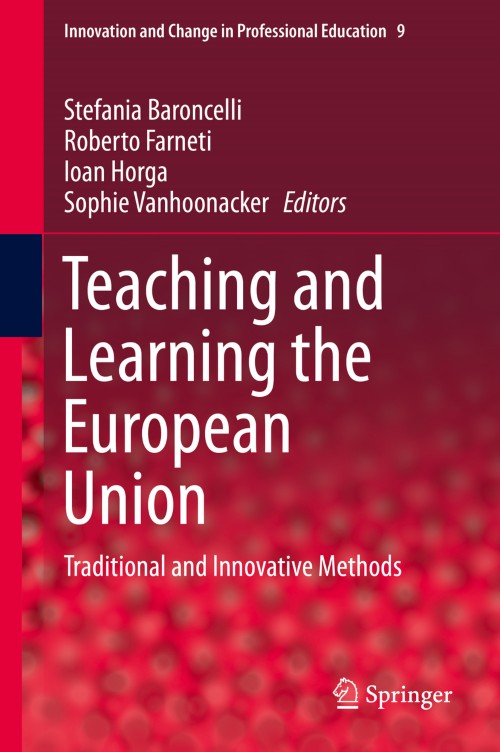
Teaching and Learning the European Union [electronic resource] : Traditional and Innovative Methods / edited by Stefania Baroncelli, Roberto Farneti, Ioan Horga, Sophie Vanhoonacker.
Erişim Adresi
ISBN
9789400770430
Dil Kodu
İngilizce
Yer Numarası
DK/8100
Basım Bildirimi
1st ed. 2014.
Yayın Bilgisi
Dordrecht : Springer Netherlands : Imprint: Springer, 2014.
Fiziksel Niteleme
VIII, 248 p. 14 illus., 12 illus. in color. online resource.
Dizi
Innovation and Change in Professional Education, 2542-9957 ; 9
İçindekiler Notu
1. Introduction - Teaching European Studies: Educational Challenges -- PART I – EUROPEAN STUDIES: CONTEXTS AND CHALLENGES -- 2. Shaping the New Professional for the New Professions; W.H. Gijselaers, A. Dailey-Hebert and A.C. Niculescu -- 3. Working at the EU Institutions: New Human Resources Selection Strategy; N.D. Bearfield -- 4. Educating for EU Citizenship and Civic Engagement through Active Learning; G. J. van Dyke -- 5. Multilingual Universities: Policies and Practices; R. Franceschini and D. Veronesi -- 6. Thinking Europe: A Canadian Academic Immersion inside the European Institutions - EU Study Tour and Internship Program; E. Lavalle and A. Berlin -- PART II – MAPPING INNOVATIONS IN TEACHING AND LEARNING -- 7. Mapping Innovative Teaching Methods and Tools in European Studies: Results from a Comprehensive Study; S. Baroncelli, F. Fonti and G. Stevancevic -- 8. Innovativeness in Teaching European Studies: an Empirical Investigation; F. Fonti and G. Stevancevic -- 9. Linguistic Pluralism in European Studies; S. Baroncelli -- PART III – INNOVATIVE TEACHING AND EARNING IN EUROPEAN STUDIES -- 10. Assessing EU Simulations: Evidence from the Transatlantic EuroSim; R. Jones and P. Bursens -- 11. Distance Learning as an Alternative Method of Teaching European Studies; N. Timus -- 12. Problem Based Learning in European Studies; H. Maurer and C. Neuhold -- 13. Finding the Right Mix? Teaching European Studies through Blended Learning; A. Mihai -- 14. The Network is the Message: Social Networks as Teaching Tools; R. Farneti, I. Bianchi, T. Mayrgündter and J. Niederhauser -- Biographies -- Index. .
Özet, vb.
This volume examines the EU’s changing educational context and its challenges. Based on an extensive survey of more than 2000 European Studies courses in 30 European countries, it maps and analyses the features of teaching methodologies as they emerge from both disciplinary as well as interdisciplinary curricula. It presents a series of case studies on some of the most-used innovative teaching tools emerging in the field such as simulation games, e-learning, problem based learning, blended learning, and learning through the use of social networks. Based on the contributors’ own experiences and academic research, the book examines both strengths and possible pitfalls of these increasingly popular methods. The book’s critical approach will inspire educators and scholars committed to improving the teaching methods and tools in the area of European Studies and other programmes of higher education facing similar challenges.
Konu
Professional education.
Vocational education.
Education, Higher.
Learning, Psychology of.
International education .
Comparative education.
Professional and Vocational Education.
Higher Education.
Instructional Psychology.
International and Comparative Education.
Vocational education.
Education, Higher.
Learning, Psychology of.
International education .
Comparative education.
Professional and Vocational Education.
Higher Education.
Instructional Psychology.
International and Comparative Education.
Kurum Adı
Eseri Alıntıla
Referansları kullanmadan önce gözden geçirmeniz ve varsa gerekli düzeltmeleri yapmanız önerilir.
Dijital Kaynak
MARC Görünümü
LEADER 05029nam a22006135i 4500
001 806806
003 TR_AnAIT
005 20260127002842
007 cr nn 008mamaa
008 131004s2014 ne | s |||| 0|eng d
020 |a9789400770430|9978-94-007-7043-0
024 7 |a10.1007/978-94-007-7043-0|2doi
041 |aeng
049 |aTürk Tarih Kurumu Kütüphanesi
050 4|aLC1051-1072
050 4|aLC1041-1048
072 7|aJNRV|2bicssc
072 7|aEDU046000|2bisacsh
072 7|aJNRV|2thema
082 04|a370.113|223
090 |aDK/8100
245 10|aTeaching and Learning the European Union|h[electronic resource] :|bTraditional and Innovative Methods /|cedited by Stefania Baroncelli, Roberto Farneti, Ioan Horga, Sophie Vanhoonacker.
250 |a1st ed. 2014.
264 1|aDordrecht :|bSpringer Netherlands :|bImprint: Springer,|c2014.
300 |aVIII, 248 p. 14 illus., 12 illus. in color.|bonline resource.
336 |atext|btxt|2rdacontent
337 |acomputer|bc|2rdamedia
338 |aonline resource|bcr|2rdacarrier
347 |atext file|bPDF|2rda
490 1 |aInnovation and Change in Professional Education,|x2542-9957 ;|v9
505 0 |a1. Introduction - Teaching European Studies: Educational Challenges -- PART I – EUROPEAN STUDIES: CONTEXTS AND CHALLENGES -- 2. Shaping the New Professional for the New Professions; W.H. Gijselaers, A. Dailey-Hebert and A.C. Niculescu -- 3. Working at the EU Institutions: New Human Resources Selection Strategy; N.D. Bearfield -- 4. Educating for EU Citizenship and Civic Engagement through Active Learning; G. J. van Dyke -- 5. Multilingual Universities: Policies and Practices; R. Franceschini and D. Veronesi -- 6. Thinking Europe: A Canadian Academic Immersion inside the European Institutions - EU Study Tour and Internship Program; E. Lavalle and A. Berlin -- PART II – MAPPING INNOVATIONS IN TEACHING AND LEARNING -- 7. Mapping Innovative Teaching Methods and Tools in European Studies: Results from a Comprehensive Study; S. Baroncelli, F. Fonti and G. Stevancevic -- 8. Innovativeness in Teaching European Studies: an Empirical Investigation; F. Fonti and G. Stevancevic -- 9. Linguistic Pluralism in European Studies; S. Baroncelli -- PART III – INNOVATIVE TEACHING AND EARNING IN EUROPEAN STUDIES -- 10. Assessing EU Simulations: Evidence from the Transatlantic EuroSim; R. Jones and P. Bursens -- 11. Distance Learning as an Alternative Method of Teaching European Studies; N. Timus -- 12. Problem Based Learning in European Studies; H. Maurer and C. Neuhold -- 13. Finding the Right Mix? Teaching European Studies through Blended Learning; A. Mihai -- 14. The Network is the Message: Social Networks as Teaching Tools; R. Farneti, I. Bianchi, T. Mayrgündter and J. Niederhauser -- Biographies -- Index. .
520 |aThis volume examines the EU’s changing educational context and its challenges. Based on an extensive survey of more than 2000 European Studies courses in 30 European countries, it maps and analyses the features of teaching methodologies as they emerge from both disciplinary as well as interdisciplinary curricula. It presents a series of case studies on some of the most-used innovative teaching tools emerging in the field such as simulation games, e-learning, problem based learning, blended learning, and learning through the use of social networks. Based on the contributors’ own experiences and academic research, the book examines both strengths and possible pitfalls of these increasingly popular methods. The book’s critical approach will inspire educators and scholars committed to improving the teaching methods and tools in the area of European Studies and other programmes of higher education facing similar challenges.
650 0|aProfessional education.
650 0|aVocational education.
650 0|aEducation, Higher.
650 0|aLearning, Psychology of.
650 0|aInternational education .
650 0|aComparative education.
650 14|aProfessional and Vocational Education.
650 24|aHigher Education.
650 24|aInstructional Psychology.
650 24|aInternational and Comparative Education.
700 1 |aBaroncelli, Stefania.|eeditor.|4edt|4http://id.loc.gov/vocabulary/relators/edt
700 1 |aFarneti, Roberto.|eeditor.|4edt|4http://id.loc.gov/vocabulary/relators/edt
700 1 |aHorga, Ioan.|eeditor.|4edt|4http://id.loc.gov/vocabulary/relators/edt
700 1 |aVanhoonacker, Sophie.|eeditor.|4edt|4http://id.loc.gov/vocabulary/relators/edt
710 2 |aSpringerLink (Online service)
773 0 |tSpringer Nature eBook
776 08|iPrinted edition:|z9789400770423
776 08|iPrinted edition:|z9789400770447
776 08|iPrinted edition:|z9789401778749
830 0|aInnovation and Change in Professional Education,|x2542-9957 ;|v9
856 40|uhttps://doi.org/10.1007/978-94-007-7043-0
912 |aZDB-2-SHU
912 |aZDB-2-SXED
950 |aHumanities, Social Sciences and Law (SpringerNature-11648)
950 |aEducation (R0) (SpringerNature-43721)
001 806806
003 TR_AnAIT
005 20260127002842
007 cr nn 008mamaa
008 131004s2014 ne | s |||| 0|eng d
020 |a9789400770430|9978-94-007-7043-0
024 7 |a10.1007/978-94-007-7043-0|2doi
041 |aeng
049 |aTürk Tarih Kurumu Kütüphanesi
050 4|aLC1051-1072
050 4|aLC1041-1048
072 7|aJNRV|2bicssc
072 7|aEDU046000|2bisacsh
072 7|aJNRV|2thema
082 04|a370.113|223
090 |aDK/8100
245 10|aTeaching and Learning the European Union|h[electronic resource] :|bTraditional and Innovative Methods /|cedited by Stefania Baroncelli, Roberto Farneti, Ioan Horga, Sophie Vanhoonacker.
250 |a1st ed. 2014.
264 1|aDordrecht :|bSpringer Netherlands :|bImprint: Springer,|c2014.
300 |aVIII, 248 p. 14 illus., 12 illus. in color.|bonline resource.
336 |atext|btxt|2rdacontent
337 |acomputer|bc|2rdamedia
338 |aonline resource|bcr|2rdacarrier
347 |atext file|bPDF|2rda
490 1 |aInnovation and Change in Professional Education,|x2542-9957 ;|v9
505 0 |a1. Introduction - Teaching European Studies: Educational Challenges -- PART I – EUROPEAN STUDIES: CONTEXTS AND CHALLENGES -- 2. Shaping the New Professional for the New Professions; W.H. Gijselaers, A. Dailey-Hebert and A.C. Niculescu -- 3. Working at the EU Institutions: New Human Resources Selection Strategy; N.D. Bearfield -- 4. Educating for EU Citizenship and Civic Engagement through Active Learning; G. J. van Dyke -- 5. Multilingual Universities: Policies and Practices; R. Franceschini and D. Veronesi -- 6. Thinking Europe: A Canadian Academic Immersion inside the European Institutions - EU Study Tour and Internship Program; E. Lavalle and A. Berlin -- PART II – MAPPING INNOVATIONS IN TEACHING AND LEARNING -- 7. Mapping Innovative Teaching Methods and Tools in European Studies: Results from a Comprehensive Study; S. Baroncelli, F. Fonti and G. Stevancevic -- 8. Innovativeness in Teaching European Studies: an Empirical Investigation; F. Fonti and G. Stevancevic -- 9. Linguistic Pluralism in European Studies; S. Baroncelli -- PART III – INNOVATIVE TEACHING AND EARNING IN EUROPEAN STUDIES -- 10. Assessing EU Simulations: Evidence from the Transatlantic EuroSim; R. Jones and P. Bursens -- 11. Distance Learning as an Alternative Method of Teaching European Studies; N. Timus -- 12. Problem Based Learning in European Studies; H. Maurer and C. Neuhold -- 13. Finding the Right Mix? Teaching European Studies through Blended Learning; A. Mihai -- 14. The Network is the Message: Social Networks as Teaching Tools; R. Farneti, I. Bianchi, T. Mayrgündter and J. Niederhauser -- Biographies -- Index. .
520 |aThis volume examines the EU’s changing educational context and its challenges. Based on an extensive survey of more than 2000 European Studies courses in 30 European countries, it maps and analyses the features of teaching methodologies as they emerge from both disciplinary as well as interdisciplinary curricula. It presents a series of case studies on some of the most-used innovative teaching tools emerging in the field such as simulation games, e-learning, problem based learning, blended learning, and learning through the use of social networks. Based on the contributors’ own experiences and academic research, the book examines both strengths and possible pitfalls of these increasingly popular methods. The book’s critical approach will inspire educators and scholars committed to improving the teaching methods and tools in the area of European Studies and other programmes of higher education facing similar challenges.
650 0|aProfessional education.
650 0|aVocational education.
650 0|aEducation, Higher.
650 0|aLearning, Psychology of.
650 0|aInternational education .
650 0|aComparative education.
650 14|aProfessional and Vocational Education.
650 24|aHigher Education.
650 24|aInstructional Psychology.
650 24|aInternational and Comparative Education.
700 1 |aBaroncelli, Stefania.|eeditor.|4edt|4http://id.loc.gov/vocabulary/relators/edt
700 1 |aFarneti, Roberto.|eeditor.|4edt|4http://id.loc.gov/vocabulary/relators/edt
700 1 |aHorga, Ioan.|eeditor.|4edt|4http://id.loc.gov/vocabulary/relators/edt
700 1 |aVanhoonacker, Sophie.|eeditor.|4edt|4http://id.loc.gov/vocabulary/relators/edt
710 2 |aSpringerLink (Online service)
773 0 |tSpringer Nature eBook
776 08|iPrinted edition:|z9789400770423
776 08|iPrinted edition:|z9789400770447
776 08|iPrinted edition:|z9789401778749
830 0|aInnovation and Change in Professional Education,|x2542-9957 ;|v9
856 40|uhttps://doi.org/10.1007/978-94-007-7043-0
912 |aZDB-2-SHU
912 |aZDB-2-SXED
950 |aHumanities, Social Sciences and Law (SpringerNature-11648)
950 |aEducation (R0) (SpringerNature-43721)
Materyaller
Depodan talep edilen materyal sadece kütüphane içerisinde kullanılmaktadır.
Materyal dışarıya ödünç verilmemektedir.
Materyal dışarıya ödünç verilmemektedir.
