

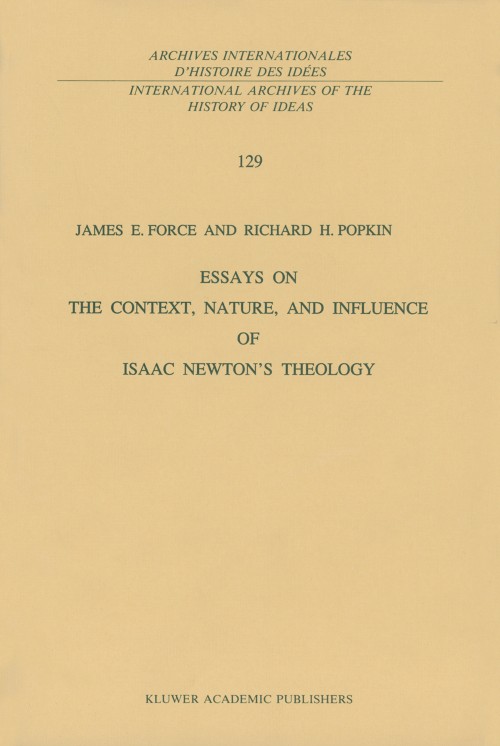
Essays on the Context, Nature, and Influence of Isaac Newton’s Theology [electronic resource] / by J.E. Force, R.H. Popkin.
Erişim Adresi
ISBN
9789400919440
Dil Kodu
İngilizce
Yer Numarası
DK/8104
Yazar
Basım Bildirimi
1st ed. 1990.
Yayın Bilgisi
Dordrecht : Springer Netherlands : Imprint: Springer, 1990.
Fiziksel Niteleme
X, 226 p. online resource.
Dizi
International Archives of the History of Ideas Archives internationales d'histoire des idées, 2215-0307 ; 129
İçindekiler Notu
1. Some Further Comments on Newton and Maimonides -- 2. The Crisis of Polytheism and the Answers of Vossius, Cudworth, and Newton -- 3. Polytheism, Deism, and Newton -- 4. The Newtonians and Deism -- 5. Newton’s God of Dominion: The Unity of Newton’s Theological, Scientific, and Political Thought -- 6. Newton as a Bible Scholar -- 7. Sir Isaac Newton, “Gentleman of Wide Swallow”?: Newton and the Latitudinarians -- 8. The Breakdown of the Newtonian Synthesis of Science and Religion: Hume, Newton, and the Royal Society -- 9. Newton and Fundamentalism, II -- 10. Hume’s Interest in Newton and Science.
Özet, vb.
This collection of essays is the fruit of about fifteen years of discussion and research by James Force and me. As I look back on it, our interest and concern with Newton's theological ideas began in 1975 at Washington University in St. Louis. James Force was a graduate student in philosophy and I was a professor there. For a few years before, I had been doing research and writing on Millenarianism and Messianism in the 17th and 18th centuries, touching occasionally on Newton. I had bought a copy of Newton's Observations upon the Prophecies of Daniel, and the Apocalypse of St. John for a few pounds and, occasionally, read in it. In the Spring of 1975 I was giving a graduate seminar on Millenarian and Messianic ideas in the development of modem philosophy. Force was in the seminar. One day he came very excitedly up to me and said he wanted to write his dissertation on William Whiston. At that point in history, the only thing that came to my mind about Whiston was that he had published a, or the, standard translation of Josephus (which I also happened to have in my library. ) Force told me about the amazing views he had found in Whiston's notes on Josephus and in some of the few writings he could find in St. Louis by, or about, Whiston, who was Newton's successor as Lucasian Professor of mathematics at Cambridge and who wrote inordinately on Millenarian theology.
Konu
Philosophy, Modern.
History.
Religion.
Early Modern Philosophy.
History.
Religion.
History.
Religion.
Early Modern Philosophy.
History.
Religion.
Diğer Yazarlar
Kurum Adı
Eseri Alıntıla
Referansları kullanmadan önce gözden geçirmeniz ve varsa gerekli düzeltmeleri yapmanız önerilir.
Dijital Kaynak
MARC Görünümü
LEADER 04792nam a22005895i 4500
001 806810
003 TR_AnAIT
005 20260127002848
007 cr nn 008mamaa
008 121227s1990 ne | s |||| 0|eng d
020 |a9789400919440|9978-94-009-1944-0
024 7 |a10.1007/978-94-009-1944-0|2doi
041 |aeng
049 |aTürk Tarih Kurumu Kütüphanesi
050 4|aB800.2-804
072 7|aHPCD|2bicssc
072 7|aPHI016000|2bisacsh
072 7|aQDH|2thema
082 04|a190.903|223
090 |aDK/8104
100 1 |aForce, J.E.|eauthor.|4aut|4http://id.loc.gov/vocabulary/relators/aut
245 10|aEssays on the Context, Nature, and Influence of Isaac Newton’s Theology|h[electronic resource] /|cby J.E. Force, R.H. Popkin.
250 |a1st ed. 1990.
264 1|aDordrecht :|bSpringer Netherlands :|bImprint: Springer,|c1990.
300 |aX, 226 p.|bonline resource.
336 |atext|btxt|2rdacontent
337 |acomputer|bc|2rdamedia
338 |aonline resource|bcr|2rdacarrier
347 |atext file|bPDF|2rda
490 1 |aInternational Archives of the History of Ideas Archives internationales d'histoire des idées,|x2215-0307 ;|v129
505 0 |a1. Some Further Comments on Newton and Maimonides -- 2. The Crisis of Polytheism and the Answers of Vossius, Cudworth, and Newton -- 3. Polytheism, Deism, and Newton -- 4. The Newtonians and Deism -- 5. Newton’s God of Dominion: The Unity of Newton’s Theological, Scientific, and Political Thought -- 6. Newton as a Bible Scholar -- 7. Sir Isaac Newton, “Gentleman of Wide Swallow”?: Newton and the Latitudinarians -- 8. The Breakdown of the Newtonian Synthesis of Science and Religion: Hume, Newton, and the Royal Society -- 9. Newton and Fundamentalism, II -- 10. Hume’s Interest in Newton and Science.
520 |aThis collection of essays is the fruit of about fifteen years of discussion and research by James Force and me. As I look back on it, our interest and concern with Newton's theological ideas began in 1975 at Washington University in St. Louis. James Force was a graduate student in philosophy and I was a professor there. For a few years before, I had been doing research and writing on Millenarianism and Messianism in the 17th and 18th centuries, touching occasionally on Newton. I had bought a copy of Newton's Observations upon the Prophecies of Daniel, and the Apocalypse of St. John for a few pounds and, occasionally, read in it. In the Spring of 1975 I was giving a graduate seminar on Millenarian and Messianic ideas in the development of modem philosophy. Force was in the seminar. One day he came very excitedly up to me and said he wanted to write his dissertation on William Whiston. At that point in history, the only thing that came to my mind about Whiston was that he had published a, or the, standard translation of Josephus (which I also happened to have in my library. ) Force told me about the amazing views he had found in Whiston's notes on Josephus and in some of the few writings he could find in St. Louis by, or about, Whiston, who was Newton's successor as Lucasian Professor of mathematics at Cambridge and who wrote inordinately on Millenarian theology.
532 8 |aAccessibility summary: This PDF is not accessible. It is based on scanned pages and does not support features such as screen reader compatibility or described non-text content (images, graphs etc). However, it likely supports searchable and selectable text based on OCR (Optical Character Recognition). Users with accessibility needs may not be able to use this content effectively. Please contact us at accessibilitysupport@springernature.com if you require assistance or an alternative format.
532 8 |aInaccessible, or known limited accessibility
532 8 |aNo reading system accessibility options actively disabled
532 8 |aPublisher contact for further accessibility information: accessibilitysupport@springernature.com
650 0|aPhilosophy, Modern.
650 0|aHistory.
650 0|aReligion.
650 14|aEarly Modern Philosophy.
650 24|aHistory.
650 24|aReligion.
700 1 |aPopkin, R.H.|eauthor.|4aut|4http://id.loc.gov/vocabulary/relators/aut
710 2 |aSpringerLink (Online service)
773 0 |tSpringer Nature eBook
776 08|iPrinted edition:|z9780792305835
776 08|iPrinted edition:|z9789400919457
776 08|iPrinted edition:|z9789401073684
830 0|aInternational Archives of the History of Ideas Archives internationales d'histoire des idées,|x2215-0307 ;|v129
856 40|uhttps://doi.org/10.1007/978-94-009-1944-0
912 |aZDB-2-SHU
912 |aZDB-2-SXPR
912 |aZDB-2-BAE
950 |aHumanities, Social Sciences and Law (SpringerNature-11648)
950 |aPhilosophy and Religion (R0) (SpringerNature-43725)
001 806810
003 TR_AnAIT
005 20260127002848
007 cr nn 008mamaa
008 121227s1990 ne | s |||| 0|eng d
020 |a9789400919440|9978-94-009-1944-0
024 7 |a10.1007/978-94-009-1944-0|2doi
041 |aeng
049 |aTürk Tarih Kurumu Kütüphanesi
050 4|aB800.2-804
072 7|aHPCD|2bicssc
072 7|aPHI016000|2bisacsh
072 7|aQDH|2thema
082 04|a190.903|223
090 |aDK/8104
100 1 |aForce, J.E.|eauthor.|4aut|4http://id.loc.gov/vocabulary/relators/aut
245 10|aEssays on the Context, Nature, and Influence of Isaac Newton’s Theology|h[electronic resource] /|cby J.E. Force, R.H. Popkin.
250 |a1st ed. 1990.
264 1|aDordrecht :|bSpringer Netherlands :|bImprint: Springer,|c1990.
300 |aX, 226 p.|bonline resource.
336 |atext|btxt|2rdacontent
337 |acomputer|bc|2rdamedia
338 |aonline resource|bcr|2rdacarrier
347 |atext file|bPDF|2rda
490 1 |aInternational Archives of the History of Ideas Archives internationales d'histoire des idées,|x2215-0307 ;|v129
505 0 |a1. Some Further Comments on Newton and Maimonides -- 2. The Crisis of Polytheism and the Answers of Vossius, Cudworth, and Newton -- 3. Polytheism, Deism, and Newton -- 4. The Newtonians and Deism -- 5. Newton’s God of Dominion: The Unity of Newton’s Theological, Scientific, and Political Thought -- 6. Newton as a Bible Scholar -- 7. Sir Isaac Newton, “Gentleman of Wide Swallow”?: Newton and the Latitudinarians -- 8. The Breakdown of the Newtonian Synthesis of Science and Religion: Hume, Newton, and the Royal Society -- 9. Newton and Fundamentalism, II -- 10. Hume’s Interest in Newton and Science.
520 |aThis collection of essays is the fruit of about fifteen years of discussion and research by James Force and me. As I look back on it, our interest and concern with Newton's theological ideas began in 1975 at Washington University in St. Louis. James Force was a graduate student in philosophy and I was a professor there. For a few years before, I had been doing research and writing on Millenarianism and Messianism in the 17th and 18th centuries, touching occasionally on Newton. I had bought a copy of Newton's Observations upon the Prophecies of Daniel, and the Apocalypse of St. John for a few pounds and, occasionally, read in it. In the Spring of 1975 I was giving a graduate seminar on Millenarian and Messianic ideas in the development of modem philosophy. Force was in the seminar. One day he came very excitedly up to me and said he wanted to write his dissertation on William Whiston. At that point in history, the only thing that came to my mind about Whiston was that he had published a, or the, standard translation of Josephus (which I also happened to have in my library. ) Force told me about the amazing views he had found in Whiston's notes on Josephus and in some of the few writings he could find in St. Louis by, or about, Whiston, who was Newton's successor as Lucasian Professor of mathematics at Cambridge and who wrote inordinately on Millenarian theology.
532 8 |aAccessibility summary: This PDF is not accessible. It is based on scanned pages and does not support features such as screen reader compatibility or described non-text content (images, graphs etc). However, it likely supports searchable and selectable text based on OCR (Optical Character Recognition). Users with accessibility needs may not be able to use this content effectively. Please contact us at accessibilitysupport@springernature.com if you require assistance or an alternative format.
532 8 |aInaccessible, or known limited accessibility
532 8 |aNo reading system accessibility options actively disabled
532 8 |aPublisher contact for further accessibility information: accessibilitysupport@springernature.com
650 0|aPhilosophy, Modern.
650 0|aHistory.
650 0|aReligion.
650 14|aEarly Modern Philosophy.
650 24|aHistory.
650 24|aReligion.
700 1 |aPopkin, R.H.|eauthor.|4aut|4http://id.loc.gov/vocabulary/relators/aut
710 2 |aSpringerLink (Online service)
773 0 |tSpringer Nature eBook
776 08|iPrinted edition:|z9780792305835
776 08|iPrinted edition:|z9789400919457
776 08|iPrinted edition:|z9789401073684
830 0|aInternational Archives of the History of Ideas Archives internationales d'histoire des idées,|x2215-0307 ;|v129
856 40|uhttps://doi.org/10.1007/978-94-009-1944-0
912 |aZDB-2-SHU
912 |aZDB-2-SXPR
912 |aZDB-2-BAE
950 |aHumanities, Social Sciences and Law (SpringerNature-11648)
950 |aPhilosophy and Religion (R0) (SpringerNature-43725)
Materyaller
Depodan talep edilen materyal sadece kütüphane içerisinde kullanılmaktadır.
Materyal dışarıya ödünç verilmemektedir.
Materyal dışarıya ödünç verilmemektedir.
