LEADER 04391nam a22004935i 4500
001 806814
003 TR_AnAIT
005 20260127002853
007 cr nn 008mamaa
008 121227s1974 ne | s |||| 0|eng d
020 |a9789401020169|9978-94-010-2016-9
024 7 |a10.1007/978-94-010-2016-9|2doi
041 |aeng
049 |aTürk Tarih Kurumu Kütüphanesi
050 4|aBD143-237
072 7|aHPK|2bicssc
072 7|aPHI004000|2bisacsh
072 7|aQDTK|2thema
082 04|a120|223
090 |aDK/8108
100 1 |aWeiss, F.G.|eauthor.|4aut|4http://id.loc.gov/vocabulary/relators/aut
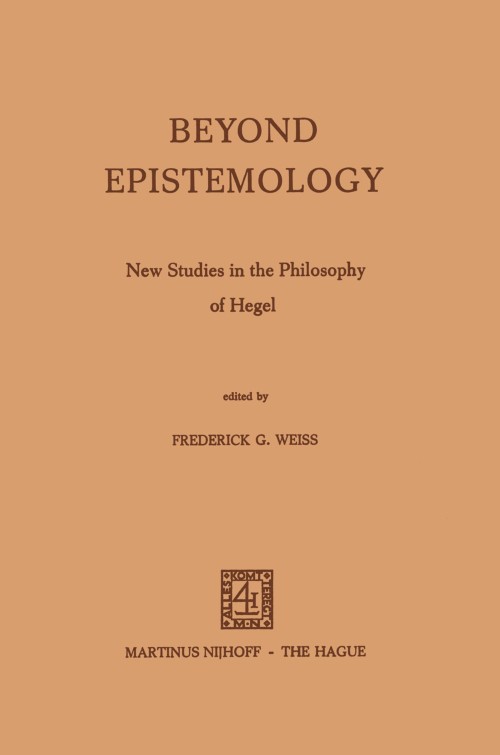
245 10|aBeyond Epistemology|h[electronic resource] :|bNew Studies in the Philosophy of Hegel /|cby F.G. Weiss.
250 |a1st ed. 1974.
264 1|aDordrecht :|bSpringer Netherlands :|bImprint: Springer,|c1974.
300 |a254 p.|bonline resource.
336 |atext|btxt|2rdacontent
337 |acomputer|bc|2rdamedia
338 |aonline resource|bcr|2rdacarrier
347 |atext file|bPDF|2rda
505 0 |aI. “Hegel: How, and How Far, is Philosophy Possible?” -- II. “Hegel’s Theory of Religious Knowledge” -- III. “On Artistic Knowledge: A Study in Hegel’s Philosophy of Art” -- IV. “Hegel: Truth in the Philosophical Sciences of Society, Politics, and History” -- V. “Hegel and the Natural Sciences” -- VI. “Reflexive Asymmetry: Hegel’s Most Fundamental Methodological Ruse” -- VII. “Phenomenology: Hegel and Husserl” -- VIII. “Hegel and Hermeneutics” -- IX. Appendix. “Reason and Religious Truth”: Hegel’s Foreword to H. FR. W. Hinrichs’ Die Religion im inneren Verhältnisse zur Wissenschaft (1822), translated by A. V. Miller, with Introduction by Merold Westphal -- Contributors.
520 |aThis book approaches Hegel from the standpoint of what we might call the question of knowledge. Hegel, of course, had no "theory of knowledge" in the narrow and abstract sense in which it has come to be understood since Locke and Kant. "The examination of knowledge," he holds, "can only be carried out by an act of knowledge," and "to seek to know before we know is as absurd as the wise resolution of Scholasticus, not to venture into the water until he had learned to swim. " * While Hegel wrote no treatise exclusively devoted to epistemology, his entire philosophy is nonetheless a many-faceted theory of truth, and thus our title - Beyond Epistemology - is meant to suggest a return to the classical meaning and relation of the terms episteme and logos. I had originally planned to include a lengthy introduction for these essays, setting out Hegel's general view of philosophic truth. But as the papers came in, it became clear that I had chosen my contributors too well; indeed, they have all but put me out of business. In any case, it gives me great pleasure to have been able to gather this symposium of outstanding Hegel scholars, to provide for them a forum on a common theme of great importance, and especially, thanks to Arnold Miller, to have Hegel himself among them. Frederick G. Weiss Charlottesville, Va. • The Logic of Hegel, trans. from the Etu;yclopaedta by William Wallace. 2nd ed.
532 8 |aAccessibility summary: This PDF is not accessible. It is based on scanned pages and does not support features such as screen reader compatibility or described non-text content (images, graphs etc). However, it likely supports searchable and selectable text based on OCR (Optical Character Recognition). Users with accessibility needs may not be able to use this content effectively. Please contact us at accessibilitysupport@springernature.com if you require assistance or an alternative format.
532 8 |aInaccessible, or known limited accessibility
532 8 |aNo reading system accessibility options actively disabled
532 8 |aPublisher contact for further accessibility information: accessibilitysupport@springernature.com
650 0|aKnowledge, Theory of.
650 14|aEpistemology.
710 2 |aSpringerLink (Online service)
773 0 |tSpringer Nature eBook
776 08|iPrinted edition:|z9789024715848
776 08|iPrinted edition:|z9789401020176
856 40|uhttps://doi.org/10.1007/978-94-010-2016-9
912 |aZDB-2-SHU
912 |aZDB-2-SXPR
912 |aZDB-2-BAE
950 |aHumanities, Social Sciences and Law (SpringerNature-11648)
950 |aPhilosophy and Religion (R0) (SpringerNature-43725)