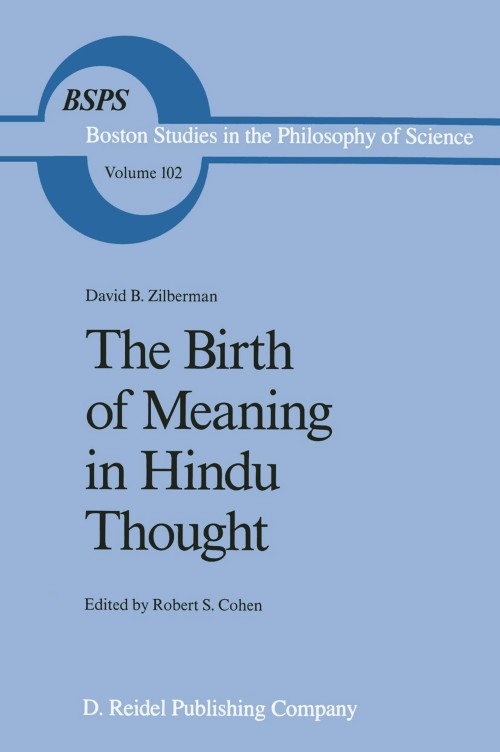
The Birth of Meaning in Hindu Thought [electronic resource] / by David B. Zilberman ; edited by Robert S. Cohen.
Erişim Adresi
ISBN
9789400914315
Dil Kodu
İngilizce
Yer Numarası
DK/8113
Yazar
Basım Bildirimi
1st ed. 1988.
Yayın Bilgisi
Dordrecht : Springer Netherlands : Imprint: Springer, 1988.
Fiziksel Niteleme
410 p. online resource.
Dizi
Boston Studies in the Philosophy and History of Science, 2214-7942 ; 102
İçindekiler Notu
I / Hindu Systems of Thought as Epistemic Disciplines -- I. The Science of Philosophies -- II. The Mechanism of Organization -- III. The Structural Design -- IV. Para-Methodology -- V. Modality and Modalization -- VI. The Self-Developing Culture and Text -- VII. Six Epistemic Disciplines Unfolding Into One Another -- VIII. Modal Semiotics and the Categories of Philosophical Thinking -- IX. Six Entries into the World of Philosophical Reflections -- X. Summa Philosophiae -- II / The Birth of ‘Meaning’: A Systematic Genealogy of Indian Semantics -- I. Segregation of Meaning and Language -- II. The Rgveda in the Making: A Meaningful Activity Without ‘Meaning’ -- III. The Nirukta: A Knot of Semantic and Etymological Problems -- IV. P?nini: Separating and Interconnecting Language and Logic -- V. The Individual and the Universal in Language and Knowledge -- III / Dialectics in Kant and in the Ny?ya-S?tra: Toward the History of the Formation of Formal Logical Thinking -- IV / The Canonical Self in the World of Knowledge: A Note on Ny?ya Gnoseology -- V / Revelation in Advaita Ved?nta as an Experiment in the Semantic Destruction of Language -- I. Theoretical Basis of the Possibility of Coming to Know Brahman (Pary?ya) -- II. Intuitive Basis of the Possibility of Coming to Know Brahman (Prayojana) -- III. Pary?ya of the First Stage of Reflection from the Structure of the Text to the Nature of Brahman: The Theory of False Attribution and its Sublation (Transcendence) -- IV. Prayojana of the First Stage of Reflection: The Intuition of False Attribution and its Sublation (Transcendence) -- V. Pary?ya of the Second Stage of Reflection: The Theory of Brahman Shown in a Metaphoric Occurrence (Laksan?vritti) -- VI. Prayojana of the Second Stage of Reflection: Intuition of Brahman Shown by theMethod of Metamorphic Definition -- VII. Language Inappropriateness Exposed and Brahman Demonstrated by the Netiv?da Method: The Theory of Intuition (Pary?ya) -- VIII. Prayojana of the Vedic Realization by the Netiv?da Method: The Intuition of a Theory -- VI / Is The Bodhisattva a Skeptic? On the Trichotomy of ‘Indicative’, ‘Recollective’, and ‘Collective’ Signs -- VII / Hindu Values and Buddhism: An Exemplary Discourse -- I. Methodological -- II. Theoretical -- II.1. The Mim?msa Normology -- VIII / Understanding Cultural Traditions Through Types of Thinking -- I. Level of Absolute Reality -- II. Level of Phenomenation -- III. Level of Absolute Irreality -- IX / The Family of Hindu ‘Visions’ as Cultural Entities -- Notes and References -- Bibliography: Selected Works of David Zilberman.
Özet, vb.
In his letter to B. K. Matilal, dated February 20, 1977, the author of this book wrote about his work on Advaita-Vedanta: " ... It was not to present Advaita in the light of current problems of the logic of scientific discovery and modern philosophy of language ... but just the contrary. I do not believe that any 'logic without metaphysics' or 'philosophy of language without thinking' is possible." This passage alone may serve as the clue to Zilberman's understanding and mode of explaining that specific and highly original approach to (not 'of'!) philosophy that he himself nicknamed modal. Four points would seem to me to be most essential here. First, a philosophy cannot have 'anything un-thinking' as its object of investigation. Language, to Zilberman, is not a phenomenon of con sciousness but a spontaneously working natural mechanism (like, for instance, 'mind' to some Buddhist philosophers). It may, of course, be come used for and by consciousness; consciousness may see itself, so to speak, in language, but only secondarily, only as in one of its modifica tions, derivations or modalities. That is why to Zilberman linguistic- as to Kant psychology - cannot and must not figure as the primary ground for any philosophical investigation.
Konu
Philosophy.
Philosophy.
Philosophy.
Diğer Yazarlar
Kurum Adı

Eseri Alıntıla
Referansları kullanmadan önce gözden geçirmeniz ve varsa gerekli düzeltmeleri yapmanız önerilir.
Dijital Kaynak
MARC Görünümü
LEADER 06470nam a22005415i 4500
001 806819
003 TR_AnAIT
005 20260127002859
007 cr nn 008mamaa
008 121227s1988 ne | s |||| 0|eng d
020 |a9789400914315|9978-94-009-1431-5
024 7 |a10.1007/978-94-009-1431-5|2doi
041 |aeng
049 |aTürk Tarih Kurumu Kütüphanesi
050 4|aB1-5802
072 7|aHP|2bicssc
072 7|aPHI000000|2bisacsh
072 7|aQD|2thema
082 04|a100|223
090 |aDK/8113
100 1 |aZilberman, David B.|eauthor.|4aut|4http://id.loc.gov/vocabulary/relators/aut
245 14|aThe Birth of Meaning in Hindu Thought|h[electronic resource] /|cby David B. Zilberman ; edited by Robert S. Cohen.
250 |a1st ed. 1988.
264 1|aDordrecht :|bSpringer Netherlands :|bImprint: Springer,|c1988.
300 |a410 p.|bonline resource.
336 |atext|btxt|2rdacontent
337 |acomputer|bc|2rdamedia
338 |aonline resource|bcr|2rdacarrier
347 |atext file|bPDF|2rda
490 1 |aBoston Studies in the Philosophy and History of Science,|x2214-7942 ;|v102
505 0 |aI / Hindu Systems of Thought as Epistemic Disciplines -- I. The Science of Philosophies -- II. The Mechanism of Organization -- III. The Structural Design -- IV. Para-Methodology -- V. Modality and Modalization -- VI. The Self-Developing Culture and Text -- VII. Six Epistemic Disciplines Unfolding Into One Another -- VIII. Modal Semiotics and the Categories of Philosophical Thinking -- IX. Six Entries into the World of Philosophical Reflections -- X. Summa Philosophiae -- II / The Birth of ‘Meaning’: A Systematic Genealogy of Indian Semantics -- I. Segregation of Meaning and Language -- II. The Rgveda in the Making: A Meaningful Activity Without ‘Meaning’ -- III. The Nirukta: A Knot of Semantic and Etymological Problems -- IV. P?nini: Separating and Interconnecting Language and Logic -- V. The Individual and the Universal in Language and Knowledge -- III / Dialectics in Kant and in the Ny?ya-S?tra: Toward the History of the Formation of Formal Logical Thinking -- IV / The Canonical Self in the World of Knowledge: A Note on Ny?ya Gnoseology -- V / Revelation in Advaita Ved?nta as an Experiment in the Semantic Destruction of Language -- I. Theoretical Basis of the Possibility of Coming to Know Brahman (Pary?ya) -- II. Intuitive Basis of the Possibility of Coming to Know Brahman (Prayojana) -- III. Pary?ya of the First Stage of Reflection from the Structure of the Text to the Nature of Brahman: The Theory of False Attribution and its Sublation (Transcendence) -- IV. Prayojana of the First Stage of Reflection: The Intuition of False Attribution and its Sublation (Transcendence) -- V. Pary?ya of the Second Stage of Reflection: The Theory of Brahman Shown in a Metaphoric Occurrence (Laksan?vritti) -- VI. Prayojana of the Second Stage of Reflection: Intuition of Brahman Shown by theMethod of Metamorphic Definition -- VII. Language Inappropriateness Exposed and Brahman Demonstrated by the Netiv?da Method: The Theory of Intuition (Pary?ya) -- VIII. Prayojana of the Vedic Realization by the Netiv?da Method: The Intuition of a Theory -- VI / Is The Bodhisattva a Skeptic? On the Trichotomy of ‘Indicative’, ‘Recollective’, and ‘Collective’ Signs -- VII / Hindu Values and Buddhism: An Exemplary Discourse -- I. Methodological -- II. Theoretical -- II.1. The Mim?msa Normology -- VIII / Understanding Cultural Traditions Through Types of Thinking -- I. Level of Absolute Reality -- II. Level of Phenomenation -- III. Level of Absolute Irreality -- IX / The Family of Hindu ‘Visions’ as Cultural Entities -- Notes and References -- Bibliography: Selected Works of David Zilberman.
520 |aIn his letter to B. K. Matilal, dated February 20, 1977, the author of this book wrote about his work on Advaita-Vedanta: " ... It was not to present Advaita in the light of current problems of the logic of scientific discovery and modern philosophy of language ... but just the contrary. I do not believe that any 'logic without metaphysics' or 'philosophy of language without thinking' is possible." This passage alone may serve as the clue to Zilberman's understanding and mode of explaining that specific and highly original approach to (not 'of'!) philosophy that he himself nicknamed modal. Four points would seem to me to be most essential here. First, a philosophy cannot have 'anything un-thinking' as its object of investigation. Language, to Zilberman, is not a phenomenon of con sciousness but a spontaneously working natural mechanism (like, for instance, 'mind' to some Buddhist philosophers). It may, of course, be come used for and by consciousness; consciousness may see itself, so to speak, in language, but only secondarily, only as in one of its modifica tions, derivations or modalities. That is why to Zilberman linguistic- as to Kant psychology - cannot and must not figure as the primary ground for any philosophical investigation.
532 8 |aAccessibility summary: This PDF is not accessible. It is based on scanned pages and does not support features such as screen reader compatibility or described non-text content (images, graphs etc). However, it likely supports searchable and selectable text based on OCR (Optical Character Recognition). Users with accessibility needs may not be able to use this content effectively. Please contact us at accessibilitysupport@springernature.com if you require assistance or an alternative format.
532 8 |aInaccessible, or known limited accessibility
532 8 |aNo reading system accessibility options actively disabled
532 8 |aPublisher contact for further accessibility information: accessibilitysupport@springernature.com
650 0|aPhilosophy.
650 14|aPhilosophy.
700 1 |aCohen, Robert S.|eeditor.|4edt|4http://id.loc.gov/vocabulary/relators/edt
710 2 |aSpringerLink (Online service)
773 0 |tSpringer Nature eBook
776 08|iPrinted edition:|z9789027724977
776 08|iPrinted edition:|z9789400914322
776 08|iPrinted edition:|z9789401071413
830 0|aBoston Studies in the Philosophy and History of Science,|x2214-7942 ;|v102
856 40|uhttps://doi.org/10.1007/978-94-009-1431-5
912 |aZDB-2-SHU
912 |aZDB-2-SXPR
912 |aZDB-2-BAE
950 |aHumanities, Social Sciences and Law (SpringerNature-11648)
950 |aPhilosophy and Religion (R0) (SpringerNature-43725)
001 806819
003 TR_AnAIT
005 20260127002859
007 cr nn 008mamaa
008 121227s1988 ne | s |||| 0|eng d
020 |a9789400914315|9978-94-009-1431-5
024 7 |a10.1007/978-94-009-1431-5|2doi
041 |aeng
049 |aTürk Tarih Kurumu Kütüphanesi
050 4|aB1-5802
072 7|aHP|2bicssc
072 7|aPHI000000|2bisacsh
072 7|aQD|2thema
082 04|a100|223
090 |aDK/8113
100 1 |aZilberman, David B.|eauthor.|4aut|4http://id.loc.gov/vocabulary/relators/aut
245 14|aThe Birth of Meaning in Hindu Thought|h[electronic resource] /|cby David B. Zilberman ; edited by Robert S. Cohen.
250 |a1st ed. 1988.
264 1|aDordrecht :|bSpringer Netherlands :|bImprint: Springer,|c1988.
300 |a410 p.|bonline resource.
336 |atext|btxt|2rdacontent
337 |acomputer|bc|2rdamedia
338 |aonline resource|bcr|2rdacarrier
347 |atext file|bPDF|2rda
490 1 |aBoston Studies in the Philosophy and History of Science,|x2214-7942 ;|v102
505 0 |aI / Hindu Systems of Thought as Epistemic Disciplines -- I. The Science of Philosophies -- II. The Mechanism of Organization -- III. The Structural Design -- IV. Para-Methodology -- V. Modality and Modalization -- VI. The Self-Developing Culture and Text -- VII. Six Epistemic Disciplines Unfolding Into One Another -- VIII. Modal Semiotics and the Categories of Philosophical Thinking -- IX. Six Entries into the World of Philosophical Reflections -- X. Summa Philosophiae -- II / The Birth of ‘Meaning’: A Systematic Genealogy of Indian Semantics -- I. Segregation of Meaning and Language -- II. The Rgveda in the Making: A Meaningful Activity Without ‘Meaning’ -- III. The Nirukta: A Knot of Semantic and Etymological Problems -- IV. P?nini: Separating and Interconnecting Language and Logic -- V. The Individual and the Universal in Language and Knowledge -- III / Dialectics in Kant and in the Ny?ya-S?tra: Toward the History of the Formation of Formal Logical Thinking -- IV / The Canonical Self in the World of Knowledge: A Note on Ny?ya Gnoseology -- V / Revelation in Advaita Ved?nta as an Experiment in the Semantic Destruction of Language -- I. Theoretical Basis of the Possibility of Coming to Know Brahman (Pary?ya) -- II. Intuitive Basis of the Possibility of Coming to Know Brahman (Prayojana) -- III. Pary?ya of the First Stage of Reflection from the Structure of the Text to the Nature of Brahman: The Theory of False Attribution and its Sublation (Transcendence) -- IV. Prayojana of the First Stage of Reflection: The Intuition of False Attribution and its Sublation (Transcendence) -- V. Pary?ya of the Second Stage of Reflection: The Theory of Brahman Shown in a Metaphoric Occurrence (Laksan?vritti) -- VI. Prayojana of the Second Stage of Reflection: Intuition of Brahman Shown by theMethod of Metamorphic Definition -- VII. Language Inappropriateness Exposed and Brahman Demonstrated by the Netiv?da Method: The Theory of Intuition (Pary?ya) -- VIII. Prayojana of the Vedic Realization by the Netiv?da Method: The Intuition of a Theory -- VI / Is The Bodhisattva a Skeptic? On the Trichotomy of ‘Indicative’, ‘Recollective’, and ‘Collective’ Signs -- VII / Hindu Values and Buddhism: An Exemplary Discourse -- I. Methodological -- II. Theoretical -- II.1. The Mim?msa Normology -- VIII / Understanding Cultural Traditions Through Types of Thinking -- I. Level of Absolute Reality -- II. Level of Phenomenation -- III. Level of Absolute Irreality -- IX / The Family of Hindu ‘Visions’ as Cultural Entities -- Notes and References -- Bibliography: Selected Works of David Zilberman.
520 |aIn his letter to B. K. Matilal, dated February 20, 1977, the author of this book wrote about his work on Advaita-Vedanta: " ... It was not to present Advaita in the light of current problems of the logic of scientific discovery and modern philosophy of language ... but just the contrary. I do not believe that any 'logic without metaphysics' or 'philosophy of language without thinking' is possible." This passage alone may serve as the clue to Zilberman's understanding and mode of explaining that specific and highly original approach to (not 'of'!) philosophy that he himself nicknamed modal. Four points would seem to me to be most essential here. First, a philosophy cannot have 'anything un-thinking' as its object of investigation. Language, to Zilberman, is not a phenomenon of con sciousness but a spontaneously working natural mechanism (like, for instance, 'mind' to some Buddhist philosophers). It may, of course, be come used for and by consciousness; consciousness may see itself, so to speak, in language, but only secondarily, only as in one of its modifica tions, derivations or modalities. That is why to Zilberman linguistic- as to Kant psychology - cannot and must not figure as the primary ground for any philosophical investigation.
532 8 |aAccessibility summary: This PDF is not accessible. It is based on scanned pages and does not support features such as screen reader compatibility or described non-text content (images, graphs etc). However, it likely supports searchable and selectable text based on OCR (Optical Character Recognition). Users with accessibility needs may not be able to use this content effectively. Please contact us at accessibilitysupport@springernature.com if you require assistance or an alternative format.
532 8 |aInaccessible, or known limited accessibility
532 8 |aNo reading system accessibility options actively disabled
532 8 |aPublisher contact for further accessibility information: accessibilitysupport@springernature.com
650 0|aPhilosophy.
650 14|aPhilosophy.
700 1 |aCohen, Robert S.|eeditor.|4edt|4http://id.loc.gov/vocabulary/relators/edt
710 2 |aSpringerLink (Online service)
773 0 |tSpringer Nature eBook
776 08|iPrinted edition:|z9789027724977
776 08|iPrinted edition:|z9789400914322
776 08|iPrinted edition:|z9789401071413
830 0|aBoston Studies in the Philosophy and History of Science,|x2214-7942 ;|v102
856 40|uhttps://doi.org/10.1007/978-94-009-1431-5
912 |aZDB-2-SHU
912 |aZDB-2-SXPR
912 |aZDB-2-BAE
950 |aHumanities, Social Sciences and Law (SpringerNature-11648)
950 |aPhilosophy and Religion (R0) (SpringerNature-43725)
Materyaller
Depodan talep edilen materyal sadece kütüphane içerisinde kullanılmaktadır.
Materyal dışarıya ödünç verilmemektedir.
