

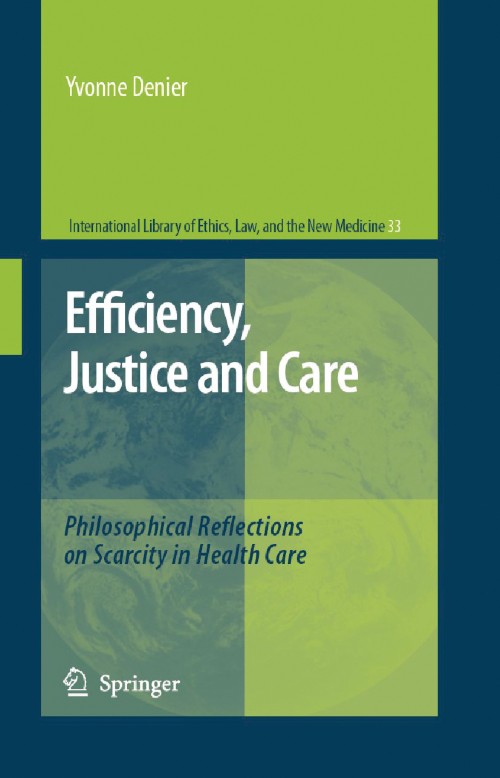
Efficiency, Justice and Care [electronic resource] : Philosophical Reflections on Scarcity in Health Care / by Yvonne Denier.
Erişim Adresi
ISBN
9781402052149
Dil Kodu
İngilizce
Yer Numarası
DK/8131
Yazar
Basım Bildirimi
1st ed. 2007.
Yayın Bilgisi
Dordrecht : Springer Netherlands : Imprint: Springer, 2007.
Fiziksel Niteleme
XX, 304 p. online resource.
Dizi
International Library of Ethics, Law, and the New Medicine, 2351-955X ; 33
İçindekiler Notu
Just Health Care: Presuppositions and Objectives -- Just Health Care: Core Issues -- Scarcity, Finitude and the Normative Value of Health -- Distributive Justice and Health Care -- Justice as Fairness: John Rawls -- Nussbaum's Approach: A Non-Contractarian Account of Care -- Setting Limits: Dworkin's Proposal -- General Conclusion: Health Care and the Limits of Human Existence -- Just Health Care: Foundations and Prospects.
Özet, vb.
What does just health care imply? Does it mean that people have a right to health care? Does it entail that there are rights-based social obligations to provide equal access to health care for everyone? And if so, why? Why are health care interests so important that they deserve special protection? What kind of social good is health care? What are its functions and do these make it different from other commodities? Furthermore, how much equality should there be in health care? What inequalities are morally acceptable and how should the burdens of achieving equality be distributed? Which matters of health care belong to the domain of justice, and which to the domain of charity? To what extent should we allow personal responsibility to play a role in allocating health care services and resources, or in distributing the costs? And what does justice require with regard to long-term care for the chronically ill and irreversibly dependent? Since the 90’s, issues of scarcity, priority setting, and rationing lie at the centre of most current debates on health care. These are pressing issues: one way or another, limits have to be set. As such, the question of what is involved in just health care becomes much more complex. This complexity can be represented as an inconsistent triad, a set of three propositions of which any two are compatible but which together form a contradiction. In the case of health care, the three rival values are: social efficiency, justice, and decent-quality care. It seems to be that we can have any two but not all three. Essentially, the central question is the following: how best to square the proverbial welfare circle. How can resources be matched to needs, or needs to resources in socially acceptable and economically feasible ways? This book attempts to answer the question how health care can be incorporated into a comprehensive theory of justice, while realising an acceptable balance between efficiency, justice andcare. ‘…I find it (the book) to be uncommonly good. The author very carefully analyzes key philosophical positions as they have been applied in this area; the research is very thorough, the writing is clear and engaging. This book could well be used in just about any university course dealing with public health care.’ Professor David Novak, University of Toronto, Canada ‘One of the most interesting books I have read in a long time…a very extensive overview of some prominent modern theories of justice and their application to resource distribution in health care. Based on this it raises a number of new and original questions, some of which also receive original and convincing answers.’ Professor Søren Holm, Cardiff Law School, United Kingdom.
Konu
Philosophy.
Ethics.
Medical sciences.
Public health.
Medicine __ Philosophy.
Bioethics.
Philosophy.
Moral Philosophy and Applied Ethics.
Health Sciences.
Public Health.
Philosophy of Medicine.
Bioethics.
Ethics.
Medical sciences.
Public health.
Medicine __ Philosophy.
Bioethics.
Philosophy.
Moral Philosophy and Applied Ethics.
Health Sciences.
Public Health.
Philosophy of Medicine.
Bioethics.
Kurum Adı
Eseri Alıntıla
Referansları kullanmadan önce gözden geçirmeniz ve varsa gerekli düzeltmeleri yapmanız önerilir.
Dijital Kaynak
MARC Görünümü
LEADER 05223nam a22005895i 4500
001 806837
003 TR_AnAIT
005 20260127002924
007 cr nn 008mamaa
008 100301s2007 ne | s |||| 0|eng d
020 |a9781402052149|9978-1-4020-5214-9
024 7 |a10.1007/978-1-4020-5214-9|2doi
041 |aeng
049 |aTürk Tarih Kurumu Kütüphanesi
050 4|aB1-5802
072 7|aHP|2bicssc
072 7|aPHI000000|2bisacsh
072 7|aQD|2thema
082 04|a100|223
090 |aDK/8131
100 1 |aDenier, Yvonne.|eauthor.|4aut|4http://id.loc.gov/vocabulary/relators/aut
245 10|aEfficiency, Justice and Care|h[electronic resource] :|bPhilosophical Reflections on Scarcity in Health Care /|cby Yvonne Denier.
250 |a1st ed. 2007.
264 1|aDordrecht :|bSpringer Netherlands :|bImprint: Springer,|c2007.
300 |aXX, 304 p.|bonline resource.
336 |atext|btxt|2rdacontent
337 |acomputer|bc|2rdamedia
338 |aonline resource|bcr|2rdacarrier
347 |atext file|bPDF|2rda
490 1 |aInternational Library of Ethics, Law, and the New Medicine,|x2351-955X ;|v33
505 0 |aJust Health Care: Presuppositions and Objectives -- Just Health Care: Core Issues -- Scarcity, Finitude and the Normative Value of Health -- Distributive Justice and Health Care -- Justice as Fairness: John Rawls -- Nussbaum's Approach: A Non-Contractarian Account of Care -- Setting Limits: Dworkin's Proposal -- General Conclusion: Health Care and the Limits of Human Existence -- Just Health Care: Foundations and Prospects.
520 |aWhat does just health care imply? Does it mean that people have a right to health care? Does it entail that there are rights-based social obligations to provide equal access to health care for everyone? And if so, why? Why are health care interests so important that they deserve special protection? What kind of social good is health care? What are its functions and do these make it different from other commodities? Furthermore, how much equality should there be in health care? What inequalities are morally acceptable and how should the burdens of achieving equality be distributed? Which matters of health care belong to the domain of justice, and which to the domain of charity? To what extent should we allow personal responsibility to play a role in allocating health care services and resources, or in distributing the costs? And what does justice require with regard to long-term care for the chronically ill and irreversibly dependent? Since the 90’s, issues of scarcity, priority setting, and rationing lie at the centre of most current debates on health care. These are pressing issues: one way or another, limits have to be set. As such, the question of what is involved in just health care becomes much more complex. This complexity can be represented as an inconsistent triad, a set of three propositions of which any two are compatible but which together form a contradiction. In the case of health care, the three rival values are: social efficiency, justice, and decent-quality care. It seems to be that we can have any two but not all three. Essentially, the central question is the following: how best to square the proverbial welfare circle. How can resources be matched to needs, or needs to resources in socially acceptable and economically feasible ways? This book attempts to answer the question how health care can be incorporated into a comprehensive theory of justice, while realising an acceptable balance between efficiency, justice andcare. ‘…I find it (the book) to be uncommonly good. The author very carefully analyzes key philosophical positions as they have been applied in this area; the research is very thorough, the writing is clear and engaging. This book could well be used in just about any university course dealing with public health care.’ Professor David Novak, University of Toronto, Canada ‘One of the most interesting books I have read in a long time…a very extensive overview of some prominent modern theories of justice and their application to resource distribution in health care. Based on this it raises a number of new and original questions, some of which also receive original and convincing answers.’ Professor Søren Holm, Cardiff Law School, United Kingdom.
650 0|aPhilosophy.
650 0|aEthics.
650 0|aMedical sciences.
650 0|aPublic health.
650 0|aMedicine|xPhilosophy.
650 0|aBioethics.
650 14|aPhilosophy.
650 24|aMoral Philosophy and Applied Ethics.
650 24|aHealth Sciences.
650 24|aPublic Health.
650 24|aPhilosophy of Medicine.
650 24|aBioethics.
710 2 |aSpringerLink (Online service)
773 0 |tSpringer Nature eBook
776 08|iPrinted edition:|z9781402052132
776 08|iPrinted edition:|z9789048110292
776 08|iPrinted edition:|z9789048173112
830 0|aInternational Library of Ethics, Law, and the New Medicine,|x2351-955X ;|v33
856 40|uhttps://doi.org/10.1007/978-1-4020-5214-9
912 |aZDB-2-SHU
912 |aZDB-2-SXPR
950 |aHumanities, Social Sciences and Law (SpringerNature-11648)
950 |aPhilosophy and Religion (R0) (SpringerNature-43725)
001 806837
003 TR_AnAIT
005 20260127002924
007 cr nn 008mamaa
008 100301s2007 ne | s |||| 0|eng d
020 |a9781402052149|9978-1-4020-5214-9
024 7 |a10.1007/978-1-4020-5214-9|2doi
041 |aeng
049 |aTürk Tarih Kurumu Kütüphanesi
050 4|aB1-5802
072 7|aHP|2bicssc
072 7|aPHI000000|2bisacsh
072 7|aQD|2thema
082 04|a100|223
090 |aDK/8131
100 1 |aDenier, Yvonne.|eauthor.|4aut|4http://id.loc.gov/vocabulary/relators/aut
245 10|aEfficiency, Justice and Care|h[electronic resource] :|bPhilosophical Reflections on Scarcity in Health Care /|cby Yvonne Denier.
250 |a1st ed. 2007.
264 1|aDordrecht :|bSpringer Netherlands :|bImprint: Springer,|c2007.
300 |aXX, 304 p.|bonline resource.
336 |atext|btxt|2rdacontent
337 |acomputer|bc|2rdamedia
338 |aonline resource|bcr|2rdacarrier
347 |atext file|bPDF|2rda
490 1 |aInternational Library of Ethics, Law, and the New Medicine,|x2351-955X ;|v33
505 0 |aJust Health Care: Presuppositions and Objectives -- Just Health Care: Core Issues -- Scarcity, Finitude and the Normative Value of Health -- Distributive Justice and Health Care -- Justice as Fairness: John Rawls -- Nussbaum's Approach: A Non-Contractarian Account of Care -- Setting Limits: Dworkin's Proposal -- General Conclusion: Health Care and the Limits of Human Existence -- Just Health Care: Foundations and Prospects.
520 |aWhat does just health care imply? Does it mean that people have a right to health care? Does it entail that there are rights-based social obligations to provide equal access to health care for everyone? And if so, why? Why are health care interests so important that they deserve special protection? What kind of social good is health care? What are its functions and do these make it different from other commodities? Furthermore, how much equality should there be in health care? What inequalities are morally acceptable and how should the burdens of achieving equality be distributed? Which matters of health care belong to the domain of justice, and which to the domain of charity? To what extent should we allow personal responsibility to play a role in allocating health care services and resources, or in distributing the costs? And what does justice require with regard to long-term care for the chronically ill and irreversibly dependent? Since the 90’s, issues of scarcity, priority setting, and rationing lie at the centre of most current debates on health care. These are pressing issues: one way or another, limits have to be set. As such, the question of what is involved in just health care becomes much more complex. This complexity can be represented as an inconsistent triad, a set of three propositions of which any two are compatible but which together form a contradiction. In the case of health care, the three rival values are: social efficiency, justice, and decent-quality care. It seems to be that we can have any two but not all three. Essentially, the central question is the following: how best to square the proverbial welfare circle. How can resources be matched to needs, or needs to resources in socially acceptable and economically feasible ways? This book attempts to answer the question how health care can be incorporated into a comprehensive theory of justice, while realising an acceptable balance between efficiency, justice andcare. ‘…I find it (the book) to be uncommonly good. The author very carefully analyzes key philosophical positions as they have been applied in this area; the research is very thorough, the writing is clear and engaging. This book could well be used in just about any university course dealing with public health care.’ Professor David Novak, University of Toronto, Canada ‘One of the most interesting books I have read in a long time…a very extensive overview of some prominent modern theories of justice and their application to resource distribution in health care. Based on this it raises a number of new and original questions, some of which also receive original and convincing answers.’ Professor Søren Holm, Cardiff Law School, United Kingdom.
650 0|aPhilosophy.
650 0|aEthics.
650 0|aMedical sciences.
650 0|aPublic health.
650 0|aMedicine|xPhilosophy.
650 0|aBioethics.
650 14|aPhilosophy.
650 24|aMoral Philosophy and Applied Ethics.
650 24|aHealth Sciences.
650 24|aPublic Health.
650 24|aPhilosophy of Medicine.
650 24|aBioethics.
710 2 |aSpringerLink (Online service)
773 0 |tSpringer Nature eBook
776 08|iPrinted edition:|z9781402052132
776 08|iPrinted edition:|z9789048110292
776 08|iPrinted edition:|z9789048173112
830 0|aInternational Library of Ethics, Law, and the New Medicine,|x2351-955X ;|v33
856 40|uhttps://doi.org/10.1007/978-1-4020-5214-9
912 |aZDB-2-SHU
912 |aZDB-2-SXPR
950 |aHumanities, Social Sciences and Law (SpringerNature-11648)
950 |aPhilosophy and Religion (R0) (SpringerNature-43725)
Materyaller
Depodan talep edilen materyal sadece kütüphane içerisinde kullanılmaktadır.
Materyal dışarıya ödünç verilmemektedir.
Materyal dışarıya ödünç verilmemektedir.
