LEADER 03949nam a22005655i 4500
001 806840
003 TR_AnAIT
005 20260127002928
007 cr nn 008mamaa
008 100301s2009 ne | s |||| 0|eng d
020 |a9781402056307|9978-1-4020-5630-7
024 7 |a10.1007/978-1-4020-5630-7|2doi
041 |aeng
049 |aTürk Tarih Kurumu Kütüphanesi
050 4|aB800.2-804
072 7|aHPCD|2bicssc
072 7|aPHI016000|2bisacsh
072 7|aQDH|2thema
082 04|a190.903|223
090 |aDK/8134
100 1 |aSchiemann, Gregor.|eauthor.|4aut|4http://id.loc.gov/vocabulary/relators/aut
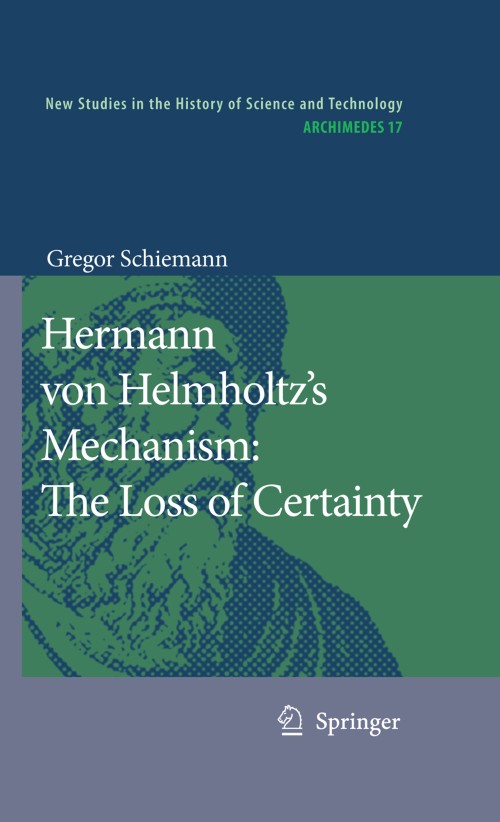
245 10|aHermann von Helmholtz’s Mechanism: The Loss of Certainty|h[electronic resource] :|bA Study on the Transition from Classical to Modern Philosophy of Nature /|cby Gregor Schiemann.
250 |a1st ed. 2009.
264 1|aDordrecht :|bSpringer Netherlands :|bImprint: Springer,|c2009.
300 |aX, 284 p.|bonline resource.
336 |atext|btxt|2rdacontent
337 |acomputer|bc|2rdamedia
338 |aonline resource|bcr|2rdacarrier
347 |atext file|bPDF|2rda
490 1 |aArchimedes, New Studies in the History and Philosophy of Science and Technology,|x2215-0064 ;|v17
505 0 |aMechanism Between the Classical and the Modern Conception of Science -- The Conception of Mechanism -- The Classical Conception of Science -- Three Traditions in Mechanism -- Contours of Modern Philosophy of Nature -- Helmholtz's Mechanism at the Dawn of Modernity -- Helmholtz, a Bildungsbürger, Scientist, and Research Strategist -- Helmholtz’s Classical Mechanism -- The Hypothetization of Helmholtz’s Mechanism -- Conditions and Causes for the Change in Helmholtz’s Conception of Science and Nature.
520 |aTwo seemingly contradictory tendencies have accompanied the development of the natural sciences in the past 150 years. On the one hand, the natural sciences have been instrumental in effecting a thoroughgoing transformation of social structures and have made a permanent impact on the conceptual world of human beings. This historical period has, on the other hand, also brought to light the merely hypothetical validity of scientific knowledge. As late as the middle of the 19th century the truth-pathos in the natural sciences was still unbroken. Yet in the succeeding years these claims to certain knowledge underwent a fundamental crisis. For scientists today, of course, the fact that their knowledge can possess only relative validity is a matter of self-evidence. The present analysis investigates the early phase of this fundamental change in the concept of science through an examination of Hermann von Helmholtz's conception of science and his mechanistic interpretation of nature. Helmholtz (1821-1894) was one of the most important natural scientists in Germany. The development of this thought offers an impressive but, until now, relatively little considered report from the field of the experimental sciences chronicling the erosion of certainty.
650 0|aPhilosophy, Modern.
650 0|aPhilosophy of nature.
650 0|aScience|xHistory.
650 0|aScience|xPhilosophy.
650 0|aPhysics|xPhilosophy.
650 14|aEarly Modern Philosophy.
650 24|aPhilosophy of Nature.
650 24|aHistory of Science.
650 24|aPhilosophy of Science.
650 24|aPhilosophical Foundations of Physics and Astronomy.
710 2 |aSpringerLink (Online service)
773 0 |tSpringer Nature eBook
776 08|iPrinted edition:|z9781402056291
776 08|iPrinted edition:|z9789048118397
776 08|iPrinted edition:|z9789048174133
830 0|aArchimedes, New Studies in the History and Philosophy of Science and Technology,|x2215-0064 ;|v17
856 40|uhttps://doi.org/10.1007/978-1-4020-5630-7
912 |aZDB-2-SHU
912 |aZDB-2-SXPR
950 |aHumanities, Social Sciences and Law (SpringerNature-11648)
950 |aPhilosophy and Religion (R0) (SpringerNature-43725)