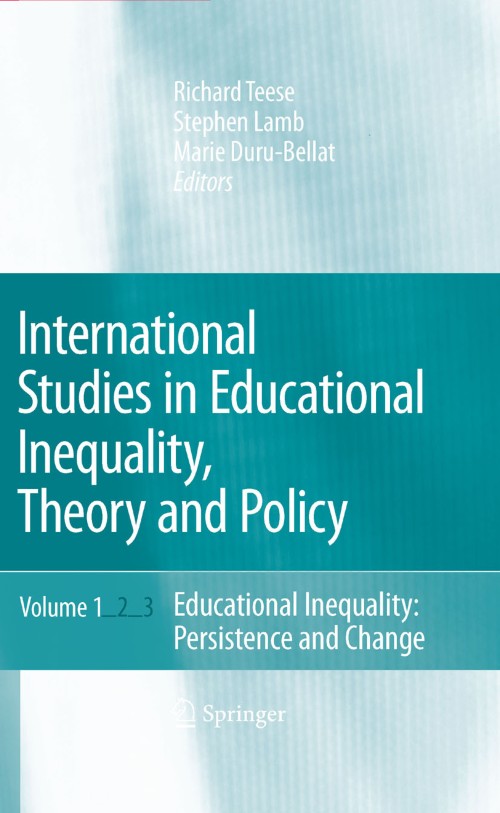
International Studies in Educational Inequality, Theory and Policy [electronic resource] / edited by Richard Teese, Stephen Lamb, Marie Duru-Bellat.
Erişim Adresi
ISBN
9781402059162
Dil Kodu
İngilizce
Yer Numarası
DK/8139
Basım Bildirimi
1st ed. 2007.
Yayın Bilgisi
Dordrecht : Springer Netherlands : Imprint: Springer, 2007.
Fiziksel Niteleme
LXIV, 941 p. online resource.
İçindekiler Notu
Time and Space in the Reproduction of Educational Inequality -- Equality of Educational Opportunity A 40 Year Retrospective -- Social Inequalities and Education Policy in England -- Achievement Gaps Among Racial-Ethnic Groups in the United States -- Accessible and Effective Education -- Gender and Education -- Education Equality Indicators in the Nations of the European Union -- An Insoluble Problem? -- Realities and Prospects for Public Education in a Context of Persistent Inequalities -- Social Disparities in Education in Sub-Saharan African Countries -- Education Inequality and Indigenous Australians -- Social Inequality in French Education Extent and Complexity of the Issues* -- First- and Second-Generation School Segregation and the Maintenance of Educational Inequality -- Structural Inequality in Australian Education -- Distinction, Representation and Identities among Middle Class Fractions in London -- Education and Social Selection in Italy -- An Assessment of Educational Equity and Policy in Spain -- Equality in Educational Policy -- Educational Inequality in Russia -- School Achievement in Italy -- Persistent Inequalities in Uruguayan Primary Education 1996 – 2002 -- Education Feminism, Gender Equality and School Reform in Late Twentieth Century England -- The Lagging Participation of Girls and Women in Maths and Science Education -- In the End is the Beginning -- Rurality and Inequality in Education -- Transforming School Education in China to a Mass System: Progress and Challenges -- School Reform and Inequality in Urban Australia -- Education Markets and Social Class Inequality -- The Effects of Generalised School Choice on Achievement and Stratification -- Taking Local Contexts More Seriously -- Understanding and Addressing Achievement Gaps During the First Four Years of School inthe United States -- The Development of Vocational Programs in Secondary Schools -- Reducing Inequality in an Age of Student Mobility -- Equality and Policy -- Walking The Tightrope -- Making Education More Equitable -- Educational Inequality in the Netherlands -- What Makes for Fair Schooling? -- Social Inequalities in Education.
Özet, vb.
Inequality is a marked and persistent feature of education systems, both in the developed and the developing worlds. Major gaps in opportunity and in outcomes have become more critical than in the past, thanks to the knowledge economy and globalization. More and more populations, both rich and poor depend on successful use of school and on gaining post-school qualifications. But access to high-quality schooling, success at school, and chances of higher education all remain socially divided, with implications for economic opportunities, personal growth, and civic and community development. What causes these divisions in how education systems work? Have decades of public investment brought about at least some improvements, even if major gaps remain? If not, what are the barriers, the social processes which have frustrated the efforts of government? The pursuit of equity as a goal of public policy is examined in this book through a series of national case-studies, covering many different global contexts from the wealthiest to some of the poorest nations on earth. What have we learnt from the policy experience globally? Do we know more today than yesterday about the origins of social inequality? Are our policies better framed, better designed to tackle inequality? And which way forward? What does the evidence suggest in terms of future approaches and emphasis? This work is published in three volumes which together form a 3-volume set.
Konu
International education .
Comparative education.
Education and state.
Educational sociology.
School management and organization.
School administration.
International and Comparative Education.
Educational Policy and Politics.
Sociology of Education.
Organization and Leadership.
Comparative education.
Education and state.
Educational sociology.
School management and organization.
School administration.
International and Comparative Education.
Educational Policy and Politics.
Sociology of Education.
Organization and Leadership.
Diğer Yazarlar
Kurum Adı

Eseri Alıntıla
Referansları kullanmadan önce gözden geçirmeniz ve varsa gerekli düzeltmeleri yapmanız önerilir.
Dijital Kaynak
MARC Görünümü
LEADER 05777nam a22005895i 4500
001 806845
003 TR_AnAIT
005 20260127002933
007 cr nn 008mamaa
008 120201s2007 ne | s |||| 0|eng d
020 |a9781402059162|9978-1-4020-5916-2
024 7 |a10.1007/978-1-4020-5916-2|2doi
041 |aeng
049 |aTürk Tarih Kurumu Kütüphanesi
050 4|aLB43
050 4|aLC1090
072 7|aJN|2bicssc
072 7|aEDU043000|2bisacsh
072 7|aJND|2thema
082 04|a370.116|223
082 04|a370.9|223
090 |aDK/8139
245 10|aInternational Studies in Educational Inequality, Theory and Policy|h[electronic resource] /|cedited by Richard Teese, Stephen Lamb, Marie Duru-Bellat.
250 |a1st ed. 2007.
264 1|aDordrecht :|bSpringer Netherlands :|bImprint: Springer,|c2007.
300 |aLXIV, 941 p.|bonline resource.
336 |atext|btxt|2rdacontent
337 |acomputer|bc|2rdamedia
338 |aonline resource|bcr|2rdacarrier
347 |atext file|bPDF|2rda
505 0 |aTime and Space in the Reproduction of Educational Inequality -- Equality of Educational Opportunity A 40 Year Retrospective -- Social Inequalities and Education Policy in England -- Achievement Gaps Among Racial-Ethnic Groups in the United States -- Accessible and Effective Education -- Gender and Education -- Education Equality Indicators in the Nations of the European Union -- An Insoluble Problem? -- Realities and Prospects for Public Education in a Context of Persistent Inequalities -- Social Disparities in Education in Sub-Saharan African Countries -- Education Inequality and Indigenous Australians -- Social Inequality in French Education Extent and Complexity of the Issues* -- First- and Second-Generation School Segregation and the Maintenance of Educational Inequality -- Structural Inequality in Australian Education -- Distinction, Representation and Identities among Middle Class Fractions in London -- Education and Social Selection in Italy -- An Assessment of Educational Equity and Policy in Spain -- Equality in Educational Policy -- Educational Inequality in Russia -- School Achievement in Italy -- Persistent Inequalities in Uruguayan Primary Education 1996 – 2002 -- Education Feminism, Gender Equality and School Reform in Late Twentieth Century England -- The Lagging Participation of Girls and Women in Maths and Science Education -- In the End is the Beginning -- Rurality and Inequality in Education -- Transforming School Education in China to a Mass System: Progress and Challenges -- School Reform and Inequality in Urban Australia -- Education Markets and Social Class Inequality -- The Effects of Generalised School Choice on Achievement and Stratification -- Taking Local Contexts More Seriously -- Understanding and Addressing Achievement Gaps During the First Four Years of School inthe United States -- The Development of Vocational Programs in Secondary Schools -- Reducing Inequality in an Age of Student Mobility -- Equality and Policy -- Walking The Tightrope -- Making Education More Equitable -- Educational Inequality in the Netherlands -- What Makes for Fair Schooling? -- Social Inequalities in Education.
520 |aInequality is a marked and persistent feature of education systems, both in the developed and the developing worlds. Major gaps in opportunity and in outcomes have become more critical than in the past, thanks to the knowledge economy and globalization. More and more populations, both rich and poor depend on successful use of school and on gaining post-school qualifications. But access to high-quality schooling, success at school, and chances of higher education all remain socially divided, with implications for economic opportunities, personal growth, and civic and community development. What causes these divisions in how education systems work? Have decades of public investment brought about at least some improvements, even if major gaps remain? If not, what are the barriers, the social processes which have frustrated the efforts of government? The pursuit of equity as a goal of public policy is examined in this book through a series of national case-studies, covering many different global contexts from the wealthiest to some of the poorest nations on earth. What have we learnt from the policy experience globally? Do we know more today than yesterday about the origins of social inequality? Are our policies better framed, better designed to tackle inequality? And which way forward? What does the evidence suggest in terms of future approaches and emphasis? This work is published in three volumes which together form a 3-volume set.
650 0|aInternational education .
650 0|aComparative education.
650 0|aEducation and state.
650 0|aEducational sociology.
650 0|aSchool management and organization.
650 0|aSchool administration.
650 14|aInternational and Comparative Education.
650 24|aEducational Policy and Politics.
650 24|aSociology of Education.
650 24|aOrganization and Leadership.
700 1 |aTeese, Richard.|eeditor.|4edt|4http://id.loc.gov/vocabulary/relators/edt
700 1 |aLamb, Stephen.|eeditor.|4edt|4http://id.loc.gov/vocabulary/relators/edt
700 1 |aDuru-Bellat, Marie.|eeditor.|4edt|4http://id.loc.gov/vocabulary/relators/edt
710 2 |aSpringerLink (Online service)
773 0 |tSpringer Nature eBook
776 08|iPrinted edition:|z9781402059155
776 08|iPrinted edition:|z9789048112777
776 08|iPrinted edition:|z9789402404692
856 40|uhttps://doi.org/10.1007/978-1-4020-5916-2
912 |aZDB-2-SHU
912 |aZDB-2-SXED
950 |aHumanities, Social Sciences and Law (SpringerNature-11648)
950 |aEducation (R0) (SpringerNature-43721)
001 806845
003 TR_AnAIT
005 20260127002933
007 cr nn 008mamaa
008 120201s2007 ne | s |||| 0|eng d
020 |a9781402059162|9978-1-4020-5916-2
024 7 |a10.1007/978-1-4020-5916-2|2doi
041 |aeng
049 |aTürk Tarih Kurumu Kütüphanesi
050 4|aLB43
050 4|aLC1090
072 7|aJN|2bicssc
072 7|aEDU043000|2bisacsh
072 7|aJND|2thema
082 04|a370.116|223
082 04|a370.9|223
090 |aDK/8139
245 10|aInternational Studies in Educational Inequality, Theory and Policy|h[electronic resource] /|cedited by Richard Teese, Stephen Lamb, Marie Duru-Bellat.
250 |a1st ed. 2007.
264 1|aDordrecht :|bSpringer Netherlands :|bImprint: Springer,|c2007.
300 |aLXIV, 941 p.|bonline resource.
336 |atext|btxt|2rdacontent
337 |acomputer|bc|2rdamedia
338 |aonline resource|bcr|2rdacarrier
347 |atext file|bPDF|2rda
505 0 |aTime and Space in the Reproduction of Educational Inequality -- Equality of Educational Opportunity A 40 Year Retrospective -- Social Inequalities and Education Policy in England -- Achievement Gaps Among Racial-Ethnic Groups in the United States -- Accessible and Effective Education -- Gender and Education -- Education Equality Indicators in the Nations of the European Union -- An Insoluble Problem? -- Realities and Prospects for Public Education in a Context of Persistent Inequalities -- Social Disparities in Education in Sub-Saharan African Countries -- Education Inequality and Indigenous Australians -- Social Inequality in French Education Extent and Complexity of the Issues* -- First- and Second-Generation School Segregation and the Maintenance of Educational Inequality -- Structural Inequality in Australian Education -- Distinction, Representation and Identities among Middle Class Fractions in London -- Education and Social Selection in Italy -- An Assessment of Educational Equity and Policy in Spain -- Equality in Educational Policy -- Educational Inequality in Russia -- School Achievement in Italy -- Persistent Inequalities in Uruguayan Primary Education 1996 – 2002 -- Education Feminism, Gender Equality and School Reform in Late Twentieth Century England -- The Lagging Participation of Girls and Women in Maths and Science Education -- In the End is the Beginning -- Rurality and Inequality in Education -- Transforming School Education in China to a Mass System: Progress and Challenges -- School Reform and Inequality in Urban Australia -- Education Markets and Social Class Inequality -- The Effects of Generalised School Choice on Achievement and Stratification -- Taking Local Contexts More Seriously -- Understanding and Addressing Achievement Gaps During the First Four Years of School inthe United States -- The Development of Vocational Programs in Secondary Schools -- Reducing Inequality in an Age of Student Mobility -- Equality and Policy -- Walking The Tightrope -- Making Education More Equitable -- Educational Inequality in the Netherlands -- What Makes for Fair Schooling? -- Social Inequalities in Education.
520 |aInequality is a marked and persistent feature of education systems, both in the developed and the developing worlds. Major gaps in opportunity and in outcomes have become more critical than in the past, thanks to the knowledge economy and globalization. More and more populations, both rich and poor depend on successful use of school and on gaining post-school qualifications. But access to high-quality schooling, success at school, and chances of higher education all remain socially divided, with implications for economic opportunities, personal growth, and civic and community development. What causes these divisions in how education systems work? Have decades of public investment brought about at least some improvements, even if major gaps remain? If not, what are the barriers, the social processes which have frustrated the efforts of government? The pursuit of equity as a goal of public policy is examined in this book through a series of national case-studies, covering many different global contexts from the wealthiest to some of the poorest nations on earth. What have we learnt from the policy experience globally? Do we know more today than yesterday about the origins of social inequality? Are our policies better framed, better designed to tackle inequality? And which way forward? What does the evidence suggest in terms of future approaches and emphasis? This work is published in three volumes which together form a 3-volume set.
650 0|aInternational education .
650 0|aComparative education.
650 0|aEducation and state.
650 0|aEducational sociology.
650 0|aSchool management and organization.
650 0|aSchool administration.
650 14|aInternational and Comparative Education.
650 24|aEducational Policy and Politics.
650 24|aSociology of Education.
650 24|aOrganization and Leadership.
700 1 |aTeese, Richard.|eeditor.|4edt|4http://id.loc.gov/vocabulary/relators/edt
700 1 |aLamb, Stephen.|eeditor.|4edt|4http://id.loc.gov/vocabulary/relators/edt
700 1 |aDuru-Bellat, Marie.|eeditor.|4edt|4http://id.loc.gov/vocabulary/relators/edt
710 2 |aSpringerLink (Online service)
773 0 |tSpringer Nature eBook
776 08|iPrinted edition:|z9781402059155
776 08|iPrinted edition:|z9789048112777
776 08|iPrinted edition:|z9789402404692
856 40|uhttps://doi.org/10.1007/978-1-4020-5916-2
912 |aZDB-2-SHU
912 |aZDB-2-SXED
950 |aHumanities, Social Sciences and Law (SpringerNature-11648)
950 |aEducation (R0) (SpringerNature-43721)
Materyaller
Depodan talep edilen materyal sadece kütüphane içerisinde kullanılmaktadır.
Materyal dışarıya ödünç verilmemektedir.
