LEADER 04352nam a22005895i 4500
001 806847
003 TR_AnAIT
005 20260127002936
007 cr nn 008mamaa
008 100301s2007 ne | s |||| 0|eng d
020 |a9781402060465|9978-1-4020-6046-5
024 7 |a10.1007/978-1-4020-6046-5|2doi
041 |aeng
049 |aTürk Tarih Kurumu Kütüphanesi
050 4|aP98-98.5
072 7|aCFX|2bicssc
072 7|aCOM073000|2bisacsh
072 7|aCFX|2thema
082 04|a410.285|223
090 |aDK/8141
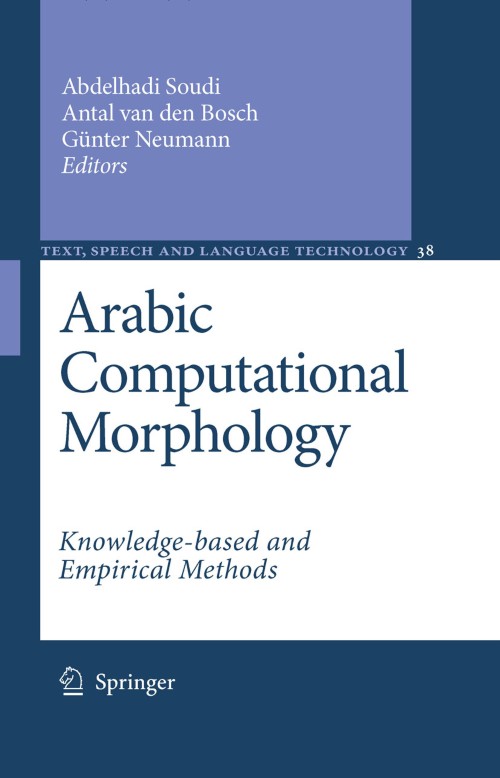
245 10|aArabic Computational Morphology|h[electronic resource] :|bKnowledge-based and Empirical Methods /|cedited by Abdelhadi Soudi, Antal van den Bosch, Günter Neumann.
250 |a1st ed. 2007.
264 1|aDordrecht :|bSpringer Netherlands :|bImprint: Springer,|c2007.
300 |aVIII, 308 p.|bonline resource.
336 |atext|btxt|2rdacontent
337 |acomputer|bc|2rdamedia
338 |aonline resource|bcr|2rdacarrier
347 |atext file|bPDF|2rda
490 1 |aText, Speech and Language Technology,|x2542-9388 ;|v38
505 0 |aArabic Computational Morphology: Knowledge-based and Empirical Methods -- On Arabic Transliteration -- Issues in Arabic Morphological Analysis -- Knowledge-Based Methods -- A Syllable-based Account of Arabic Morphology -- Inheritance-based Approach to Arabic Verbal Root-and-Pattern Morphology -- Arabic Computational Morphology: A Trade-off Between Multiple Operations and Multiple Stems -- Grammar-Lexis Relations in the Computational Morphology of Arabic -- Empirical Methods -- Learning to Identify Semitic Roots -- Automatic Processing of Modern Standard Arabic Text -- Supervised and Unsupervised Learning of Arabic Morphology -- Memory-based Morphological Analysis and Part-of-speech Tagging of Arabic -- Integration of Arabic Morphology in Larger Applications -- Light Stemming for Arabic Information Retrieval -- Adapting Morphology for Arabic Information Retrieval* -- Arabic Morphological Representations for Machine Translation -- Arabic Morphological Generation and its Impact on the Quality of Machine Translation to Arabic.
520 |aThe morphology of Arabic poses special challenges to computational natural language processing systems. The exceptional degree of ambiguity in the writing system, the rich morphology, and the highly complex word formation process of roots and patterns all contribute to making computational approaches to Arabic very challenging. Indeed many computational linguists across the world have taken up this challenge over time, and many of the researchers with a track record in this research area have contributed to this book. The book’s subtitle aims to reflect that widely different computational approaches to the Arabic morphological system have been proposed. These accounts fall into two main paradigms: the knowledge-based and the empirical. Since morphological knowledge plays an essential role in any higher-level understanding and processing of Arabic text, the book also features a part on the role of Arabic morphology in larger applications, i.e. Information Retrieval (IR) and Machine Translation (MT).
650 0|aComputational linguistics.
650 0|aLinguistics.
650 0|aOriental languages.
650 0|aNatural language processing (Computer science).
650 0|aInformation storage and retrieval systems.
650 14|aComputational Linguistics.
650 24|aLinguistics.
650 24|aOriental or Semitic Languages.
650 24|aNatural Language Processing (NLP).
650 24|aInformation Storage and Retrieval.
700 1 |aSoudi, Abdelhadi.|eeditor.|4edt|4http://id.loc.gov/vocabulary/relators/edt
700 1 |avan den Bosch, Antal.|eeditor.|4edt|4http://id.loc.gov/vocabulary/relators/edt
700 1 |aNeumann, Günter.|eeditor.|4edt|4http://id.loc.gov/vocabulary/relators/edt
710 2 |aSpringerLink (Online service)
773 0 |tSpringer Nature eBook
776 08|iPrinted edition:|z9781402060458
776 08|iPrinted edition:|z9789048113347
776 08|iPrinted edition:|z9789048175154
830 0|aText, Speech and Language Technology,|x2542-9388 ;|v38
856 40|uhttps://doi.org/10.1007/978-1-4020-6046-5
912 |aZDB-2-SHU
912 |aZDB-2-SXS
950 |aHumanities, Social Sciences and Law (SpringerNature-11648)
950 |aSocial Sciences (R0) (SpringerNature-43726)