LEADER 04288nam a22005895i 4500
001 806859
003 TR_AnAIT
005 20260127002953
007 cr nn 008mamaa
008 100301s2008 ne | s |||| 0|eng d
020 |a9781402065323|9978-1-4020-6532-3
024 7 |a10.1007/978-1-4020-6532-3|2doi
041 |aeng
049 |aTürk Tarih Kurumu Kütüphanesi
050 4|aBD143-237
072 7|aHPK|2bicssc
072 7|aPHI004000|2bisacsh
072 7|aQDTK|2thema
082 04|a120|223
090 |aDK/8153
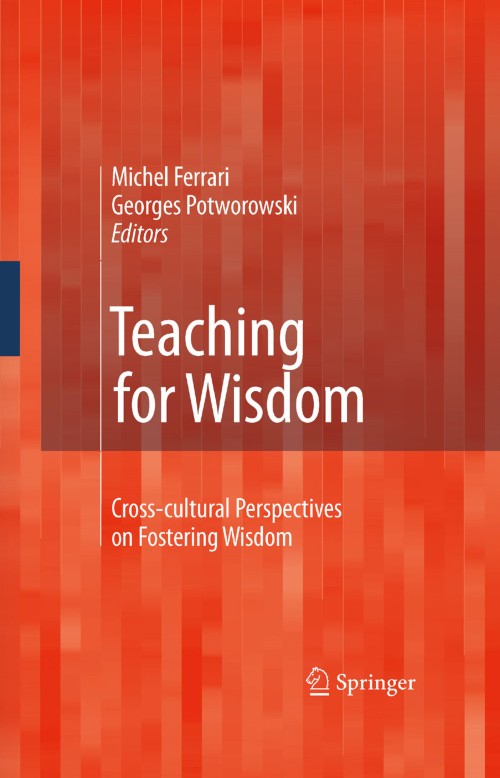
245 10|aTeaching for Wisdom|h[electronic resource] :|bCross-cultural Perspectives on Fostering Wisdom /|cedited by Michel Ferrari, Georges Potworowski.
250 |a1st ed. 2008.
264 1|aDordrecht :|bSpringer Netherlands :|bImprint: Springer,|c2008.
300 |aXII, 234 p.|bonline resource.
336 |atext|btxt|2rdacontent
337 |acomputer|bc|2rdamedia
338 |aonline resource|bcr|2rdacarrier
347 |atext file|bPDF|2rda
505 0 |aFostering Wisdom as Expertise -- Fostering Wisdom: A Psychological Perspective -- Teaching for Wisdom Through History: Infusing Wise Thinking Skills in the School Curriculum -- The Cultivation of Character Strengths -- Wisdom in Elementary School -- Master Zhu’s Wisdom -- Teaching for Wisdom as Personal Transformation -- Wisdom and Learning to Be Wise in Chinese Mahayana Buddhism -- Beginner’s Mind: Paths to the Wisdom that is Not Learned -- Ascending to Wisdom: A Christian Pedagogy -- Learning from Wise People -- The Wisdom of Plato’s Phaedo -- Can Wisdom Be Taught? Kant, Sage Philosophy, and Ethnographic Reflections from the Swahili Coast -- Conclusion -- Developing Expert and Transformative Wisdom: Can Either Be Taught in Public Schools? -- Sophia’s World: Episodes from the History of Wisdom.
520 |aWisdom is valued as an ideal aim of personal development around the world. But we rarely see how wisdom is understood in different religious and philosophical traditions and different scientific disciplines, and more particularly how wisdom is taught. The emphasis of the book is on whether wisdom can be taught, not on what wisdom is, making it both more practical and more personally engaging. More specifically, it considers how people at different times and places have engaged the age-old question of how (or whether) we can learn to live a good life, and what that life is like. The chapters in this book area welcome introduction to this vast field from a variety of different perspectives. Chapters consider Greek and Confucian philosophy, Christian, Islamic and Buddhist religion, African tradition, as well as contemporary scientific approaches to the study of wisdom. Authors of each chapter are leading scholars in their respective fields, and representing a range of disciplines including philosophy, psychology, anthropology, and religion. Chapters are written to be accessible to a broad audience, not specialists. The book hopes to open a dialogue between experts in various fields about the complex and fascinating topic of wisdom and how it is understood, both historically and personally as a transformative force within people’s lives.
650 0|aKnowledge, Theory of.
650 0|aEducational sociology.
650 0|aEducation|xPhilosophy.
650 0|aInternational education .
650 0|aComparative education.
650 0|aEducational psychology.
650 0|aPhilosophy of mind.
650 14|aEpistemology.
650 24|aSociology of Education.
650 24|aPhilosophy of Education.
650 24|aInternational and Comparative Education.
650 24|aEducational Psychology.
650 24|aPhilosophy of Mind.
700 1 |aFerrari, Michel.|eeditor.|4edt|4http://id.loc.gov/vocabulary/relators/edt
700 1 |aPotworowski, Georges.|eeditor.|4edt|4http://id.loc.gov/vocabulary/relators/edt
710 2 |aSpringerLink (Online service)
773 0 |tSpringer Nature eBook
776 08|iPrinted edition:|z9781402065316
776 08|iPrinted edition:|z9789048118816
776 08|iPrinted edition:|z9789048176601
856 40|uhttps://doi.org/10.1007/978-1-4020-6532-3
912 |aZDB-2-SHU
912 |aZDB-2-SXPR
950 |aHumanities, Social Sciences and Law (SpringerNature-11648)
950 |aPhilosophy and Religion (R0) (SpringerNature-43725)