LEADER 04241nam a22005655i 4500
001 806861
003 TR_AnAIT
005 20260127002955
007 cr nn 008mamaa
008 100604s2007 ne | s |||| 0|eng d
020 |a9781402067464|9978-1-4020-6746-4
024 7 |a10.1007/978-1-4020-6746-4|2doi
041 |aeng
049 |aTürk Tarih Kurumu Kütüphanesi
050 4|aH1-99
050 4|aAZ19.2-999
072 7|aGT|2bicssc
072 7|aNON000000|2bisacsh
072 7|aGT|2thema
082 04|a300|223
082 04|a001.3|223
090 |aDK/8155
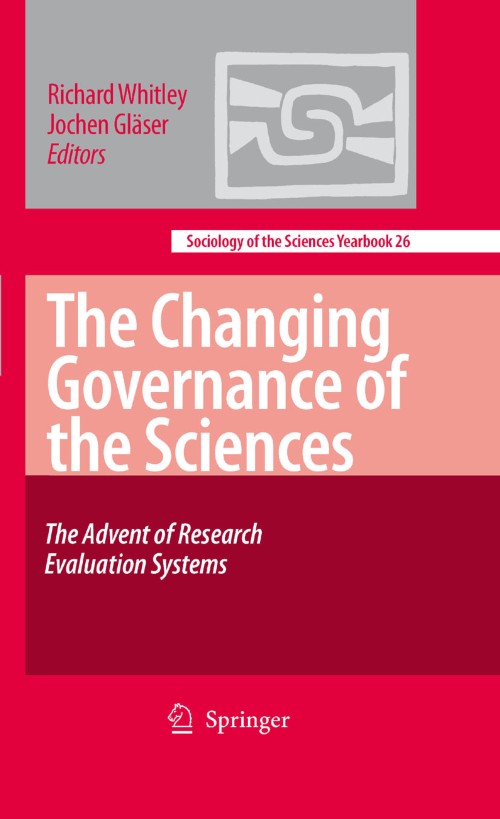
245 14|aThe Changing Governance of the Sciences|h[electronic resource] :|bThe Advent of Research Evaluation Systems /|cedited by Richard Whitley, Jochen Gläser.
250 |a1st ed. 2007.
264 1|aDordrecht :|bSpringer Netherlands :|bImprint: Springer,|c2007.
300 |aXIV, 166 p.|bonline resource.
336 |atext|btxt|2rdacontent
337 |acomputer|bc|2rdamedia
338 |aonline resource|bcr|2rdacarrier
347 |atext file|bPDF|2rda
490 1 |aSociology of the Sciences Yearbook,|x2215-1796 ;|v26
505 0 |aChanging Governance of the Public Sciences -- Universities as Strategic Actors: State Delegation and Changing Patterns of Evaluation -- The Visible Hand Versus The Invisible Hand -- Prospective And Retrospective Evaluation Systems In Context: Insights From Japan -- Elite Through Rankings – The Emergence Of the Enterprising University -- The Social Construction Of Bibliometric Evaluations -- Weak and Strong Research Evaluation Systems -- Evaluation Without Evaluators -- The Basic State of Research in Germany: Conditions of Knowledge Production Pre-Evaluation -- Research Evaluation as Organisational Development -- Interfering Governance and Emerging Centres of Control -- Research Evaluation in Transition -- Death By Peer Review? -- Concluding Reflections -- The Social Orders of Research Evaluation Systems.
520 |aThe establishment of national systems of retrospective research evaluations is one of the most significant of recent changes in the governance of science. In many countries, state attempts to manage public science systems and improve their quality have triggered the institutionalisation of such systems, which vary greatly in their methods of assessing research performance, and consequences for universities. The contributions to this volume discuss, inter alia, the birth and development of research evaluation systems as well as the reasons for their absence in the United States, the responses by universities and academics to these new governance regimes, and their consequences for the production of scientific knowledge. By integrating new theoretical approaches with country studies and studies of general phenomena such as university rankings and bibliometric evaluations, the book shows how these novel state steering mechanisms are changing the organisation of scientific knowledge production and universities in different countries. In combining latest research and an overview of trends in the changing governance of research, the book is essential not only for scholars engaged in higher education research, science policy studies, and the sociology of science but also for policy makers and analysts from science policy and higher education policy as well as university managers and senior scientists. .
650 0|aSocial sciences.
650 0|aHumanities.
650 0|aSociology.
650 0|aPolitical science.
650 14|aHumanities and Social Sciences.
650 24|aSociology.
650 24|aPolitical Science.
700 1 |aWhitley, Richard.|eeditor.|4edt|4http://id.loc.gov/vocabulary/relators/edt
700 1 |aGläser, Jochen.|eeditor.|4edt|4http://id.loc.gov/vocabulary/relators/edt
710 2 |aSpringerLink (Online service)
773 0 |tSpringer Nature eBook
776 08|iPrinted edition:|z9781402067457
776 08|iPrinted edition:|z9789048115976
776 08|iPrinted edition:|z9789048177110
830 0|aSociology of the Sciences Yearbook,|x2215-1796 ;|v26
856 40|uhttps://doi.org/10.1007/978-1-4020-6746-4
912 |aZDB-2-SHU
912 |aZDB-2-SXH
950 |aHumanities, Social Sciences and Law (SpringerNature-11648)
950 |aHistory (R0) (SpringerNature-43722)