

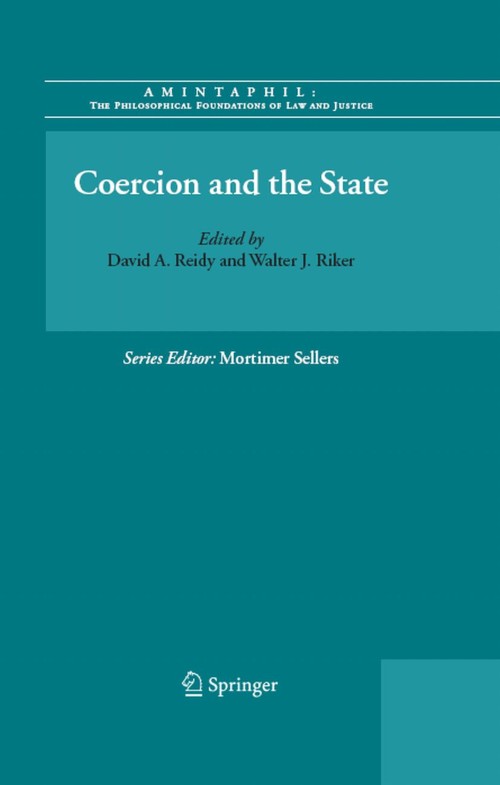
Coercion and the State [electronic resource] / edited by David A. Reidy, Walter J. Riker.
Erişim Adresi
ISBN
9781402068799
Dil Kodu
İngilizce
Yer Numarası
DK/8157
Basım Bildirimi
1st ed. 2008.
Yayın Bilgisi
Dordrecht : Springer Netherlands : Imprint: Springer, 2008.
Fiziksel Niteleme
XI, 259 p. online resource.
Dizi
AMINTAPHIL: The Philosophical Foundations of Law and Justice, 2351-9851 ; 2
İçindekiler Notu
What is Coercion? -- How Did There Come To Be Two Kinds of Coercion? -- On Coercion -- Undue Influence as Coercive Offers in Clinical Trials -- Coercion and the State: Justification and Limits -- Coercion, Justice, and Democracy -- Democratic Legitimacy and the Reasoned Will of the People -- John Brown's Duties: Obligation, Violence, and ‘Natural Duty’ -- Coercion and the State: Legal Powers and Status -- Coercion, Neutrality, and Same-Sex Marriage -- The Cheshire Cat: Same-Sex Marriage, Religion, and Coercion by Exclusion -- Coercion and the State: National Security -- Indefinite Detention for Mega-Terrorists? -- The Great Right: Habeas Corpus -- Coercion and the International Order -- Coercion Abroad for the Protection of Rights -- Transnational Power, Coercion, and Democracy -- A Developmental Approach to the Legitimacy of Global Governance Institutions -- Global Economic Justice, Partiality, and Coercion -- International and Cosmopolitan Political Obligations.
Özet, vb.
A signal feature of legal and political institutions is that they exercise coercive power. The essays in this volume examine institutional coercion with the aim of trying to understand its nature, justification and limits. Included are essays that take a fresh look at perennial questions – what, if anything, can legitimate state exercises of coercive force? What is coercion in politics and law? – and essays that take a first or nearly first look at newer questions – may the state coercively hold certain terrorists indefinitely? Does the state coerce those seeking to join in same-sex marriage when it refuses to extend legal recognition to same-sex marriage? Can there be a just international order without some agency possessed of the final and rightful authority to coerce states? Leading scholars from philosophy, political science and law examine these and related questions shedding new light on an apparently inescapable feature of political and legal life: Coercion. "The topic of coercion stands among the foundational concepts of political and legal philosophy, yet it is rarely scrutinized. This volume fills in the gap by providing an in-depth discussion of the nature and justification of coercion in matters ranging from state authority and democratic legitimacy to national security and human rights. Authored by an impressive group of philosophers and legal theorists, the chapters explore these vital issues from a wide variety of perspectives, with admirable clarity and sharply contested arguments. The book constitutes an important contribution to our understanding of the normative and institutional issues of coercion in both the domestic and international order." Deen Chatterjee, University of Utah.
Konu
Law.
Political science __ Philosophy.
Law __ Philosophy.
Law __ History.
Ethics.
Political science.
Law.
Political Philosophy.
Theories of Law, Philosophy of Law, Legal History.
Moral Philosophy and Applied Ethics.
Political Science.
Philosophy of Law.
Political science __ Philosophy.
Law __ Philosophy.
Law __ History.
Ethics.
Political science.
Law.
Political Philosophy.
Theories of Law, Philosophy of Law, Legal History.
Moral Philosophy and Applied Ethics.
Political Science.
Philosophy of Law.
Diğer Yazarlar
Kurum Adı
Eseri Alıntıla
Referansları kullanmadan önce gözden geçirmeniz ve varsa gerekli düzeltmeleri yapmanız önerilir.
Dijital Kaynak
MARC Görünümü
LEADER 04872nam a22006015i 4500
001 806863
003 TR_AnAIT
005 20260127002958
007 cr nn 008mamaa
008 100301s2008 ne | s |||| 0|eng d
020 |a9781402068799|9978-1-4020-6879-9
024 7 |a10.1007/978-1-4020-6879-9|2doi
041 |aeng
049 |aTürk Tarih Kurumu Kütüphanesi
050 4|aK1-7720
072 7|aL|2bicssc
072 7|aLAW000000|2bisacsh
072 7|aL|2thema
082 04|a340|223
090 |aDK/8157
245 10|aCoercion and the State|h[electronic resource] /|cedited by David A. Reidy, Walter J. Riker.
250 |a1st ed. 2008.
264 1|aDordrecht :|bSpringer Netherlands :|bImprint: Springer,|c2008.
300 |aXI, 259 p.|bonline resource.
336 |atext|btxt|2rdacontent
337 |acomputer|bc|2rdamedia
338 |aonline resource|bcr|2rdacarrier
347 |atext file|bPDF|2rda
490 1 |aAMINTAPHIL: The Philosophical Foundations of Law and Justice,|x2351-9851 ;|v2
505 0 |aWhat is Coercion? -- How Did There Come To Be Two Kinds of Coercion? -- On Coercion -- Undue Influence as Coercive Offers in Clinical Trials -- Coercion and the State: Justification and Limits -- Coercion, Justice, and Democracy -- Democratic Legitimacy and the Reasoned Will of the People -- John Brown's Duties: Obligation, Violence, and ‘Natural Duty’ -- Coercion and the State: Legal Powers and Status -- Coercion, Neutrality, and Same-Sex Marriage -- The Cheshire Cat: Same-Sex Marriage, Religion, and Coercion by Exclusion -- Coercion and the State: National Security -- Indefinite Detention for Mega-Terrorists? -- The Great Right: Habeas Corpus -- Coercion and the International Order -- Coercion Abroad for the Protection of Rights -- Transnational Power, Coercion, and Democracy -- A Developmental Approach to the Legitimacy of Global Governance Institutions -- Global Economic Justice, Partiality, and Coercion -- International and Cosmopolitan Political Obligations.
520 |aA signal feature of legal and political institutions is that they exercise coercive power. The essays in this volume examine institutional coercion with the aim of trying to understand its nature, justification and limits. Included are essays that take a fresh look at perennial questions – what, if anything, can legitimate state exercises of coercive force? What is coercion in politics and law? – and essays that take a first or nearly first look at newer questions – may the state coercively hold certain terrorists indefinitely? Does the state coerce those seeking to join in same-sex marriage when it refuses to extend legal recognition to same-sex marriage? Can there be a just international order without some agency possessed of the final and rightful authority to coerce states? Leading scholars from philosophy, political science and law examine these and related questions shedding new light on an apparently inescapable feature of political and legal life: Coercion. "The topic of coercion stands among the foundational concepts of political and legal philosophy, yet it is rarely scrutinized. This volume fills in the gap by providing an in-depth discussion of the nature and justification of coercion in matters ranging from state authority and democratic legitimacy to national security and human rights. Authored by an impressive group of philosophers and legal theorists, the chapters explore these vital issues from a wide variety of perspectives, with admirable clarity and sharply contested arguments. The book constitutes an important contribution to our understanding of the normative and institutional issues of coercion in both the domestic and international order." Deen Chatterjee, University of Utah.
650 0|aLaw.
650 0|aPolitical science|xPhilosophy.
650 0|aLaw|xPhilosophy.
650 0|aLaw|xHistory.
650 0|aEthics.
650 0|aPolitical science.
650 14|aLaw.
650 24|aPolitical Philosophy.
650 24|aTheories of Law, Philosophy of Law, Legal History.
650 24|aMoral Philosophy and Applied Ethics.
650 24|aPolitical Science.
650 24|aPhilosophy of Law.
700 1 |aReidy, David A.|eeditor.|4edt|4http://id.loc.gov/vocabulary/relators/edt
700 1 |aRiker, Walter J.|eeditor.|4edt|4http://id.loc.gov/vocabulary/relators/edt
710 2 |aSpringerLink (Online service)
773 0 |tSpringer Nature eBook
776 08|iPrinted edition:|z9781402068782
776 08|iPrinted edition:|z9789048116348
776 08|iPrinted edition:|z9789048177486
830 0|aAMINTAPHIL: The Philosophical Foundations of Law and Justice,|x2351-9851 ;|v2
856 40|uhttps://doi.org/10.1007/978-1-4020-6879-9
912 |aZDB-2-SHU
912 |aZDB-2-SXLC
950 |aHumanities, Social Sciences and Law (SpringerNature-11648)
950 |aLaw and Criminology (R0) (SpringerNature-43727)
001 806863
003 TR_AnAIT
005 20260127002958
007 cr nn 008mamaa
008 100301s2008 ne | s |||| 0|eng d
020 |a9781402068799|9978-1-4020-6879-9
024 7 |a10.1007/978-1-4020-6879-9|2doi
041 |aeng
049 |aTürk Tarih Kurumu Kütüphanesi
050 4|aK1-7720
072 7|aL|2bicssc
072 7|aLAW000000|2bisacsh
072 7|aL|2thema
082 04|a340|223
090 |aDK/8157
245 10|aCoercion and the State|h[electronic resource] /|cedited by David A. Reidy, Walter J. Riker.
250 |a1st ed. 2008.
264 1|aDordrecht :|bSpringer Netherlands :|bImprint: Springer,|c2008.
300 |aXI, 259 p.|bonline resource.
336 |atext|btxt|2rdacontent
337 |acomputer|bc|2rdamedia
338 |aonline resource|bcr|2rdacarrier
347 |atext file|bPDF|2rda
490 1 |aAMINTAPHIL: The Philosophical Foundations of Law and Justice,|x2351-9851 ;|v2
505 0 |aWhat is Coercion? -- How Did There Come To Be Two Kinds of Coercion? -- On Coercion -- Undue Influence as Coercive Offers in Clinical Trials -- Coercion and the State: Justification and Limits -- Coercion, Justice, and Democracy -- Democratic Legitimacy and the Reasoned Will of the People -- John Brown's Duties: Obligation, Violence, and ‘Natural Duty’ -- Coercion and the State: Legal Powers and Status -- Coercion, Neutrality, and Same-Sex Marriage -- The Cheshire Cat: Same-Sex Marriage, Religion, and Coercion by Exclusion -- Coercion and the State: National Security -- Indefinite Detention for Mega-Terrorists? -- The Great Right: Habeas Corpus -- Coercion and the International Order -- Coercion Abroad for the Protection of Rights -- Transnational Power, Coercion, and Democracy -- A Developmental Approach to the Legitimacy of Global Governance Institutions -- Global Economic Justice, Partiality, and Coercion -- International and Cosmopolitan Political Obligations.
520 |aA signal feature of legal and political institutions is that they exercise coercive power. The essays in this volume examine institutional coercion with the aim of trying to understand its nature, justification and limits. Included are essays that take a fresh look at perennial questions – what, if anything, can legitimate state exercises of coercive force? What is coercion in politics and law? – and essays that take a first or nearly first look at newer questions – may the state coercively hold certain terrorists indefinitely? Does the state coerce those seeking to join in same-sex marriage when it refuses to extend legal recognition to same-sex marriage? Can there be a just international order without some agency possessed of the final and rightful authority to coerce states? Leading scholars from philosophy, political science and law examine these and related questions shedding new light on an apparently inescapable feature of political and legal life: Coercion. "The topic of coercion stands among the foundational concepts of political and legal philosophy, yet it is rarely scrutinized. This volume fills in the gap by providing an in-depth discussion of the nature and justification of coercion in matters ranging from state authority and democratic legitimacy to national security and human rights. Authored by an impressive group of philosophers and legal theorists, the chapters explore these vital issues from a wide variety of perspectives, with admirable clarity and sharply contested arguments. The book constitutes an important contribution to our understanding of the normative and institutional issues of coercion in both the domestic and international order." Deen Chatterjee, University of Utah.
650 0|aLaw.
650 0|aPolitical science|xPhilosophy.
650 0|aLaw|xPhilosophy.
650 0|aLaw|xHistory.
650 0|aEthics.
650 0|aPolitical science.
650 14|aLaw.
650 24|aPolitical Philosophy.
650 24|aTheories of Law, Philosophy of Law, Legal History.
650 24|aMoral Philosophy and Applied Ethics.
650 24|aPolitical Science.
650 24|aPhilosophy of Law.
700 1 |aReidy, David A.|eeditor.|4edt|4http://id.loc.gov/vocabulary/relators/edt
700 1 |aRiker, Walter J.|eeditor.|4edt|4http://id.loc.gov/vocabulary/relators/edt
710 2 |aSpringerLink (Online service)
773 0 |tSpringer Nature eBook
776 08|iPrinted edition:|z9781402068782
776 08|iPrinted edition:|z9789048116348
776 08|iPrinted edition:|z9789048177486
830 0|aAMINTAPHIL: The Philosophical Foundations of Law and Justice,|x2351-9851 ;|v2
856 40|uhttps://doi.org/10.1007/978-1-4020-6879-9
912 |aZDB-2-SHU
912 |aZDB-2-SXLC
950 |aHumanities, Social Sciences and Law (SpringerNature-11648)
950 |aLaw and Criminology (R0) (SpringerNature-43727)
Materyaller
Depodan talep edilen materyal sadece kütüphane içerisinde kullanılmaktadır.
Materyal dışarıya ödünç verilmemektedir.
Materyal dışarıya ödünç verilmemektedir.
