

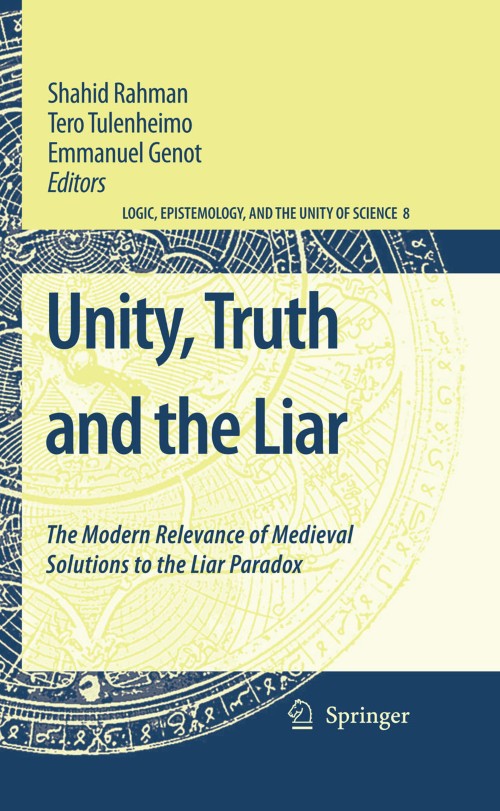
Unity, Truth and the Liar [electronic resource] : The Modern Relevance of Medieval Solutions to the Liar Paradox / edited by Shahid Rahman, Tero Tulenheimo, Emmanuel Genot.
Erişim Adresi
ISBN
9781402084683
Dil Kodu
İngilizce
Yer Numarası
DK/8165
Basım Bildirimi
1st ed. 2008.
Yayın Bilgisi
Dordrecht : Springer Netherlands : Imprint: Springer, 2008.
Fiziksel Niteleme
XXIV, 338 p. online resource.
Dizi
Logic, Epistemology, and the Unity of Science, 2214-9783 ; 8
İçindekiler Notu
Disputatio -- The Truth Schema and the Liar -- Read and Indirect Revenge -- Tarski's Hidden Theory of Meaning: Sentences Say Exactly One Thing -- Doubting Thomas: From Bradwardine Back to Anon -- Logic Without Truth -- Scheming and Lying -- Comments on Stephen Read's “The Truth-Schema and the Liar” -- Models for Liars in Bradwardine's Theory of Truth -- On a New Account of the Liar -- The Liar Cannot Be Solved -- Out of the Liar Tangle -- Read about T-Scheme -- Further Thoughts on Tarski's T-scheme and the Liar -- Historical Background: Restrictionism versus the Manifold Theory of Meaning -- Restrictionism: A Medieval Approach Revisited -- William Heytesbury and the Treatment of Insolubilia in Fourteenth-Century England Followed by a Critical Edition of Three Anonymous Treatises De Insolubilibus Inspired by Heytesbury.
Özet, vb.
The Liar Paradox challenges logicians’ and semanticists’ theories of truth and meaning. Modern accounts of paradoxes in formal semantics offer solutions through the hierarchy of object language and metalanguage. Yet this solution to the Liar presupposes that sentences have unique meaning. This assumption is non-controversial in formal languages, but an account of how “hidden meaning” is made explicit is necessary to any complete analysis of natural language. Since the Liar Paradox presents itself as a sentence uniting contradictory meanings, appreciating how they can be united in a single sentence may provide new insights into this and other paradoxes. This volume includes a target paper, taking up the challenge to revive, within a modern (formal) framework, a medieval solution to the Liar Paradox which did not assume Uniqueness of Meaning. Stephen Read, author of the target paper, attempts to formally state a theory of truth that dates back to the 14th century logician Thomas Bradwardine; the theory offers a solution to the Liar Paradox in which the Liar sentence turns out to be false. The rest of the volume consists of papers discussing and/or challenging Read’s – and Bradwardine’s -- views one the one hand, and papers addressing the doctrinal and historical background of medieval theories of truth on the other hand. It also includes a critical edition of Heytesbury’s treatise on insolubles, closely related to Bradwardine’s view. Including formal, philosophical and historical discussions, this volume intends to renew the debate about paradoxes and theory of truth, and to show that the interest of earlier medieval work is not merely historical but, on the contrary, still relevant for modern, formal semantic theory. It is of interest for both professional philosophers and advanced students of philosophy.
Konu
Logic.
Language and languages __ Philosophy.
Semiotics.
Philosophy, Medieval.
Logic.
Philosophy of Language.
Semiotics.
Medieval Philosophy.
Language and languages __ Philosophy.
Semiotics.
Philosophy, Medieval.
Logic.
Philosophy of Language.
Semiotics.
Medieval Philosophy.
Diğer Yazarlar
Kurum Adı
Eseri Alıntıla
Referansları kullanmadan önce gözden geçirmeniz ve varsa gerekli düzeltmeleri yapmanız önerilir.
Dijital Kaynak
MARC Görünümü
LEADER 04827nam a22005655i 4500
001 806871
003 TR_AnAIT
005 20260127003010
007 cr nn 008mamaa
008 100301s2008 ne | s |||| 0|eng d
020 |a9781402084683|9978-1-4020-8468-3
024 7 |a10.1007/978-1-4020-8468-3|2doi
041 |aeng
049 |aTürk Tarih Kurumu Kütüphanesi
050 4|aBC1-199
072 7|aHPL|2bicssc
072 7|aPHI011000|2bisacsh
072 7|aQDTL|2thema
082 04|a160|223
090 |aDK/8165
245 10|aUnity, Truth and the Liar|h[electronic resource] :|bThe Modern Relevance of Medieval Solutions to the Liar Paradox /|cedited by Shahid Rahman, Tero Tulenheimo, Emmanuel Genot.
250 |a1st ed. 2008.
264 1|aDordrecht :|bSpringer Netherlands :|bImprint: Springer,|c2008.
300 |aXXIV, 338 p.|bonline resource.
336 |atext|btxt|2rdacontent
337 |acomputer|bc|2rdamedia
338 |aonline resource|bcr|2rdacarrier
347 |atext file|bPDF|2rda
490 1 |aLogic, Epistemology, and the Unity of Science,|x2214-9783 ;|v8
505 0 |aDisputatio -- The Truth Schema and the Liar -- Read and Indirect Revenge -- Tarski's Hidden Theory of Meaning: Sentences Say Exactly One Thing -- Doubting Thomas: From Bradwardine Back to Anon -- Logic Without Truth -- Scheming and Lying -- Comments on Stephen Read's “The Truth-Schema and the Liar” -- Models for Liars in Bradwardine's Theory of Truth -- On a New Account of the Liar -- The Liar Cannot Be Solved -- Out of the Liar Tangle -- Read about T-Scheme -- Further Thoughts on Tarski's T-scheme and the Liar -- Historical Background: Restrictionism versus the Manifold Theory of Meaning -- Restrictionism: A Medieval Approach Revisited -- William Heytesbury and the Treatment of Insolubilia in Fourteenth-Century England Followed by a Critical Edition of Three Anonymous Treatises De Insolubilibus Inspired by Heytesbury.
520 |aThe Liar Paradox challenges logicians’ and semanticists’ theories of truth and meaning. Modern accounts of paradoxes in formal semantics offer solutions through the hierarchy of object language and metalanguage. Yet this solution to the Liar presupposes that sentences have unique meaning. This assumption is non-controversial in formal languages, but an account of how “hidden meaning” is made explicit is necessary to any complete analysis of natural language. Since the Liar Paradox presents itself as a sentence uniting contradictory meanings, appreciating how they can be united in a single sentence may provide new insights into this and other paradoxes. This volume includes a target paper, taking up the challenge to revive, within a modern (formal) framework, a medieval solution to the Liar Paradox which did not assume Uniqueness of Meaning. Stephen Read, author of the target paper, attempts to formally state a theory of truth that dates back to the 14th century logician Thomas Bradwardine; the theory offers a solution to the Liar Paradox in which the Liar sentence turns out to be false. The rest of the volume consists of papers discussing and/or challenging Read’s – and Bradwardine’s -- views one the one hand, and papers addressing the doctrinal and historical background of medieval theories of truth on the other hand. It also includes a critical edition of Heytesbury’s treatise on insolubles, closely related to Bradwardine’s view. Including formal, philosophical and historical discussions, this volume intends to renew the debate about paradoxes and theory of truth, and to show that the interest of earlier medieval work is not merely historical but, on the contrary, still relevant for modern, formal semantic theory. It is of interest for both professional philosophers and advanced students of philosophy.
650 0|aLogic.
650 0|aLanguage and languages|xPhilosophy.
650 0|aSemiotics.
650 0|aPhilosophy, Medieval.
650 14|aLogic.
650 24|aPhilosophy of Language.
650 24|aSemiotics.
650 24|aMedieval Philosophy.
700 1 |aRahman, Shahid.|eeditor.|4edt|4http://id.loc.gov/vocabulary/relators/edt
700 1 |aTulenheimo, Tero.|eeditor.|4edt|4http://id.loc.gov/vocabulary/relators/edt
700 1 |aGenot, Emmanuel.|eeditor.|4edt|4http://id.loc.gov/vocabulary/relators/edt
710 2 |aSpringerLink (Online service)
773 0 |tSpringer Nature eBook
776 08|iPrinted edition:|z9781402084676
776 08|iPrinted edition:|z9789048120109
776 08|iPrinted edition:|z9789048178889
830 0|aLogic, Epistemology, and the Unity of Science,|x2214-9783 ;|v8
856 40|uhttps://doi.org/10.1007/978-1-4020-8468-3
912 |aZDB-2-SHU
912 |aZDB-2-SXPR
950 |aHumanities, Social Sciences and Law (SpringerNature-11648)
950 |aPhilosophy and Religion (R0) (SpringerNature-43725)
001 806871
003 TR_AnAIT
005 20260127003010
007 cr nn 008mamaa
008 100301s2008 ne | s |||| 0|eng d
020 |a9781402084683|9978-1-4020-8468-3
024 7 |a10.1007/978-1-4020-8468-3|2doi
041 |aeng
049 |aTürk Tarih Kurumu Kütüphanesi
050 4|aBC1-199
072 7|aHPL|2bicssc
072 7|aPHI011000|2bisacsh
072 7|aQDTL|2thema
082 04|a160|223
090 |aDK/8165
245 10|aUnity, Truth and the Liar|h[electronic resource] :|bThe Modern Relevance of Medieval Solutions to the Liar Paradox /|cedited by Shahid Rahman, Tero Tulenheimo, Emmanuel Genot.
250 |a1st ed. 2008.
264 1|aDordrecht :|bSpringer Netherlands :|bImprint: Springer,|c2008.
300 |aXXIV, 338 p.|bonline resource.
336 |atext|btxt|2rdacontent
337 |acomputer|bc|2rdamedia
338 |aonline resource|bcr|2rdacarrier
347 |atext file|bPDF|2rda
490 1 |aLogic, Epistemology, and the Unity of Science,|x2214-9783 ;|v8
505 0 |aDisputatio -- The Truth Schema and the Liar -- Read and Indirect Revenge -- Tarski's Hidden Theory of Meaning: Sentences Say Exactly One Thing -- Doubting Thomas: From Bradwardine Back to Anon -- Logic Without Truth -- Scheming and Lying -- Comments on Stephen Read's “The Truth-Schema and the Liar” -- Models for Liars in Bradwardine's Theory of Truth -- On a New Account of the Liar -- The Liar Cannot Be Solved -- Out of the Liar Tangle -- Read about T-Scheme -- Further Thoughts on Tarski's T-scheme and the Liar -- Historical Background: Restrictionism versus the Manifold Theory of Meaning -- Restrictionism: A Medieval Approach Revisited -- William Heytesbury and the Treatment of Insolubilia in Fourteenth-Century England Followed by a Critical Edition of Three Anonymous Treatises De Insolubilibus Inspired by Heytesbury.
520 |aThe Liar Paradox challenges logicians’ and semanticists’ theories of truth and meaning. Modern accounts of paradoxes in formal semantics offer solutions through the hierarchy of object language and metalanguage. Yet this solution to the Liar presupposes that sentences have unique meaning. This assumption is non-controversial in formal languages, but an account of how “hidden meaning” is made explicit is necessary to any complete analysis of natural language. Since the Liar Paradox presents itself as a sentence uniting contradictory meanings, appreciating how they can be united in a single sentence may provide new insights into this and other paradoxes. This volume includes a target paper, taking up the challenge to revive, within a modern (formal) framework, a medieval solution to the Liar Paradox which did not assume Uniqueness of Meaning. Stephen Read, author of the target paper, attempts to formally state a theory of truth that dates back to the 14th century logician Thomas Bradwardine; the theory offers a solution to the Liar Paradox in which the Liar sentence turns out to be false. The rest of the volume consists of papers discussing and/or challenging Read’s – and Bradwardine’s -- views one the one hand, and papers addressing the doctrinal and historical background of medieval theories of truth on the other hand. It also includes a critical edition of Heytesbury’s treatise on insolubles, closely related to Bradwardine’s view. Including formal, philosophical and historical discussions, this volume intends to renew the debate about paradoxes and theory of truth, and to show that the interest of earlier medieval work is not merely historical but, on the contrary, still relevant for modern, formal semantic theory. It is of interest for both professional philosophers and advanced students of philosophy.
650 0|aLogic.
650 0|aLanguage and languages|xPhilosophy.
650 0|aSemiotics.
650 0|aPhilosophy, Medieval.
650 14|aLogic.
650 24|aPhilosophy of Language.
650 24|aSemiotics.
650 24|aMedieval Philosophy.
700 1 |aRahman, Shahid.|eeditor.|4edt|4http://id.loc.gov/vocabulary/relators/edt
700 1 |aTulenheimo, Tero.|eeditor.|4edt|4http://id.loc.gov/vocabulary/relators/edt
700 1 |aGenot, Emmanuel.|eeditor.|4edt|4http://id.loc.gov/vocabulary/relators/edt
710 2 |aSpringerLink (Online service)
773 0 |tSpringer Nature eBook
776 08|iPrinted edition:|z9781402084676
776 08|iPrinted edition:|z9789048120109
776 08|iPrinted edition:|z9789048178889
830 0|aLogic, Epistemology, and the Unity of Science,|x2214-9783 ;|v8
856 40|uhttps://doi.org/10.1007/978-1-4020-8468-3
912 |aZDB-2-SHU
912 |aZDB-2-SXPR
950 |aHumanities, Social Sciences and Law (SpringerNature-11648)
950 |aPhilosophy and Religion (R0) (SpringerNature-43725)
Materyaller
Depodan talep edilen materyal sadece kütüphane içerisinde kullanılmaktadır.
Materyal dışarıya ödünç verilmemektedir.
Materyal dışarıya ödünç verilmemektedir.
