LEADER 03738nam a22005895i 4500
001 806873
003 TR_AnAIT
005 20260127003012
007 cr nn 008mamaa
008 100301s2008 ne | s |||| 0|eng d
020 |a9781402086991|9978-1-4020-8699-1
024 7 |a10.1007/978-1-4020-8699-1|2doi
041 |aeng
049 |aTürk Tarih Kurumu Kütüphanesi
050 4|aQ174-175.3
050 4|aB67
072 7|aPDA|2bicssc
072 7|aSCI075000|2bisacsh
072 7|aPDA|2thema
082 04|a501|223
090 |aDK/8167
100 1 |aPeterson, Martin.|eauthor.|4aut|4http://id.loc.gov/vocabulary/relators/aut
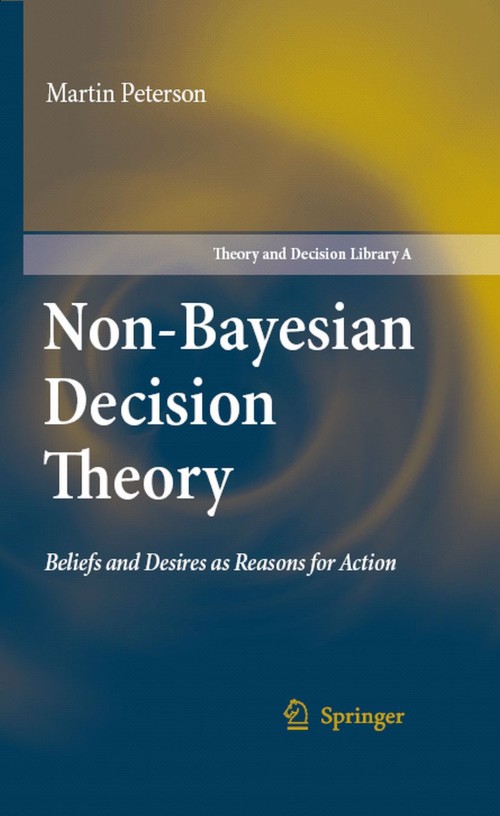
245 10|aNon-Bayesian Decision Theory|h[electronic resource] :|bBeliefs and Desires as Reasons for Action /|cby Martin Peterson.
250 |a1st ed. 2008.
264 1|aDordrecht :|bSpringer Netherlands :|bImprint: Springer,|c2008.
300 |aVIII, 170 p.|bonline resource.
336 |atext|btxt|2rdacontent
337 |acomputer|bc|2rdamedia
338 |aonline resource|bcr|2rdacarrier
347 |atext file|bPDF|2rda
490 1 |aTheory and Decision Library A:, Rational Choice in Practical Philosophy and Philosophy of Science,|x2352-2119 ;|v44
505 0 |aBayesian decision theory -- Choosing what to decide -- Indeterminate preferences -- Utility -- Subjective probability -- Expected utility -- Risk aversion.
520 |aThis book aims to present an account of rational choice from a non-Bayesian point of view. Rational agents maximize subjective expected utility, but contrary to what is claimed by Bayesians, the author argues that utility and subjective probability should not be defined in terms of preferences over uncertain prospects. To some extent, the author’s non-Bayesian view gives a modern account of what decision theory could have been like, had decision theorists not entered the Bayesian path discovered by Ramsey, Savage, and Jeffrey. The author argues that traditional Bayesian decision theory is unavailing from an action-guiding perspective. For the deliberating Bayesian agent, the output of decision theory is not a set of preferences over alternative acts - these preferences are on the contrary used as input to the theory. Instead, the output is a (set of) utility function(s) that can be used for describing the agent as an expected utility maximizer, which are of limited normative relevance.On the non-Bayesian view articulated by the author, utility and probability are defined in terms of preferences over certain outcomes. These utility and probability functions are then used for generating preferences over uncertain prospects, which conform to the principle of maximizing expected utility. It is argued that this approach offers more action guidance.
650 0|aScience|xPhilosophy.
650 0|aOperations research.
650 0|aComputer science|xMathematics.
650 0|aMathematical statistics.
650 0|aGame theory.
650 0|aEconometrics.
650 14|aPhilosophy of Science.
650 24|aOperations Research and Decision Theory.
650 24|aProbability and Statistics in Computer Science.
650 24|aGame Theory.
650 24|aQuantitative Economics.
710 2 |aSpringerLink (Online service)
773 0 |tSpringer Nature eBook
776 08|iPrinted edition:|z9781402086984
776 08|iPrinted edition:|z9789048121090
776 08|iPrinted edition:|z9789048179572
830 0|aTheory and Decision Library A:, Rational Choice in Practical Philosophy and Philosophy of Science,|x2352-2119 ;|v44
856 40|uhttps://doi.org/10.1007/978-1-4020-8699-1
912 |aZDB-2-SHU
912 |aZDB-2-SXPR
950 |aHumanities, Social Sciences and Law (SpringerNature-11648)
950 |aPhilosophy and Religion (R0) (SpringerNature-43725)