LEADER 04205nam a22006135i 4500
001 806877
003 TR_AnAIT
005 20260127003016
007 cr nn 008mamaa
008 100301s2009 ne | s |||| 0|eng d
020 |a9781402093746|9978-1-4020-9374-6
024 7 |a10.1007/978-1-4020-9374-6|2doi
041 |aeng
049 |aTürk Tarih Kurumu Kütüphanesi
050 4|aBC1-199
072 7|aHPL|2bicssc
072 7|aPHI011000|2bisacsh
072 7|aQDTL|2thema
082 04|a160|223
090 |aDK/8171
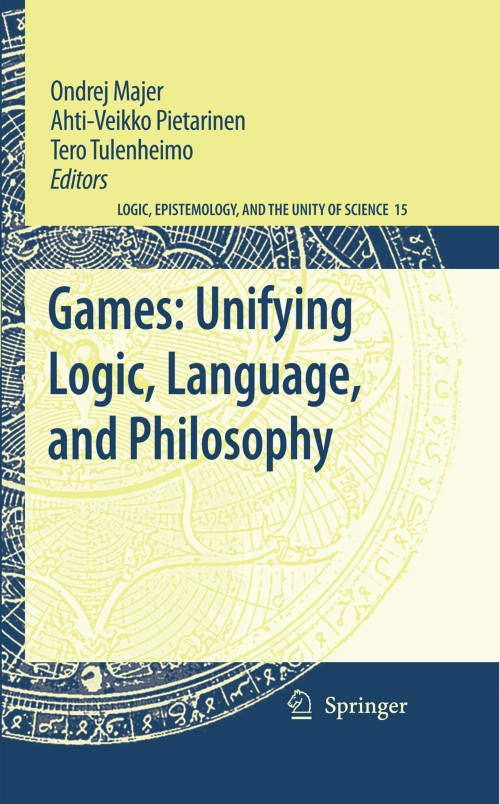
245 10|aGames: Unifying Logic, Language, and Philosophy|h[electronic resource] /|cedited by Ondrej Majer, Ahti-Veikko Pietarinen, Tero Tulenheimo.
250 |a1st ed. 2009.
264 1|aDordrecht :|bSpringer Netherlands :|bImprint: Springer,|c2009.
300 |aXXIV, 378 p.|bonline resource.
336 |atext|btxt|2rdacontent
337 |acomputer|bc|2rdamedia
338 |aonline resource|bcr|2rdacarrier
347 |atext file|bPDF|2rda
490 1 |aLogic, Epistemology, and the Unity of Science,|x2214-9783 ;|v15
505 0 |aPhilosophical Issues -- Why Play Logical Games? -- On The Narrow Epistemology of Game-Theoretic Agents -- Interpretation, Coordination and Conformity -- Fallacies as Cognitive Virtues -- Game-Theoretic Semantics -- A Strategic Perspective on if Games -- Towards Evaluation Games for Fuzzy Logics -- Games, Quantification and Discourse Structure -- Dialogues -- From Games to Dialogues and Back -- Revisiting Giles's Game -- Implicit Versus Explicit Knowledge in Dialogical Logic -- Computation and Mathematics -- In the Beginning was Game Semantics? -- The Problem of Determinacy of Infinite Games from an Intuitionistic Point of View.
520 |aOndrejMajer,Ahti-VeikkoPietarinen,andTeroTulenheimo 1 Games and logic in philosophy Recent years have witnessed a growing interest in the unifying methodo- gies over what have been perceived as pretty disparate logical ‘systems’, or else merely an assortment of formal and mathematical ‘approaches’ to phi- sophical inquiry. This development has largely been fueled by an increasing dissatisfaction to what has earlier been taken to be a straightforward outcome of ‘logical pluralism’ or ‘methodological diversity’. These phrases appear to re ect the everyday chaos of our academic pursuits rather than any genuine attempt to clarify the general principles underlying the miscellaneous ways in which logic appears to us. But the situation is changing. Unity among plurality is emerging in c- temporary studies in logical philosophy and neighbouring disciplines. This is a necessary follow-up to the intensive research into the intricacies of logical systems and methodologies performed over the recent years. The present book suggests one such peculiar but very unrestrained meth- ological perspective over the eld of logic and its applications in mathematics, language or computation: games. An allegory for opposition, cooperation and coordination, games are also concrete objects of formal study.
650 0|aLogic.
650 0|aLanguage and languages|xPhilosophy.
650 0|aMathematics.
650 0|aSemiotics.
650 0|aGame theory.
650 0|aMachine theory.
650 14|aLogic.
650 24|aPhilosophy of Language.
650 24|aApplications of Mathematics.
650 24|aSemiotics.
650 24|aGame Theory.
650 24|aFormal Languages and Automata Theory.
700 1 |aMajer, Ondrej.|eeditor.|4edt|4http://id.loc.gov/vocabulary/relators/edt
700 1 |aPietarinen, Ahti-Veikko.|eeditor.|4edt|4http://id.loc.gov/vocabulary/relators/edt
700 1 |aTulenheimo, Tero.|eeditor.|4edt|4http://id.loc.gov/vocabulary/relators/edt
710 2 |aSpringerLink (Online service)
773 0 |tSpringer Nature eBook
776 08|iPrinted edition:|z9781402093739
776 08|iPrinted edition:|z9781402093982
776 08|iPrinted edition:|z9789048181155
830 0|aLogic, Epistemology, and the Unity of Science,|x2214-9783 ;|v15
856 40|uhttps://doi.org/10.1007/978-1-4020-9374-6
912 |aZDB-2-SHU
912 |aZDB-2-SXPR
950 |aHumanities, Social Sciences and Law (SpringerNature-11648)
950 |aPhilosophy and Religion (R0) (SpringerNature-43725)