

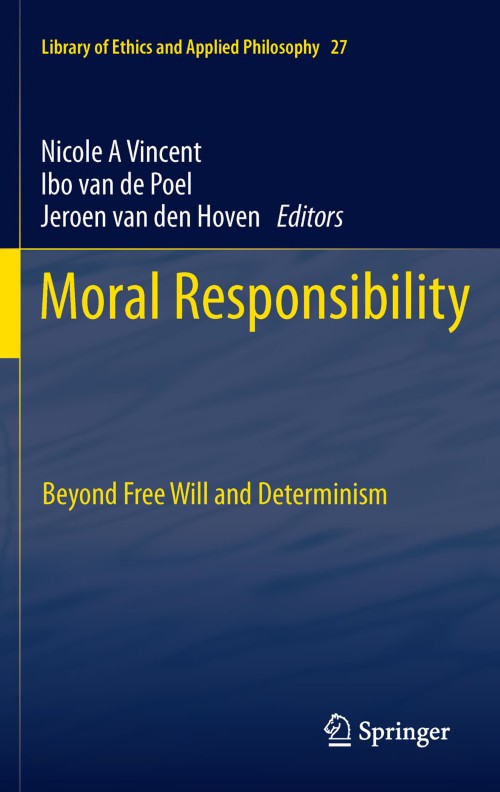
Moral Responsibility [electronic resource] : Beyond Free Will and Determinism / edited by Nicole A. Vincent, Ibo van de Poel, Jeroen van den Hoven.
Erişim Adresi
ISBN
9789400718784
Dil Kodu
İngilizce
Yer Numarası
DK/8177
Basım Bildirimi
1st ed. 2011.
Yayın Bilgisi
Dordrecht : Springer Netherlands : Imprint: Springer, 2011.
Fiziksel Niteleme
VIII, 252 p. online resource.
Dizi
Library of Ethics and Applied Philosophy, 2215-0323 ; 27
İçindekiler Notu
1 Introduction -- 2 A Structured Taxonomy of Responsibility Concepts -- 3 The Relation Between Forward-Looking and Backward-Looking Responsibility -- 4 Beyond Belief and Desire: or, How to be Orthonomous -- 5 Blame, Reasons and Capacities -- 6 Please Drink Responsibly: Can the Responsibility of Intoxicated Offenders be Justified by the Tracing Principle? -- 7 The Moral Significance of Unintentional Omission: Comparing Will-Centered and Non-Will-Centered Accounts of Moral Responsibility -- 8 Desert, Responsibility and Luck Egalitarianism -- 9 Communicative Revisionism -- 10 Moral Responsibility and Jointly Determined Consequences -- 11 Joint Responsibility Without Individual Control: Applying the Explanation Hypothesis -- 12 Climate Change and Collective Responsibility -- 13 Collective Responsibility, Epistemic Action and Climate Change.
Özet, vb.
It is well over a decade since John Fischer and Mark Ravizza – and before them, Jay Wallace and Daniel Dennett – defended responsibility from the threat of determinism. But defending responsibility from determinism is a potentially endless and largely negative enterprise; it can go on for as long as dissenting voices remain, and although such work strengthens the theoretical foundations of these theories, it won’t necessarily build anything on top of those foundations, nor will it move these theories into new territory or explain how to apply them to practical contexts. To this end, the papers in this volume address these more positive challenges by exploring how compatibilist responsibility theory can be extended and/or applied in a range of practical contexts. For instance, how is the narrow philosophical concept of responsibility that was defended from the threat of determinism related to the plural notions of responsibility present in everyday discourse, and how might this more fine-grained understanding of responsibility open up new vistas and challenges for compatibilist theory? What light might compatibilism shed, and what light might be shed upon it, by political debates about access to public welfare in the context of responsibility for one’s own health, and by legal debates about the impact of self-intoxication on responsibility. Does compatibilist theory, which was originally designed to cater for analysis of individual actions, scale to scenarios that involve group action and collective responsibility — e.g. for harms due to human-induced climate change? This book’s chapters deal with a range of theoretical problems discussed in classic compatibilist literature — e.g. the relationship between responsibility and capacity, the role of historical tracing in discounting the exculpatory value of incapacities, and the justifiability of retributive punishment. But instead of motivating theirdiscussions by focusing on the alleged threat that determinism poses to responsibility, these chapters’ authors have animated their discussions by tackling important practical problems which crop up in contemporary debates about responsibility. .
Konu
Ethics.
Law __ Philosophy.
Medicine __ Philosophy.
Philosophy of mind.
Moral Philosophy and Applied Ethics.
Philosophy of Law.
Philosophy of Medicine.
Philosophy of Mind.
Law __ Philosophy.
Medicine __ Philosophy.
Philosophy of mind.
Moral Philosophy and Applied Ethics.
Philosophy of Law.
Philosophy of Medicine.
Philosophy of Mind.
Diğer Yazarlar
Kurum Adı
Eseri Alıntıla
Referansları kullanmadan önce gözden geçirmeniz ve varsa gerekli düzeltmeleri yapmanız önerilir.
Dijital Kaynak
MARC Görünümü
LEADER 05188nam a22005655i 4500
001 806883
003 TR_AnAIT
005 20260127003023
007 cr nn 008mamaa
008 110815s2011 ne | s |||| 0|eng d
020 |a9789400718784|9978-94-007-1878-4
024 7 |a10.1007/978-94-007-1878-4|2doi
041 |aeng
049 |aTürk Tarih Kurumu Kütüphanesi
050 4|aBJ1-1725
072 7|aHPQ|2bicssc
072 7|aPHI005000|2bisacsh
072 7|aQDTQ|2thema
082 04|a170|223
090 |aDK/8177
245 10|aMoral Responsibility|h[electronic resource] :|bBeyond Free Will and Determinism /|cedited by Nicole A. Vincent, Ibo van de Poel, Jeroen van den Hoven.
250 |a1st ed. 2011.
264 1|aDordrecht :|bSpringer Netherlands :|bImprint: Springer,|c2011.
300 |aVIII, 252 p.|bonline resource.
336 |atext|btxt|2rdacontent
337 |acomputer|bc|2rdamedia
338 |aonline resource|bcr|2rdacarrier
347 |atext file|bPDF|2rda
490 1 |aLibrary of Ethics and Applied Philosophy,|x2215-0323 ;|v27
505 0 |a1 Introduction -- 2 A Structured Taxonomy of Responsibility Concepts -- 3 The Relation Between Forward-Looking and Backward-Looking Responsibility -- 4 Beyond Belief and Desire: or, How to be Orthonomous -- 5 Blame, Reasons and Capacities -- 6 Please Drink Responsibly: Can the Responsibility of Intoxicated Offenders be Justified by the Tracing Principle? -- 7 The Moral Significance of Unintentional Omission: Comparing Will-Centered and Non-Will-Centered Accounts of Moral Responsibility -- 8 Desert, Responsibility and Luck Egalitarianism -- 9 Communicative Revisionism -- 10 Moral Responsibility and Jointly Determined Consequences -- 11 Joint Responsibility Without Individual Control: Applying the Explanation Hypothesis -- 12 Climate Change and Collective Responsibility -- 13 Collective Responsibility, Epistemic Action and Climate Change.
520 |aIt is well over a decade since John Fischer and Mark Ravizza – and before them, Jay Wallace and Daniel Dennett – defended responsibility from the threat of determinism. But defending responsibility from determinism is a potentially endless and largely negative enterprise; it can go on for as long as dissenting voices remain, and although such work strengthens the theoretical foundations of these theories, it won’t necessarily build anything on top of those foundations, nor will it move these theories into new territory or explain how to apply them to practical contexts. To this end, the papers in this volume address these more positive challenges by exploring how compatibilist responsibility theory can be extended and/or applied in a range of practical contexts. For instance, how is the narrow philosophical concept of responsibility that was defended from the threat of determinism related to the plural notions of responsibility present in everyday discourse, and how might this more fine-grained understanding of responsibility open up new vistas and challenges for compatibilist theory? What light might compatibilism shed, and what light might be shed upon it, by political debates about access to public welfare in the context of responsibility for one’s own health, and by legal debates about the impact of self-intoxication on responsibility. Does compatibilist theory, which was originally designed to cater for analysis of individual actions, scale to scenarios that involve group action and collective responsibility — e.g. for harms due to human-induced climate change? This book’s chapters deal with a range of theoretical problems discussed in classic compatibilist literature — e.g. the relationship between responsibility and capacity, the role of historical tracing in discounting the exculpatory value of incapacities, and the justifiability of retributive punishment. But instead of motivating theirdiscussions by focusing on the alleged threat that determinism poses to responsibility, these chapters’ authors have animated their discussions by tackling important practical problems which crop up in contemporary debates about responsibility. .
650 0|aEthics.
650 0|aLaw|xPhilosophy.
650 0|aMedicine|xPhilosophy.
650 0|aPhilosophy of mind.
650 14|aMoral Philosophy and Applied Ethics.
650 24|aPhilosophy of Law.
650 24|aPhilosophy of Medicine.
650 24|aPhilosophy of Mind.
700 1 |aVincent, Nicole A.|eeditor.|4edt|4http://id.loc.gov/vocabulary/relators/edt
700 1 |avan de Poel, Ibo.|eeditor.|4edt|4http://id.loc.gov/vocabulary/relators/edt
700 1 |avan den Hoven, Jeroen.|eeditor.|4edt|4http://id.loc.gov/vocabulary/relators/edt
710 2 |aSpringerLink (Online service)
773 0 |tSpringer Nature eBook
776 08|iPrinted edition:|z9789400718777
776 08|iPrinted edition:|z9789400718791
776 08|iPrinted edition:|z9789400737716
830 0|aLibrary of Ethics and Applied Philosophy,|x2215-0323 ;|v27
856 40|uhttps://doi.org/10.1007/978-94-007-1878-4
912 |aZDB-2-SHU
912 |aZDB-2-SXPR
950 |aHumanities, Social Sciences and Law (SpringerNature-11648)
950 |aPhilosophy and Religion (R0) (SpringerNature-43725)
001 806883
003 TR_AnAIT
005 20260127003023
007 cr nn 008mamaa
008 110815s2011 ne | s |||| 0|eng d
020 |a9789400718784|9978-94-007-1878-4
024 7 |a10.1007/978-94-007-1878-4|2doi
041 |aeng
049 |aTürk Tarih Kurumu Kütüphanesi
050 4|aBJ1-1725
072 7|aHPQ|2bicssc
072 7|aPHI005000|2bisacsh
072 7|aQDTQ|2thema
082 04|a170|223
090 |aDK/8177
245 10|aMoral Responsibility|h[electronic resource] :|bBeyond Free Will and Determinism /|cedited by Nicole A. Vincent, Ibo van de Poel, Jeroen van den Hoven.
250 |a1st ed. 2011.
264 1|aDordrecht :|bSpringer Netherlands :|bImprint: Springer,|c2011.
300 |aVIII, 252 p.|bonline resource.
336 |atext|btxt|2rdacontent
337 |acomputer|bc|2rdamedia
338 |aonline resource|bcr|2rdacarrier
347 |atext file|bPDF|2rda
490 1 |aLibrary of Ethics and Applied Philosophy,|x2215-0323 ;|v27
505 0 |a1 Introduction -- 2 A Structured Taxonomy of Responsibility Concepts -- 3 The Relation Between Forward-Looking and Backward-Looking Responsibility -- 4 Beyond Belief and Desire: or, How to be Orthonomous -- 5 Blame, Reasons and Capacities -- 6 Please Drink Responsibly: Can the Responsibility of Intoxicated Offenders be Justified by the Tracing Principle? -- 7 The Moral Significance of Unintentional Omission: Comparing Will-Centered and Non-Will-Centered Accounts of Moral Responsibility -- 8 Desert, Responsibility and Luck Egalitarianism -- 9 Communicative Revisionism -- 10 Moral Responsibility and Jointly Determined Consequences -- 11 Joint Responsibility Without Individual Control: Applying the Explanation Hypothesis -- 12 Climate Change and Collective Responsibility -- 13 Collective Responsibility, Epistemic Action and Climate Change.
520 |aIt is well over a decade since John Fischer and Mark Ravizza – and before them, Jay Wallace and Daniel Dennett – defended responsibility from the threat of determinism. But defending responsibility from determinism is a potentially endless and largely negative enterprise; it can go on for as long as dissenting voices remain, and although such work strengthens the theoretical foundations of these theories, it won’t necessarily build anything on top of those foundations, nor will it move these theories into new territory or explain how to apply them to practical contexts. To this end, the papers in this volume address these more positive challenges by exploring how compatibilist responsibility theory can be extended and/or applied in a range of practical contexts. For instance, how is the narrow philosophical concept of responsibility that was defended from the threat of determinism related to the plural notions of responsibility present in everyday discourse, and how might this more fine-grained understanding of responsibility open up new vistas and challenges for compatibilist theory? What light might compatibilism shed, and what light might be shed upon it, by political debates about access to public welfare in the context of responsibility for one’s own health, and by legal debates about the impact of self-intoxication on responsibility. Does compatibilist theory, which was originally designed to cater for analysis of individual actions, scale to scenarios that involve group action and collective responsibility — e.g. for harms due to human-induced climate change? This book’s chapters deal with a range of theoretical problems discussed in classic compatibilist literature — e.g. the relationship between responsibility and capacity, the role of historical tracing in discounting the exculpatory value of incapacities, and the justifiability of retributive punishment. But instead of motivating theirdiscussions by focusing on the alleged threat that determinism poses to responsibility, these chapters’ authors have animated their discussions by tackling important practical problems which crop up in contemporary debates about responsibility. .
650 0|aEthics.
650 0|aLaw|xPhilosophy.
650 0|aMedicine|xPhilosophy.
650 0|aPhilosophy of mind.
650 14|aMoral Philosophy and Applied Ethics.
650 24|aPhilosophy of Law.
650 24|aPhilosophy of Medicine.
650 24|aPhilosophy of Mind.
700 1 |aVincent, Nicole A.|eeditor.|4edt|4http://id.loc.gov/vocabulary/relators/edt
700 1 |avan de Poel, Ibo.|eeditor.|4edt|4http://id.loc.gov/vocabulary/relators/edt
700 1 |avan den Hoven, Jeroen.|eeditor.|4edt|4http://id.loc.gov/vocabulary/relators/edt
710 2 |aSpringerLink (Online service)
773 0 |tSpringer Nature eBook
776 08|iPrinted edition:|z9789400718777
776 08|iPrinted edition:|z9789400718791
776 08|iPrinted edition:|z9789400737716
830 0|aLibrary of Ethics and Applied Philosophy,|x2215-0323 ;|v27
856 40|uhttps://doi.org/10.1007/978-94-007-1878-4
912 |aZDB-2-SHU
912 |aZDB-2-SXPR
950 |aHumanities, Social Sciences and Law (SpringerNature-11648)
950 |aPhilosophy and Religion (R0) (SpringerNature-43725)
Materyaller
Depodan talep edilen materyal sadece kütüphane içerisinde kullanılmaktadır.
Materyal dışarıya ödünç verilmemektedir.
Materyal dışarıya ödünç verilmemektedir.
