

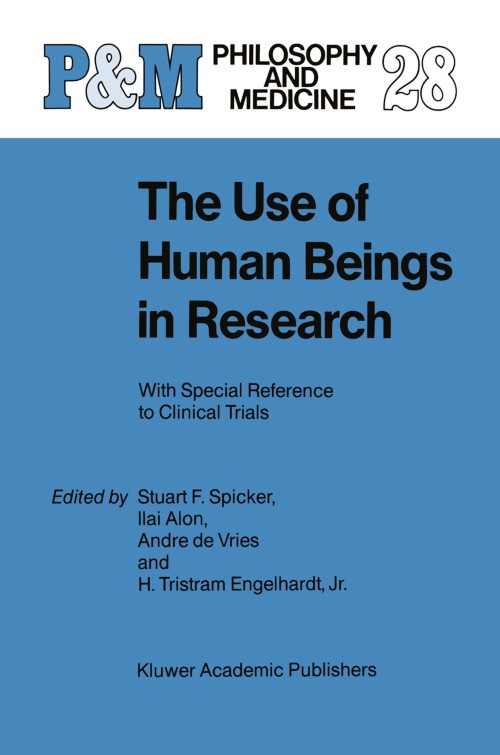
The Use of Human Beings in Research [electronic resource] : With Special Reference to Clinical Trials / edited by S.F. Spicker, I. Alon, A. de Vries, H. Tristram Engelhardt Jr.
Erişim Adresi
ISBN
9789400927056
Dil Kodu
İngilizce
Yer Numarası
DK/8216
Basım Bildirimi
1st ed. 1988.
Yayın Bilgisi
Dordrecht : Springer Netherlands : Imprint: Springer, 1988.
Fiziksel Niteleme
XXI, 294 p. online resource.
Dizi
Philosophy and Medicine, 2215-0080 ; 28
İçindekiler Notu
Section I / Human Experimentation and the Legacy of Nuremberg -- The Search for Universality in the Ethics of Human Research: Andrew C. Ivy, Henry K. Beecher, and the Legacy of Nuremberg -- Section II / The Development in Medicine of the Imperative to Conduct Research with Human Subjects: an Historical Analysis -- Cultural Contents in the History of the Use of Human Subjects in Research -- Reflections on the History of Human Experimentation -- Comparative Models and Goals for the Regulation of Human Research -- Moral Appropriateness in Human Research -- Public Control over Biomedical Experiments Involving Human Beings: An Israeli Perspective -- Section III / Ethical and Epistemological Issues in Randomized Clinical Trials -- Diagnosing Well and Treating Prudently: Randomized Clinical Trials and the Problem of Knowing Truly -- Research Risks, Randomization, and Risks to Research: Reflections on the Prudential Use of “Pilot” Trials -- Epistemological Presuppositions Involved in the Programs of Human Research -- At What Level of Statistical Certainty Ought a Random Clinical Trial to be Interrupted? -- Comment on Michael Ruse’s Essay -- Section IV / Obligations and the Avoidance of Injury -- Is There an Obligation to Participate in Biomedical Research? -- Physicians Experimenting on Themselves: Some Ethical and Philosophical Considerations -- Protection of Human Subjects: Remedies for Injury -- Israel Health Regulations: Experiments on Human Subjects - 1980 -- Notes on Contributors.
Özet, vb.
This volume, which has developed from the Fourteenth Trans Disciplinary Symposium on Philosophy and Medicine, September 5-8, 1982, at Tel Aviv University, Israel, contains the contributions of a group of distinguished scholars who together examine the ethical issues raised by the advance of biomedical science and technology. We are, of course, still at the beginning of a revolution in our understanding of human biology; scientific medicine and clinical research are scarcely one hundred years old. Both the sciences and the technology of medicine until ten or fifteen years ago had the feeling of the 19th century about them; we sense that they belonged to an older time; that era is ending. The next twenty-five to fifty years of investigative work belong to neurobiology, genetics, and reproductive biology. The technologies of information processing and imaging will make diagnosis and treatment almost incomprehensible by my generation of physicians. Our science and technology will become so powerful that we shall require all of the art and wisdom we can muster to be sure that they remain dedicated, as Francis Bacon hoped four centuries ago, "to the uses of life." It is well that, as philosophers and physicians, we grapple with the issues now when they are relatively simple, and while the pace of change is relatively slow. We require a strategy for the future; that strategy must be worked out by scientists, philosophers, physicians, lawyers, theologians, and, I should like to add, artists and poets.
Konu
Medicine __ Philosophy.
Medical laws and legislation.
Ethics.
Bioethics.
Philosophy of Medicine.
Medical Law.
Moral Philosophy and Applied Ethics.
Bioethics.
Medical laws and legislation.
Ethics.
Bioethics.
Philosophy of Medicine.
Medical Law.
Moral Philosophy and Applied Ethics.
Bioethics.
Kurum Adı
Eseri Alıntıla
Referansları kullanmadan önce gözden geçirmeniz ve varsa gerekli düzeltmeleri yapmanız önerilir.
Dijital Kaynak
MARC Görünümü
LEADER 06079nam a22006615i 4500
001 806922
003 TR_AnAIT
005 20260127003111
007 cr nn 008mamaa
008 121227s1988 ne | s |||| 0|eng d
020 |a9789400927056|9978-94-009-2705-6
024 7 |a10.1007/978-94-009-2705-6|2doi
041 |aeng
049 |aTürk Tarih Kurumu Kütüphanesi
050 4|aR723-723.7
072 7|aHP|2bicssc
072 7|aMBDC|2bicssc
072 7|aMED050000|2bisacsh
072 7|aQD|2thema
072 7|aMBDC|2thema
082 04|a610.1|223
090 |aDK/8216
245 14|aThe Use of Human Beings in Research|h[electronic resource] :|bWith Special Reference to Clinical Trials /|cedited by S.F. Spicker, I. Alon, A. de Vries, H. Tristram Engelhardt Jr.
250 |a1st ed. 1988.
264 1|aDordrecht :|bSpringer Netherlands :|bImprint: Springer,|c1988.
300 |aXXI, 294 p.|bonline resource.
336 |atext|btxt|2rdacontent
337 |acomputer|bc|2rdamedia
338 |aonline resource|bcr|2rdacarrier
347 |atext file|bPDF|2rda
490 1 |aPhilosophy and Medicine,|x2215-0080 ;|v28
505 0 |aSection I / Human Experimentation and the Legacy of Nuremberg -- The Search for Universality in the Ethics of Human Research: Andrew C. Ivy, Henry K. Beecher, and the Legacy of Nuremberg -- Section II / The Development in Medicine of the Imperative to Conduct Research with Human Subjects: an Historical Analysis -- Cultural Contents in the History of the Use of Human Subjects in Research -- Reflections on the History of Human Experimentation -- Comparative Models and Goals for the Regulation of Human Research -- Moral Appropriateness in Human Research -- Public Control over Biomedical Experiments Involving Human Beings: An Israeli Perspective -- Section III / Ethical and Epistemological Issues in Randomized Clinical Trials -- Diagnosing Well and Treating Prudently: Randomized Clinical Trials and the Problem of Knowing Truly -- Research Risks, Randomization, and Risks to Research: Reflections on the Prudential Use of “Pilot” Trials -- Epistemological Presuppositions Involved in the Programs of Human Research -- At What Level of Statistical Certainty Ought a Random Clinical Trial to be Interrupted? -- Comment on Michael Ruse’s Essay -- Section IV / Obligations and the Avoidance of Injury -- Is There an Obligation to Participate in Biomedical Research? -- Physicians Experimenting on Themselves: Some Ethical and Philosophical Considerations -- Protection of Human Subjects: Remedies for Injury -- Israel Health Regulations: Experiments on Human Subjects - 1980 -- Notes on Contributors.
520 |aThis volume, which has developed from the Fourteenth Trans Disciplinary Symposium on Philosophy and Medicine, September 5-8, 1982, at Tel Aviv University, Israel, contains the contributions of a group of distinguished scholars who together examine the ethical issues raised by the advance of biomedical science and technology. We are, of course, still at the beginning of a revolution in our understanding of human biology; scientific medicine and clinical research are scarcely one hundred years old. Both the sciences and the technology of medicine until ten or fifteen years ago had the feeling of the 19th century about them; we sense that they belonged to an older time; that era is ending. The next twenty-five to fifty years of investigative work belong to neurobiology, genetics, and reproductive biology. The technologies of information processing and imaging will make diagnosis and treatment almost incomprehensible by my generation of physicians. Our science and technology will become so powerful that we shall require all of the art and wisdom we can muster to be sure that they remain dedicated, as Francis Bacon hoped four centuries ago, "to the uses of life." It is well that, as philosophers and physicians, we grapple with the issues now when they are relatively simple, and while the pace of change is relatively slow. We require a strategy for the future; that strategy must be worked out by scientists, philosophers, physicians, lawyers, theologians, and, I should like to add, artists and poets.
532 8 |aAccessibility summary: This PDF is not accessible. It is based on scanned pages and does not support features such as screen reader compatibility or described non-text content (images, graphs etc). However, it likely supports searchable and selectable text based on OCR (Optical Character Recognition). Users with accessibility needs may not be able to use this content effectively. Please contact us at accessibilitysupport@springernature.com if you require assistance or an alternative format.
532 8 |aInaccessible, or known limited accessibility
532 8 |aNo reading system accessibility options actively disabled
532 8 |aPublisher contact for further accessibility information: accessibilitysupport@springernature.com
650 0|aMedicine|xPhilosophy.
650 0|aMedical laws and legislation.
650 0|aEthics.
650 0|aBioethics.
650 14|aPhilosophy of Medicine.
650 24|aMedical Law.
650 24|aMoral Philosophy and Applied Ethics.
650 24|aBioethics.
700 1 |aSpicker, S.F.|eeditor.|4edt|4http://id.loc.gov/vocabulary/relators/edt
700 1 |aAlon, I.|eeditor.|4edt|4http://id.loc.gov/vocabulary/relators/edt
700 1 |ade Vries, A.|eeditor.|4edt|4http://id.loc.gov/vocabulary/relators/edt
700 1 |aEngelhardt Jr., H. Tristram.|eeditor.|4edt|4http://id.loc.gov/vocabulary/relators/edt
710 2 |aSpringerLink (Online service)
773 0 |tSpringer Nature eBook
776 08|iPrinted edition:|z9781556080432
776 08|iPrinted edition:|z9789400927063
776 08|iPrinted edition:|z9789401077194
830 0|aPhilosophy and Medicine,|x2215-0080 ;|v28
856 40|uhttps://doi.org/10.1007/978-94-009-2705-6
912 |aZDB-2-SHU
912 |aZDB-2-SXPR
912 |aZDB-2-BAE
950 |aHumanities, Social Sciences and Law (SpringerNature-11648)
950 |aPhilosophy and Religion (R0) (SpringerNature-43725)
001 806922
003 TR_AnAIT
005 20260127003111
007 cr nn 008mamaa
008 121227s1988 ne | s |||| 0|eng d
020 |a9789400927056|9978-94-009-2705-6
024 7 |a10.1007/978-94-009-2705-6|2doi
041 |aeng
049 |aTürk Tarih Kurumu Kütüphanesi
050 4|aR723-723.7
072 7|aHP|2bicssc
072 7|aMBDC|2bicssc
072 7|aMED050000|2bisacsh
072 7|aQD|2thema
072 7|aMBDC|2thema
082 04|a610.1|223
090 |aDK/8216
245 14|aThe Use of Human Beings in Research|h[electronic resource] :|bWith Special Reference to Clinical Trials /|cedited by S.F. Spicker, I. Alon, A. de Vries, H. Tristram Engelhardt Jr.
250 |a1st ed. 1988.
264 1|aDordrecht :|bSpringer Netherlands :|bImprint: Springer,|c1988.
300 |aXXI, 294 p.|bonline resource.
336 |atext|btxt|2rdacontent
337 |acomputer|bc|2rdamedia
338 |aonline resource|bcr|2rdacarrier
347 |atext file|bPDF|2rda
490 1 |aPhilosophy and Medicine,|x2215-0080 ;|v28
505 0 |aSection I / Human Experimentation and the Legacy of Nuremberg -- The Search for Universality in the Ethics of Human Research: Andrew C. Ivy, Henry K. Beecher, and the Legacy of Nuremberg -- Section II / The Development in Medicine of the Imperative to Conduct Research with Human Subjects: an Historical Analysis -- Cultural Contents in the History of the Use of Human Subjects in Research -- Reflections on the History of Human Experimentation -- Comparative Models and Goals for the Regulation of Human Research -- Moral Appropriateness in Human Research -- Public Control over Biomedical Experiments Involving Human Beings: An Israeli Perspective -- Section III / Ethical and Epistemological Issues in Randomized Clinical Trials -- Diagnosing Well and Treating Prudently: Randomized Clinical Trials and the Problem of Knowing Truly -- Research Risks, Randomization, and Risks to Research: Reflections on the Prudential Use of “Pilot” Trials -- Epistemological Presuppositions Involved in the Programs of Human Research -- At What Level of Statistical Certainty Ought a Random Clinical Trial to be Interrupted? -- Comment on Michael Ruse’s Essay -- Section IV / Obligations and the Avoidance of Injury -- Is There an Obligation to Participate in Biomedical Research? -- Physicians Experimenting on Themselves: Some Ethical and Philosophical Considerations -- Protection of Human Subjects: Remedies for Injury -- Israel Health Regulations: Experiments on Human Subjects - 1980 -- Notes on Contributors.
520 |aThis volume, which has developed from the Fourteenth Trans Disciplinary Symposium on Philosophy and Medicine, September 5-8, 1982, at Tel Aviv University, Israel, contains the contributions of a group of distinguished scholars who together examine the ethical issues raised by the advance of biomedical science and technology. We are, of course, still at the beginning of a revolution in our understanding of human biology; scientific medicine and clinical research are scarcely one hundred years old. Both the sciences and the technology of medicine until ten or fifteen years ago had the feeling of the 19th century about them; we sense that they belonged to an older time; that era is ending. The next twenty-five to fifty years of investigative work belong to neurobiology, genetics, and reproductive biology. The technologies of information processing and imaging will make diagnosis and treatment almost incomprehensible by my generation of physicians. Our science and technology will become so powerful that we shall require all of the art and wisdom we can muster to be sure that they remain dedicated, as Francis Bacon hoped four centuries ago, "to the uses of life." It is well that, as philosophers and physicians, we grapple with the issues now when they are relatively simple, and while the pace of change is relatively slow. We require a strategy for the future; that strategy must be worked out by scientists, philosophers, physicians, lawyers, theologians, and, I should like to add, artists and poets.
532 8 |aAccessibility summary: This PDF is not accessible. It is based on scanned pages and does not support features such as screen reader compatibility or described non-text content (images, graphs etc). However, it likely supports searchable and selectable text based on OCR (Optical Character Recognition). Users with accessibility needs may not be able to use this content effectively. Please contact us at accessibilitysupport@springernature.com if you require assistance or an alternative format.
532 8 |aInaccessible, or known limited accessibility
532 8 |aNo reading system accessibility options actively disabled
532 8 |aPublisher contact for further accessibility information: accessibilitysupport@springernature.com
650 0|aMedicine|xPhilosophy.
650 0|aMedical laws and legislation.
650 0|aEthics.
650 0|aBioethics.
650 14|aPhilosophy of Medicine.
650 24|aMedical Law.
650 24|aMoral Philosophy and Applied Ethics.
650 24|aBioethics.
700 1 |aSpicker, S.F.|eeditor.|4edt|4http://id.loc.gov/vocabulary/relators/edt
700 1 |aAlon, I.|eeditor.|4edt|4http://id.loc.gov/vocabulary/relators/edt
700 1 |ade Vries, A.|eeditor.|4edt|4http://id.loc.gov/vocabulary/relators/edt
700 1 |aEngelhardt Jr., H. Tristram.|eeditor.|4edt|4http://id.loc.gov/vocabulary/relators/edt
710 2 |aSpringerLink (Online service)
773 0 |tSpringer Nature eBook
776 08|iPrinted edition:|z9781556080432
776 08|iPrinted edition:|z9789400927063
776 08|iPrinted edition:|z9789401077194
830 0|aPhilosophy and Medicine,|x2215-0080 ;|v28
856 40|uhttps://doi.org/10.1007/978-94-009-2705-6
912 |aZDB-2-SHU
912 |aZDB-2-SXPR
912 |aZDB-2-BAE
950 |aHumanities, Social Sciences and Law (SpringerNature-11648)
950 |aPhilosophy and Religion (R0) (SpringerNature-43725)
Materyaller
Depodan talep edilen materyal sadece kütüphane içerisinde kullanılmaktadır.
Materyal dışarıya ödünç verilmemektedir.
Materyal dışarıya ödünç verilmemektedir.
