LEADER 03627nam a22005055i 4500
001 806939
003 TR_AnAIT
005 20260127003130
007 cr nn 008mamaa
008 100301s2009 ne | s |||| 0|eng d
020 |a9781402098215|9978-1-4020-9821-5
024 7 |a10.1007/978-1-4020-9821-5|2doi
041 |aeng
049 |aTürk Tarih Kurumu Kütüphanesi
050 4|aBJ1-1725
072 7|aHPQ|2bicssc
072 7|aPHI005000|2bisacsh
072 7|aQDTQ|2thema
082 04|a170|223
090 |aDK/8233
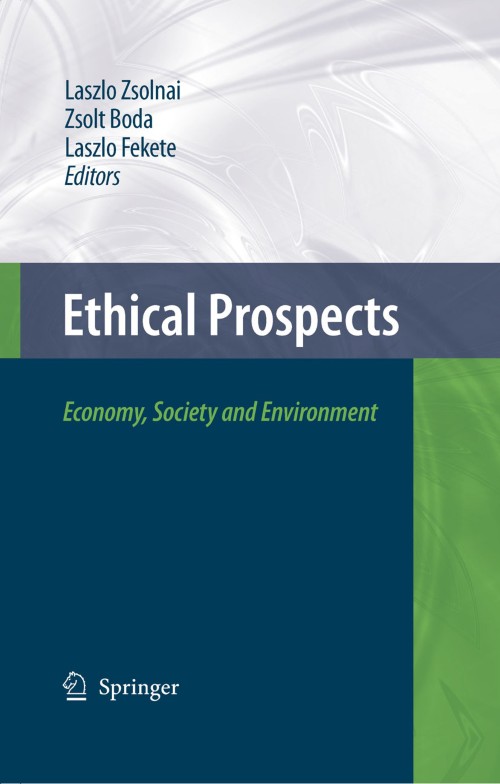
245 10|aEthical Prospects|h[electronic resource] :|bEconomy, Society and Environment /|cedited by Laszlo Zsolnai.
250 |a1st ed. 2009.
264 1|aDordrecht :|bSpringer Netherlands :|bImprint: Springer,|c2009.
300 |aXXVIII, 310 p.|bonline resource.
336 |atext|btxt|2rdacontent
337 |acomputer|bc|2rdamedia
338 |aonline resource|bcr|2rdacarrier
347 |atext file|bPDF|2rda
505 0 |aNew Perspectives and Findings -- The Good Company -- Dialogic Ethics for Business -- Management Education – A Path to Business Integrity? -- Value Creation as the Foundation of Economics -- Buddhist Economics for Business -- Innovative Practices and Policy Reforms -- The Role of Government in Corporate Social Responsibility * -- Sustainable Systems Implementation -- Public versus Private Domain: Knowledge and Information in the Global Communications Network -- Changing the Scoring System for the Game of Economic Life -- Ethical Banking* -- Opinions: The Challenge of Future Generations -- Representing Future Generations -- A Speechless Mass Behind Sustainability -- The Right of Future Generations -- The Legacy of Business Leaders -- Enhancing the Quality of Our Decisions for Nurturing a Sustainable World -- Debate: Republican Liberalism versus Market Liberalism -- Republican Liberalism versus Market Liberalism -- Comments on Peter Ulrich’s “Republican Liberalism versus Market Liberalism” -- Who Can Civilize the Market? -- Is Ethics Integral? -- Which Role for Business Ethics? Some Reflections on Peter Ulrich’s Statement -- Reply: Republican Liberalism and Its Implications for Business Ethics.
520 |aEthical Prospects: Economy, Society and Environment aims to present and summarize new perspectives and leading-edge results in ethics reflecting on interconnected economic, social and environmental issues. The yearbook reports on innovative practices and policy reforms and provides a forum for discussion about groundbreaking theories. The main function of the yearbook is to present ideas and initiatives that lead toward responsible business practices, policies for the common good and ecological sustainability. It seeks form a value-community of scholars, practitioners and policymakers engaged in genuine ethics in business, environmental management, and public policy.
650 0|aEthics.
650 0|aBusiness.
650 0|aManagement science.
650 0|aEnvironmental management.
650 14|aMoral Philosophy and Applied Ethics.
650 24|aBusiness and Management.
650 24|aEnvironmental Management.
700 1 |aZsolnai, Laszlo.|eeditor.|4edt|4http://id.loc.gov/vocabulary/relators/edt
710 2 |aSpringerLink (Online service)
773 0 |tSpringer Nature eBook
776 08|iPrinted edition:|z9781402098208
776 08|iPrinted edition:|z9781402098635
776 08|iPrinted edition:|z9789048182060
856 40|uhttps://doi.org/10.1007/978-1-4020-9821-5
912 |aZDB-2-SHU
912 |aZDB-2-SXPR
950 |aHumanities, Social Sciences and Law (SpringerNature-11648)
950 |aPhilosophy and Religion (R0) (SpringerNature-43725)