

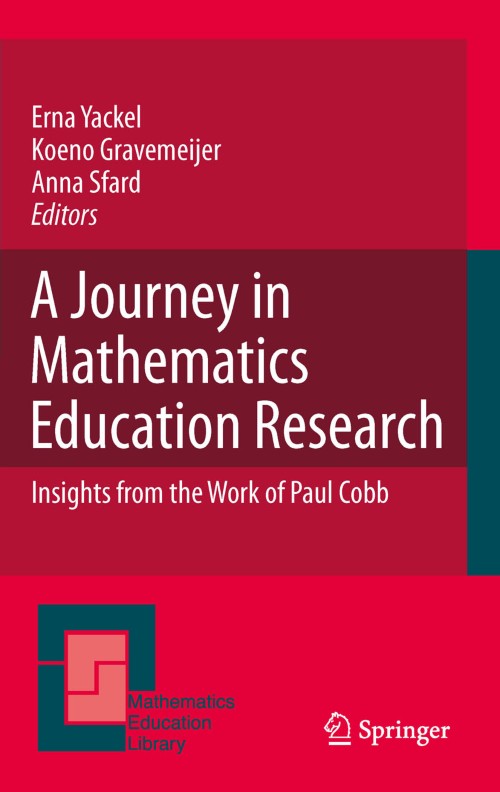
A Journey in Mathematics Education Research [electronic resource] : Insights from the Work of Paul Cobb / edited by Erna Yackel, Koeno Gravemeijer, Anna Sfard.
Erişim Adresi
ISBN
9789048197293
Dil Kodu
İngilizce
Yer Numarası
DK/8252
Basım Bildirimi
1st ed. 2011.
Yayın Bilgisi
Dordrecht : Springer Netherlands : Imprint: Springer, 2011.
Fiziksel Niteleme
XXIV, 248 p. online resource.
Dizi
Mathematics Education Library, 2214-983X ; 48
İçindekiler Notu
Radical Constructivism -- Social Constructivism -- Symbolizing and Instructional Design -- Mathematical Practices -- Equity and Identity -- Institutional Setting of Mathematics Teaching and Learning.
Özet, vb.
This book presents ideas developed by Paul Cobb and his colleagues that have significantly influenced the field of mathematics education over the past three decades. In this volume, they are brought together for readers to present a clear view of how the field has changed during that time. During his career Cobb moved from looking at a single child's mathematical reasoning, to a class learning a particular mathematical topic, to a group of school teachers, and to a school district with all its teachers, teachers' teachers and principals. It was his wish to make a real difference and his constantly revised understanding of what it takes to do so that dictated this gradual broadening of the unit of analysis. This development is presented in this book with the help of chronologically organized previously published papers, each of which represents a distinct stage in this intellectual journey and is preceded by a new commentary that sheds additional light on the processes of reconceptualization and thus helps the reader to understand the reasons, mechanisms, and outcomes of researchers’ constant pursuit of new insights. This book thus demonstrates how research develops and evolves when theory and practice are taken as mutually informing aspects of the researcher’s work. In this sense, the volume is relevant to audiences primarily interested in practical aspects of mathematics education as well as to those whose primary interests lie in theoretical developments.
Konu
Mathematics __ Study and teaching .
Mathematics Education.
Mathematics Education.
Diğer Yazarlar
Kurum Adı
