

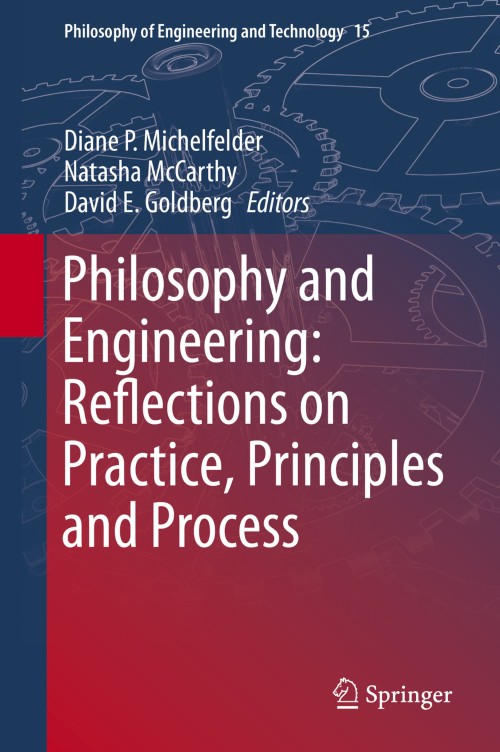
Philosophy and Engineering: Reflections on Practice, Principles and Process [electronic resource] / edited by Diane P Michelfelder, Natasha McCarthy, David E. Goldberg.
Erişim Adresi
ISBN
9789400777620
Dil Kodu
İngilizce
Yer Numarası
DK/8270
Basım Bildirimi
1st ed. 2013.
Yayın Bilgisi
Dordrecht : Springer Netherlands : Imprint: Springer, 2013.
Fiziksel Niteleme
XIX, 431 p. 42 illus. online resource.
Dizi
Philosophy of Engineering and Technology, 1879-7210 ; 15
İçindekiler Notu
Preface -- Foreword: An Exchange with Carl Mitcham -- Part I: Reflections on Practice. Chapter 1. The Ignorance of Engineers and How They Know It; Hans Poser -- Chapter 2. Rules of Skill: Ethics in Engineering; Wade L. Robison -- Chapter 3. Engineering as Performance: An “Experiential Gestalt” for the Understanding of Engineering; Rick Evans -- Chapter 4. The Formulation of Engineering Identities: Storytelling as Philosophical Inquiry; Russell Korte -- Chapter 5. Ove Arup: Theoretical and Moral Positions in Action and the Origins of an Engineering Firm; Andrew Chilvers and Sarah Bell -- Chapter 6. Transferable Skills Development in Engineering Students: Analysis of Service-Learning Impact; Donna M. Rizzo, Mandar M. Dewoolkar, and Nancy J. Hayden -- Chapter 7. Future Reflective Practitioners: The Contributions of Philosophy; Viola Schiaffionati -- Chapter 8. Fitting Engineering into Philosophy; Joseph C. Pitt -- Chapter 9. Engineering as Willing; Jon Alan Schmidt -- Part II: Reflections on Principles -- Chapter 10. Debunking Contemporary Myths Concerning Engineering; Billy Vaughn Koen -- Chapter 11. The Engineer’s Identity Crisis: Homo Faber or Homo Sapiens?; Priyan Dias -- Chapter 12. Varieties of Parthood: Ontology learns from Engineering; Peter Simons -- Chapter 13. Engineered Artifacts; Byron Newberry -- Chapter 14. Engineering Ethics: From Preventive Ethics to Aspirational Ethics; Charles E. Harris, Jr. -- Chapter 15. Making the Case for the Inclusion of Lay Persons on Engineering Accreditation Panels: A Role for an Engineering Hippocratic Oath?; William Grimson and Mike Murphy -- Chapter 16. Ethical Awareness in Chinese Professional Engineering Organizations: Textual Research on Constitutions of Chinese Engineering Societies; CAO Nanyan, SU Junbin, HU Mingyan -- Chapter 17. Engineering for Peace: An Obligation of Professional Capabilities; W. Richard Bowen -- Chapter 18. Roboethics and Telerobotic Weapons Systems; John P. Sullins -- Chapter 19. Normative Crossover: The Ethos of Socio-Technological Systems; Rune Nydal -- Part III: Reflections on Process -- Chapter 20. Translating Values into Design Requirements; Ibo van de Poel -- Chapter 21. Engineering Hubris: Adam Smith and the Quest for the Perfect Machine; Scott Forschler -- Chapter 22. The Technology of Collective Memory and the Normativity of Truth; Kieron O’Hara -- Chapter 23. Plans for Modeling Rational Acceptance of Technology; Wybo Houkes and Auke J.K. Pols -- Chapter 24. On the Epistemology of Breakthrough Innovation: The Orthogonal and Non-Linear Natures of Discovery; Bruce A. Vojak and Raymond L. Price -- Chapter 25. Uncertainty in the Design of Non-Prototypical Engineered Systems; William M. Bulleit -- Chapter 26. Object-Oriented Method and the Relationship between Structure and Function of Technical Artifacts; PAN Enrong -- Chapter 27. The Methodological Ladder of Industrialized Inventions: A Descriptive-Based and Explanation-Enhanced Prescriptive Model; M. H. Abolkheir -- Chapter 28. On the Feasibility ofNanotechnology: A Chinese Perspective; WANG Guoyu -- Chapter 29. Engineering Innovation: Energy, Policy, and the Role of Engineering; Zachary Pirtle -- Chapter 30. Is Engineering Philosophically Weak?; David E. Goldberg.
Özet, vb.
Building on the breakthrough text Philosophy and Engineering: An Emerging Agenda, this book offers 30 chapters covering conceptual and substantive developments in the philosophy of engineering, along with a series of critical reflections by engineering practitioners. The volume demonstrates how reflective engineering can contribute to a better understanding of engineering identity and explores how integrating engineering and philosophy could lead to innovation in engineering methods, design and education. The volume is divided into reflections on practice, principles and process, each of which challenges prevalent assumptions and commitments within engineering and philosophy. The volume explores the ontological and epistemological dimensions of engineering and exposes the falsity of the commonly held belief that the field is simply the application of science knowledge to problem solving. Above all, the perspectives collected here demonstrate the value of a constructive dialogue between engineering and philosophy and show how collaboration between the disciplines casts light on longstanding problems from both sides. The chapters in this volume are from a diverse and international body of authors, including philosophers and engineers, and represent a highly select group of papers originally presented in three different conferences. These are the 2008 Workshop on Philosophy and Engineering (WPE-2008) held at the Royal Academy of Engineering; the 2009 meeting of the Society for Philosophy and Technology (SPT-2009) at the University of Twente in the Netherlands; and the Forum on Philosophy, Engineering, and Technology (fPET-2010), held in Golden, Colorado at the Colorado School of Mines.
Konu
Technology __ Philosophy.
Engineering.
Science __ Study and teaching.
Philosophy of Technology.
Technology and Engineering.
Science Education.
Engineering.
Science __ Study and teaching.
Philosophy of Technology.
Technology and Engineering.
Science Education.
Diğer Yazarlar
Kurum Adı
Eseri Alıntıla
Referansları kullanmadan önce gözden geçirmeniz ve varsa gerekli düzeltmeleri yapmanız önerilir.
Dijital Kaynak
MARC Görünümü
LEADER 07132nam a22005655i 4500
001 806976
003 TR_AnAIT
005 20260127003208
007 cr nn 008mamaa
008 140113s2013 ne | s |||| 0|eng d
020 |a9789400777620|9978-94-007-7762-0
024 7 |a10.1007/978-94-007-7762-0|2doi
041 |aeng
049 |aTürk Tarih Kurumu Kütüphanesi
050 4|aT14
072 7|aHP|2bicssc
072 7|aTB|2bicssc
072 7|aSCI075000|2bisacsh
072 7|aQD|2thema
072 7|aTB|2thema
082 04|a601|223
090 |aDK/8270
245 10|aPhilosophy and Engineering: Reflections on Practice, Principles and Process|h[electronic resource] /|cedited by Diane P Michelfelder, Natasha McCarthy, David E. Goldberg.
250 |a1st ed. 2013.
264 1|aDordrecht :|bSpringer Netherlands :|bImprint: Springer,|c2013.
300 |aXIX, 431 p. 42 illus.|bonline resource.
336 |atext|btxt|2rdacontent
337 |acomputer|bc|2rdamedia
338 |aonline resource|bcr|2rdacarrier
347 |atext file|bPDF|2rda
490 1 |aPhilosophy of Engineering and Technology,|x1879-7210 ;|v15
505 0 |aPreface -- Foreword: An Exchange with Carl Mitcham -- Part I: Reflections on Practice. Chapter 1. The Ignorance of Engineers and How They Know It; Hans Poser -- Chapter 2. Rules of Skill: Ethics in Engineering; Wade L. Robison -- Chapter 3. Engineering as Performance: An “Experiential Gestalt” for the Understanding of Engineering; Rick Evans -- Chapter 4. The Formulation of Engineering Identities: Storytelling as Philosophical Inquiry; Russell Korte -- Chapter 5. Ove Arup: Theoretical and Moral Positions in Action and the Origins of an Engineering Firm; Andrew Chilvers and Sarah Bell -- Chapter 6. Transferable Skills Development in Engineering Students: Analysis of Service-Learning Impact; Donna M. Rizzo, Mandar M. Dewoolkar, and Nancy J. Hayden -- Chapter 7. Future Reflective Practitioners: The Contributions of Philosophy; Viola Schiaffionati -- Chapter 8. Fitting Engineering into Philosophy; Joseph C. Pitt -- Chapter 9. Engineering as Willing; Jon Alan Schmidt -- Part II: Reflections on Principles -- Chapter 10. Debunking Contemporary Myths Concerning Engineering; Billy Vaughn Koen -- Chapter 11. The Engineer’s Identity Crisis: Homo Faber or Homo Sapiens?; Priyan Dias -- Chapter 12. Varieties of Parthood: Ontology learns from Engineering; Peter Simons -- Chapter 13. Engineered Artifacts; Byron Newberry -- Chapter 14. Engineering Ethics: From Preventive Ethics to Aspirational Ethics; Charles E. Harris, Jr. -- Chapter 15. Making the Case for the Inclusion of Lay Persons on Engineering Accreditation Panels: A Role for an Engineering Hippocratic Oath?; William Grimson and Mike Murphy -- Chapter 16. Ethical Awareness in Chinese Professional Engineering Organizations: Textual Research on Constitutions of Chinese Engineering Societies; CAO Nanyan, SU Junbin, HU Mingyan -- Chapter 17. Engineering for Peace: An Obligation of Professional Capabilities; W. Richard Bowen -- Chapter 18. Roboethics and Telerobotic Weapons Systems; John P. Sullins -- Chapter 19. Normative Crossover: The Ethos of Socio-Technological Systems; Rune Nydal -- Part III: Reflections on Process -- Chapter 20. Translating Values into Design Requirements; Ibo van de Poel -- Chapter 21. Engineering Hubris: Adam Smith and the Quest for the Perfect Machine; Scott Forschler -- Chapter 22. The Technology of Collective Memory and the Normativity of Truth; Kieron O’Hara -- Chapter 23. Plans for Modeling Rational Acceptance of Technology; Wybo Houkes and Auke J.K. Pols -- Chapter 24. On the Epistemology of Breakthrough Innovation: The Orthogonal and Non-Linear Natures of Discovery; Bruce A. Vojak and Raymond L. Price -- Chapter 25. Uncertainty in the Design of Non-Prototypical Engineered Systems; William M. Bulleit -- Chapter 26. Object-Oriented Method and the Relationship between Structure and Function of Technical Artifacts; PAN Enrong -- Chapter 27. The Methodological Ladder of Industrialized Inventions: A Descriptive-Based and Explanation-Enhanced Prescriptive Model; M. H. Abolkheir -- Chapter 28. On the Feasibility ofNanotechnology: A Chinese Perspective; WANG Guoyu -- Chapter 29. Engineering Innovation: Energy, Policy, and the Role of Engineering; Zachary Pirtle -- Chapter 30. Is Engineering Philosophically Weak?; David E. Goldberg.
520 |aBuilding on the breakthrough text Philosophy and Engineering: An Emerging Agenda, this book offers 30 chapters covering conceptual and substantive developments in the philosophy of engineering, along with a series of critical reflections by engineering practitioners. The volume demonstrates how reflective engineering can contribute to a better understanding of engineering identity and explores how integrating engineering and philosophy could lead to innovation in engineering methods, design and education. The volume is divided into reflections on practice, principles and process, each of which challenges prevalent assumptions and commitments within engineering and philosophy. The volume explores the ontological and epistemological dimensions of engineering and exposes the falsity of the commonly held belief that the field is simply the application of science knowledge to problem solving. Above all, the perspectives collected here demonstrate the value of a constructive dialogue between engineering and philosophy and show how collaboration between the disciplines casts light on longstanding problems from both sides. The chapters in this volume are from a diverse and international body of authors, including philosophers and engineers, and represent a highly select group of papers originally presented in three different conferences. These are the 2008 Workshop on Philosophy and Engineering (WPE-2008) held at the Royal Academy of Engineering; the 2009 meeting of the Society for Philosophy and Technology (SPT-2009) at the University of Twente in the Netherlands; and the Forum on Philosophy, Engineering, and Technology (fPET-2010), held in Golden, Colorado at the Colorado School of Mines.
650 0|aTechnology|xPhilosophy.
650 0|aEngineering.
650 0|aScience|xStudy and teaching.
650 14|aPhilosophy of Technology.
650 24|aTechnology and Engineering.
650 24|aScience Education.
700 1 |aMichelfelder, Diane P.|eeditor.|4edt|4http://id.loc.gov/vocabulary/relators/edt
700 1 |aMcCarthy, Natasha.|eeditor.|4edt|4http://id.loc.gov/vocabulary/relators/edt
700 1 |aGoldberg, David E.|eeditor.|4edt|4http://id.loc.gov/vocabulary/relators/edt
710 2 |aSpringerLink (Online service)
773 0 |tSpringer Nature eBook
776 08|iPrinted edition:|z9789400777613
776 08|iPrinted edition:|z9789400777637
776 08|iPrinted edition:|z9789402402513
830 0|aPhilosophy of Engineering and Technology,|x1879-7210 ;|v15
856 40|uhttps://doi.org/10.1007/978-94-007-7762-0
912 |aZDB-2-SHU
912 |aZDB-2-SXPR
950 |aHumanities, Social Sciences and Law (SpringerNature-11648)
950 |aPhilosophy and Religion (R0) (SpringerNature-43725)
001 806976
003 TR_AnAIT
005 20260127003208
007 cr nn 008mamaa
008 140113s2013 ne | s |||| 0|eng d
020 |a9789400777620|9978-94-007-7762-0
024 7 |a10.1007/978-94-007-7762-0|2doi
041 |aeng
049 |aTürk Tarih Kurumu Kütüphanesi
050 4|aT14
072 7|aHP|2bicssc
072 7|aTB|2bicssc
072 7|aSCI075000|2bisacsh
072 7|aQD|2thema
072 7|aTB|2thema
082 04|a601|223
090 |aDK/8270
245 10|aPhilosophy and Engineering: Reflections on Practice, Principles and Process|h[electronic resource] /|cedited by Diane P Michelfelder, Natasha McCarthy, David E. Goldberg.
250 |a1st ed. 2013.
264 1|aDordrecht :|bSpringer Netherlands :|bImprint: Springer,|c2013.
300 |aXIX, 431 p. 42 illus.|bonline resource.
336 |atext|btxt|2rdacontent
337 |acomputer|bc|2rdamedia
338 |aonline resource|bcr|2rdacarrier
347 |atext file|bPDF|2rda
490 1 |aPhilosophy of Engineering and Technology,|x1879-7210 ;|v15
505 0 |aPreface -- Foreword: An Exchange with Carl Mitcham -- Part I: Reflections on Practice. Chapter 1. The Ignorance of Engineers and How They Know It; Hans Poser -- Chapter 2. Rules of Skill: Ethics in Engineering; Wade L. Robison -- Chapter 3. Engineering as Performance: An “Experiential Gestalt” for the Understanding of Engineering; Rick Evans -- Chapter 4. The Formulation of Engineering Identities: Storytelling as Philosophical Inquiry; Russell Korte -- Chapter 5. Ove Arup: Theoretical and Moral Positions in Action and the Origins of an Engineering Firm; Andrew Chilvers and Sarah Bell -- Chapter 6. Transferable Skills Development in Engineering Students: Analysis of Service-Learning Impact; Donna M. Rizzo, Mandar M. Dewoolkar, and Nancy J. Hayden -- Chapter 7. Future Reflective Practitioners: The Contributions of Philosophy; Viola Schiaffionati -- Chapter 8. Fitting Engineering into Philosophy; Joseph C. Pitt -- Chapter 9. Engineering as Willing; Jon Alan Schmidt -- Part II: Reflections on Principles -- Chapter 10. Debunking Contemporary Myths Concerning Engineering; Billy Vaughn Koen -- Chapter 11. The Engineer’s Identity Crisis: Homo Faber or Homo Sapiens?; Priyan Dias -- Chapter 12. Varieties of Parthood: Ontology learns from Engineering; Peter Simons -- Chapter 13. Engineered Artifacts; Byron Newberry -- Chapter 14. Engineering Ethics: From Preventive Ethics to Aspirational Ethics; Charles E. Harris, Jr. -- Chapter 15. Making the Case for the Inclusion of Lay Persons on Engineering Accreditation Panels: A Role for an Engineering Hippocratic Oath?; William Grimson and Mike Murphy -- Chapter 16. Ethical Awareness in Chinese Professional Engineering Organizations: Textual Research on Constitutions of Chinese Engineering Societies; CAO Nanyan, SU Junbin, HU Mingyan -- Chapter 17. Engineering for Peace: An Obligation of Professional Capabilities; W. Richard Bowen -- Chapter 18. Roboethics and Telerobotic Weapons Systems; John P. Sullins -- Chapter 19. Normative Crossover: The Ethos of Socio-Technological Systems; Rune Nydal -- Part III: Reflections on Process -- Chapter 20. Translating Values into Design Requirements; Ibo van de Poel -- Chapter 21. Engineering Hubris: Adam Smith and the Quest for the Perfect Machine; Scott Forschler -- Chapter 22. The Technology of Collective Memory and the Normativity of Truth; Kieron O’Hara -- Chapter 23. Plans for Modeling Rational Acceptance of Technology; Wybo Houkes and Auke J.K. Pols -- Chapter 24. On the Epistemology of Breakthrough Innovation: The Orthogonal and Non-Linear Natures of Discovery; Bruce A. Vojak and Raymond L. Price -- Chapter 25. Uncertainty in the Design of Non-Prototypical Engineered Systems; William M. Bulleit -- Chapter 26. Object-Oriented Method and the Relationship between Structure and Function of Technical Artifacts; PAN Enrong -- Chapter 27. The Methodological Ladder of Industrialized Inventions: A Descriptive-Based and Explanation-Enhanced Prescriptive Model; M. H. Abolkheir -- Chapter 28. On the Feasibility ofNanotechnology: A Chinese Perspective; WANG Guoyu -- Chapter 29. Engineering Innovation: Energy, Policy, and the Role of Engineering; Zachary Pirtle -- Chapter 30. Is Engineering Philosophically Weak?; David E. Goldberg.
520 |aBuilding on the breakthrough text Philosophy and Engineering: An Emerging Agenda, this book offers 30 chapters covering conceptual and substantive developments in the philosophy of engineering, along with a series of critical reflections by engineering practitioners. The volume demonstrates how reflective engineering can contribute to a better understanding of engineering identity and explores how integrating engineering and philosophy could lead to innovation in engineering methods, design and education. The volume is divided into reflections on practice, principles and process, each of which challenges prevalent assumptions and commitments within engineering and philosophy. The volume explores the ontological and epistemological dimensions of engineering and exposes the falsity of the commonly held belief that the field is simply the application of science knowledge to problem solving. Above all, the perspectives collected here demonstrate the value of a constructive dialogue between engineering and philosophy and show how collaboration between the disciplines casts light on longstanding problems from both sides. The chapters in this volume are from a diverse and international body of authors, including philosophers and engineers, and represent a highly select group of papers originally presented in three different conferences. These are the 2008 Workshop on Philosophy and Engineering (WPE-2008) held at the Royal Academy of Engineering; the 2009 meeting of the Society for Philosophy and Technology (SPT-2009) at the University of Twente in the Netherlands; and the Forum on Philosophy, Engineering, and Technology (fPET-2010), held in Golden, Colorado at the Colorado School of Mines.
650 0|aTechnology|xPhilosophy.
650 0|aEngineering.
650 0|aScience|xStudy and teaching.
650 14|aPhilosophy of Technology.
650 24|aTechnology and Engineering.
650 24|aScience Education.
700 1 |aMichelfelder, Diane P.|eeditor.|4edt|4http://id.loc.gov/vocabulary/relators/edt
700 1 |aMcCarthy, Natasha.|eeditor.|4edt|4http://id.loc.gov/vocabulary/relators/edt
700 1 |aGoldberg, David E.|eeditor.|4edt|4http://id.loc.gov/vocabulary/relators/edt
710 2 |aSpringerLink (Online service)
773 0 |tSpringer Nature eBook
776 08|iPrinted edition:|z9789400777613
776 08|iPrinted edition:|z9789400777637
776 08|iPrinted edition:|z9789402402513
830 0|aPhilosophy of Engineering and Technology,|x1879-7210 ;|v15
856 40|uhttps://doi.org/10.1007/978-94-007-7762-0
912 |aZDB-2-SHU
912 |aZDB-2-SXPR
950 |aHumanities, Social Sciences and Law (SpringerNature-11648)
950 |aPhilosophy and Religion (R0) (SpringerNature-43725)
Materyaller
Depodan talep edilen materyal sadece kütüphane içerisinde kullanılmaktadır.
Materyal dışarıya ödünç verilmemektedir.
Materyal dışarıya ödünç verilmemektedir.
