LEADER 04009nam a22004335i 4500
001 806984
003 TR_AnAIT
005 20260127003217
007 cr nn 008mamaa
008 140205s2014 ne | s |||| 0|eng d
020 |a9789462094734|9978-94-6209-473-4
024 7 |a10.1007/978-94-6209-473-4|2doi
041 |aeng
049 |aTürk Tarih Kurumu Kütüphanesi
050 4|aL1-991
072 7|aJN|2bicssc
072 7|aEDU000000|2bisacsh
072 7|aJN|2thema
082 04|a370|223
090 |aDK/8278
100 1 |aHamilton, David.|eauthor.|4aut|4http://id.loc.gov/vocabulary/relators/aut
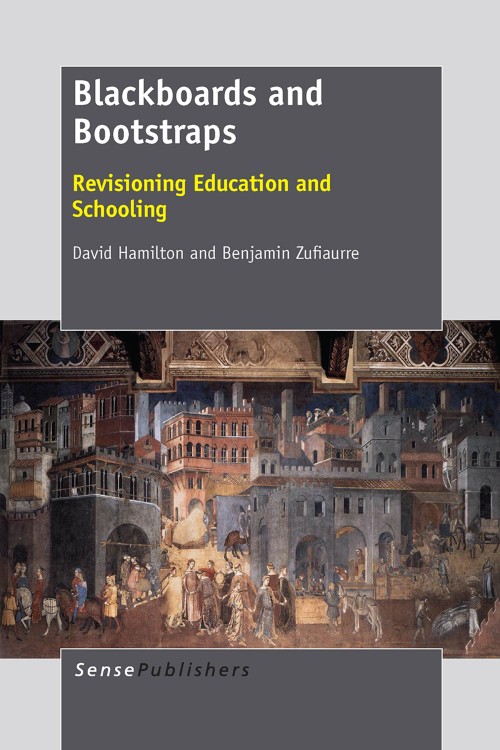
245 10|aBlackboards and Bootstraps|h[electronic resource] :|bRevisioning Education and Schooling /|cby David Hamilton, Benjamin Zufiaurre.
250 |a1st ed. 2014.
264 1|aRotterdam :|bSensePublishers :|bImprint: SensePublishers,|c2014.
300 |aXII, 160 p.|bonline resource.
336 |atext|btxt|2rdacontent
337 |acomputer|bc|2rdamedia
338 |aonline resource|bcr|2rdacarrier
347 |atext file|bPDF|2rda
520 |a"Blackboards and Bootstraps: Revisioning education and schooling contributes to an international conversation about public education that, in recent decades, has been attenuated if not silenced by advocates of neoliberalism, marketisation and neocorporatism. Written for a wide audience, this book is not a manifesto for the twenty-first century. It is more of an invitation than a blueprint. In drawing a distinction between education and schooling, it identifies, recovers and explores many ideas about education and schooling that are no less important to the practice of the present than they were to the pedagogues of the past. The introduction questions the role of schooling in the future trajectory of spaceship earth. The remainder of the book considers these questions by revisiting a range of ideas that underpin current practice. It launches itself by returning to the sixteenth century, a time when the organisation and conduct of modern schooling took shape around a new set of terms – syllabus, class, curriculum and didactics – that, in their Latin forms not only became prominent in the international educational lexicon but also survived into the twentieth century. By the First World War, there was an international awareness that schooling is not the same as education. Schooling originally for the land-owning, mercantile and commercial elites of the sixteenth century had only partially engaged with the visions of democratic schooling voiced in the eighteenth century Enlightenment and the subsequent extension of suffrage and national and sexual liberation movements. Impressed by the universalistic achievements of the Renaissance and the Enlightenment, the authors raise the prospect of a new educational humanism in the globalised world of the twenty-first century. ".
532 8 |aAccessibility summary: This PDF eBook is produced by a third-party. We have requested that the file be made accessible and compliant with the European Accessibility Act (EAA). However, we have not been able to fully verify its compliance with recognized accessibility standards (such as PDF/UA or WCAG). For detailed accessibility information, please refer to the original publisher’s website. If you require an accessible version of this content, please contact accessibilitysupport@springernature.com. We are committed to improving accessibility and will work with the publisher to meet your needs wherever possible.
532 8 |aPublisher contact for further accessibility information: accessibilitysupport@springernature.com
650 0|aEducation.
650 14|aEducation.
700 1 |aZufiaurre, Benjamin.|eauthor.|4aut|4http://id.loc.gov/vocabulary/relators/aut
710 2 |aSpringerLink (Online service)
773 0 |tSpringer Nature eBook
856 40|uhttps://doi.org/10.1007/978-94-6209-473-4
912 |aZDB-2-SHU
912 |aZDB-2-SXED
950 |aHumanities, Social Sciences and Law (SpringerNature-11648)
950 |aEducation (R0) (SpringerNature-43721)