LEADER 04239nam a22005295i 4500
001 806989
003 TR_AnAIT
005 20260127003223
007 cr nn 008mamaa
008 121227s1970 ne | s |||| 0|eng d
020 |a9789401032100|9978-94-010-3210-0
024 7 |a10.1007/978-94-010-3210-0|2doi
041 |aeng
049 |aTürk Tarih Kurumu Kütüphanesi
050 4|aD1-2027
072 7|aHB|2bicssc
072 7|aHBAH|2bicssc
072 7|aHIS000000|2bisacsh
072 7|aNH|2thema
072 7|aNHAH|2thema
082 04|a900|223
090 |aDK/8283
100 1 |aChung-Gi Kwai.|eauthor.|4aut|4http://id.loc.gov/vocabulary/relators/aut
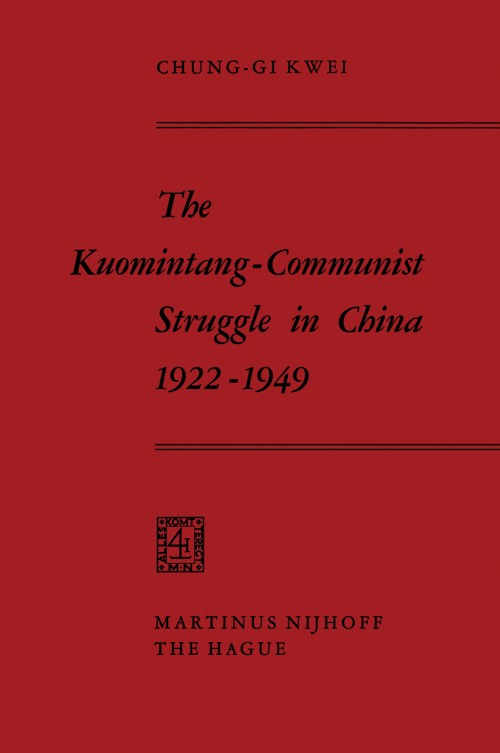
245 14|aThe Kuomintang-Communist Struggle in China 1922–1949|h[electronic resource] /|cby Chung-Gi Kwai.
250 |a1st ed. 1970.
264 1|aDordrecht :|bSpringer Netherlands :|bImprint: Springer,|c1970.
300 |a141 p.|bonline resource.
336 |atext|btxt|2rdacontent
337 |acomputer|bc|2rdamedia
338 |aonline resource|bcr|2rdacarrier
347 |atext file|bPDF|2rda
505 0 |aI. Dr. Sun’s Policy of Aligning with Soviet Russia and Admitting Chinese Communists to Kuomintang Membership -- II. Why Did the Third International Order Chinese Reds to Become Members of the Kuomintang? -- III. The Kuomintang after Admitting Chinese Reds to its Membership -- IV. Purging of the Party and Stoppage of Kuomintang Communist Cooperation -- V. Armed Uprisings and the Trek to Yenan -- VI. Direct Talks Between the Kuomintang and the Communists -- VII. American Mediation and the Political Consultative Conference -- VIII. Peace Talks During the Acting-Presidency of Li Tsung-Jen`.
520 |aAnyone making a study of the causes that led to the fall of the Chinese mainland into Communist hands will have to examine the long struggles between the two major rival parties in China, the Nationalists or the Kuomintang and the Chinese Communists. As the author once took a personal part in those struggles, he has assumed the task of giving an account of the facts as known to him. Some of the intricate events recorded in the following pages may be little known to the outside world or have not yet been revealed by others. What he has put down here has been carefully checked by him and is all backed up by firsthand sources. For example, on the eve of the March 19, 1926 Chungshan gunboat incident at Canton, an incident in which the Communists had plotted to kidnap General Chiang Kai-shek, then Commandant of the Whampoa Military Academy, someone had asked the General himself in person whether he was going back to Whampoa that day. Three telephone calls were made asking this question. In making a report of the incident after it was over, General Chiang did not identify who the individual was who was so persistent in ascertaining the General's movements on that momentous day, nor did he ever breathe a word of it even to his closest aides. Up to now few people know for sure who the person might have been.
532 8 |aAccessibility summary: This PDF is not accessible. It is based on scanned pages and does not support features such as screen reader compatibility or described non-text content (images, graphs etc). However, it likely supports searchable and selectable text based on OCR (Optical Character Recognition). Users with accessibility needs may not be able to use this content effectively. Please contact us at accessibilitysupport@springernature.com if you require assistance or an alternative format.
532 8 |aInaccessible, or known limited accessibility
532 8 |aNo reading system accessibility options actively disabled
532 8 |aPublisher contact for further accessibility information: accessibilitysupport@springernature.com
650 0|aHistory.
650 14|aHistory.
710 2 |aSpringerLink (Online service)
773 0 |tSpringer Nature eBook
776 08|iPrinted edition:|z9789024750047
776 08|iPrinted edition:|z9789401032117
776 08|iPrinted edition:|z9789401032124
856 40|uhttps://doi.org/10.1007/978-94-010-3210-0
912 |aZDB-2-SHU
912 |aZDB-2-SXH
912 |aZDB-2-BAE
950 |aHumanities, Social Sciences and Law (SpringerNature-11648)
950 |aHistory (R0) (SpringerNature-43722)