

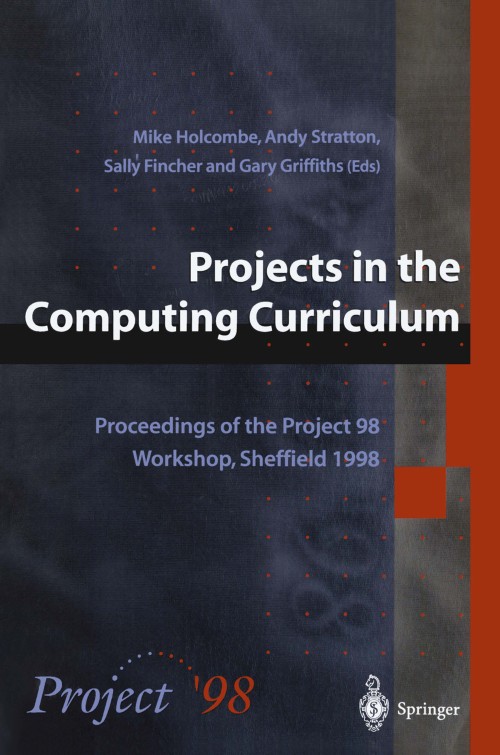
Projects in the Computing Curriculum [electronic resource] : Proceedings of the Project 98 Workshop, Sheffield 1998 / edited by Michael Holcombe, Andrew F. Stratton, Sally A. Fincher, Gary Griffiths.
Erişim Adresi
ISBN
9781447112617
Dil Kodu
İngilizce
Yer Numarası
DK/8375
Basım Bildirimi
1st ed. 1998.
Yayın Bilgisi
London : Springer London : Imprint: Springer, 1998.
Fiziksel Niteleme
XV, 231 p. 9 illus. online resource.
İçindekiler Notu
1 Professional Issues and Projects -- Teaching Professional Ethics to Software Engineers -- Using Other People’s Experience of Project Work: Realising Fitness for Purpose -- Using Group Project Work to Enhance the Learning of Professional Issues -- 2 Group Projects -- Improving the Quality of Software Engineering Courses Through University Based Industrial Projects -- Using Virtual Workspaces to Promote HND Group Project Success -- Group Projects for the Software Engineering of Knowledge Based Systems -- The Prof@T Project -- 3 New Directions -- VICI: Experiences in Introducing Student run Software Companies into the Curriculum -- Non-technical Issues in Undergraduate CS Project Work or What Are We (All) Here For? -- 4 Negotiation -- HEFCE EPCOS Project: Towards a Framework for Transferable Negotiated Learning Practices in Team Projects -- The Role of Learning Conversations (and the Learning Coach) in Computing Projects in Higher Education in the UK -- 5 Managing Projects -- Computing Science Projects at the University of Glasgow -- The Sheffield University Maxi Project — The Industrial Project Manager’s Perspective -- Perceptions of Final Year Project Outcomes -- Poster -- Group Projects -- Student Posters -- A Window on Group Formation Factors -- The VICI Student IT Company -- Author Index.
Özet, vb.
Dr Peter Milton, Director of Programme Review, Quality Assurance Agency I am grateful to the authors for giving me the opportunity to write this foreword, mainly because it represents the first occasion that the Fund for the Development of Teaching and Learning (FDTL) has led directly to a pUblication such as this. In my former capacity as Director of Quality Assessment at the Higher Education Funding Council for England (HEFCE), I chaired the FDTL Committee during 1996/7 and am delighted to see the projects which were selected so painstakingly leading to successful outcomes. Assessment of the quality of higher education (HE) was introduced in 1993 and was intended to improve public information about what was on offer in British universities and colleges, as well as to assist in the enhancement of educational opportunities for students. This was part of a larger agenda in which educational quality and the standards achieved by students have come under increasing scrutiny, with a long-term objective of linking funding allocations to the quality of the provision. It was in this context that the FDTL Initiative was launched in 1995 to support projects aimed at stimulating developments in teaching and learning and to encourage the dissemination of good practice across the HE sector. Good practice is identified through the process of quality assessment and bids for funding can only be made by those institutions which have demonstrated high quality provision. To date, the programme includes 63 projects drawn from 23 subject areas.
Konu
Learning, Psychology of.
Computer science.
Education __ Curricula.
Electronic digital computers __ Evaluation.
Software engineering.
Instructional Psychology.
Theory of Computation.
Curriculum Studies.
System Performance and Evaluation.
Software Engineering.
Computer science.
Education __ Curricula.
Electronic digital computers __ Evaluation.
Software engineering.
Instructional Psychology.
Theory of Computation.
Curriculum Studies.
System Performance and Evaluation.
Software Engineering.
Kurum Adı
Eseri Alıntıla
Referansları kullanmadan önce gözden geçirmeniz ve varsa gerekli düzeltmeleri yapmanız önerilir.
Dijital Kaynak
MARC Görünümü
LEADER 05851nam a22006255i 4500
001 807082
003 TR_AnAIT
005 20260127003412
007 cr nn 008mamaa
008 121227s1998 xxk| s |||| 0|eng d
020 |a9781447112617|9978-1-4471-1261-7
024 7 |a10.1007/978-1-4471-1261-7|2doi
041 |aeng
049 |aTürk Tarih Kurumu Kütüphanesi
050 4|aLB1060-1077
072 7|aJNC|2bicssc
072 7|aEDU009000|2bisacsh
072 7|aJNC|2thema
082 04|a370.15|223
090 |aDK/8375
245 10|aProjects in the Computing Curriculum|h[electronic resource] :|bProceedings of the Project 98 Workshop, Sheffield 1998 /|cedited by Michael Holcombe, Andrew F. Stratton, Sally A. Fincher, Gary Griffiths.
250 |a1st ed. 1998.
264 1|aLondon :|bSpringer London :|bImprint: Springer,|c1998.
300 |aXV, 231 p. 9 illus.|bonline resource.
336 |atext|btxt|2rdacontent
337 |acomputer|bc|2rdamedia
338 |aonline resource|bcr|2rdacarrier
347 |atext file|bPDF|2rda
505 0 |a1 Professional Issues and Projects -- Teaching Professional Ethics to Software Engineers -- Using Other People’s Experience of Project Work: Realising Fitness for Purpose -- Using Group Project Work to Enhance the Learning of Professional Issues -- 2 Group Projects -- Improving the Quality of Software Engineering Courses Through University Based Industrial Projects -- Using Virtual Workspaces to Promote HND Group Project Success -- Group Projects for the Software Engineering of Knowledge Based Systems -- The Prof@T Project -- 3 New Directions -- VICI: Experiences in Introducing Student run Software Companies into the Curriculum -- Non-technical Issues in Undergraduate CS Project Work or What Are We (All) Here For? -- 4 Negotiation -- HEFCE EPCOS Project: Towards a Framework for Transferable Negotiated Learning Practices in Team Projects -- The Role of Learning Conversations (and the Learning Coach) in Computing Projects in Higher Education in the UK -- 5 Managing Projects -- Computing Science Projects at the University of Glasgow -- The Sheffield University Maxi Project — The Industrial Project Manager’s Perspective -- Perceptions of Final Year Project Outcomes -- Poster -- Group Projects -- Student Posters -- A Window on Group Formation Factors -- The VICI Student IT Company -- Author Index.
520 |aDr Peter Milton, Director of Programme Review, Quality Assurance Agency I am grateful to the authors for giving me the opportunity to write this foreword, mainly because it represents the first occasion that the Fund for the Development of Teaching and Learning (FDTL) has led directly to a pUblication such as this. In my former capacity as Director of Quality Assessment at the Higher Education Funding Council for England (HEFCE), I chaired the FDTL Committee during 1996/7 and am delighted to see the projects which were selected so painstakingly leading to successful outcomes. Assessment of the quality of higher education (HE) was introduced in 1993 and was intended to improve public information about what was on offer in British universities and colleges, as well as to assist in the enhancement of educational opportunities for students. This was part of a larger agenda in which educational quality and the standards achieved by students have come under increasing scrutiny, with a long-term objective of linking funding allocations to the quality of the provision. It was in this context that the FDTL Initiative was launched in 1995 to support projects aimed at stimulating developments in teaching and learning and to encourage the dissemination of good practice across the HE sector. Good practice is identified through the process of quality assessment and bids for funding can only be made by those institutions which have demonstrated high quality provision. To date, the programme includes 63 projects drawn from 23 subject areas.
532 8 |aAccessibility summary: This PDF is not accessible. It is based on scanned pages and does not support features such as screen reader compatibility or described non-text content (images, graphs etc). However, it likely supports searchable and selectable text based on OCR (Optical Character Recognition). Users with accessibility needs may not be able to use this content effectively. Please contact us at accessibilitysupport@springernature.com if you require assistance or an alternative format.
532 8 |aInaccessible, or known limited accessibility
532 8 |aNo reading system accessibility options actively disabled
532 8 |aPublisher contact for further accessibility information: accessibilitysupport@springernature.com
650 0|aLearning, Psychology of.
650 0|aComputer science.
650 0|aEducation|xCurricula.
650 0|aElectronic digital computers|xEvaluation.
650 0|aSoftware engineering.
650 14|aInstructional Psychology.
650 24|aTheory of Computation.
650 24|aCurriculum Studies.
650 24|aSystem Performance and Evaluation.
650 24|aSoftware Engineering.
700 1 |aHolcombe, Michael.|eeditor.|4edt|4http://id.loc.gov/vocabulary/relators/edt
700 1 |aStratton, Andrew F.|eeditor.|4edt|4http://id.loc.gov/vocabulary/relators/edt
700 1 |aFincher, Sally A.|eeditor.|4edt|4http://id.loc.gov/vocabulary/relators/edt
700 1 |aGriffiths, Gary.|eeditor.|4edt|4http://id.loc.gov/vocabulary/relators/edt
710 2 |aSpringerLink (Online service)
773 0 |tSpringer Nature eBook
776 08|iPrinted edition:|z9781852330101
776 08|iPrinted edition:|z9781447112624
856 40|uhttps://doi.org/10.1007/978-1-4471-1261-7
912 |aZDB-2-SHU
912 |aZDB-2-SXED
912 |aZDB-2-BAE
950 |aHumanities, Social Sciences and Law (SpringerNature-11648)
950 |aEducation (R0) (SpringerNature-43721)
001 807082
003 TR_AnAIT
005 20260127003412
007 cr nn 008mamaa
008 121227s1998 xxk| s |||| 0|eng d
020 |a9781447112617|9978-1-4471-1261-7
024 7 |a10.1007/978-1-4471-1261-7|2doi
041 |aeng
049 |aTürk Tarih Kurumu Kütüphanesi
050 4|aLB1060-1077
072 7|aJNC|2bicssc
072 7|aEDU009000|2bisacsh
072 7|aJNC|2thema
082 04|a370.15|223
090 |aDK/8375
245 10|aProjects in the Computing Curriculum|h[electronic resource] :|bProceedings of the Project 98 Workshop, Sheffield 1998 /|cedited by Michael Holcombe, Andrew F. Stratton, Sally A. Fincher, Gary Griffiths.
250 |a1st ed. 1998.
264 1|aLondon :|bSpringer London :|bImprint: Springer,|c1998.
300 |aXV, 231 p. 9 illus.|bonline resource.
336 |atext|btxt|2rdacontent
337 |acomputer|bc|2rdamedia
338 |aonline resource|bcr|2rdacarrier
347 |atext file|bPDF|2rda
505 0 |a1 Professional Issues and Projects -- Teaching Professional Ethics to Software Engineers -- Using Other People’s Experience of Project Work: Realising Fitness for Purpose -- Using Group Project Work to Enhance the Learning of Professional Issues -- 2 Group Projects -- Improving the Quality of Software Engineering Courses Through University Based Industrial Projects -- Using Virtual Workspaces to Promote HND Group Project Success -- Group Projects for the Software Engineering of Knowledge Based Systems -- The Prof@T Project -- 3 New Directions -- VICI: Experiences in Introducing Student run Software Companies into the Curriculum -- Non-technical Issues in Undergraduate CS Project Work or What Are We (All) Here For? -- 4 Negotiation -- HEFCE EPCOS Project: Towards a Framework for Transferable Negotiated Learning Practices in Team Projects -- The Role of Learning Conversations (and the Learning Coach) in Computing Projects in Higher Education in the UK -- 5 Managing Projects -- Computing Science Projects at the University of Glasgow -- The Sheffield University Maxi Project — The Industrial Project Manager’s Perspective -- Perceptions of Final Year Project Outcomes -- Poster -- Group Projects -- Student Posters -- A Window on Group Formation Factors -- The VICI Student IT Company -- Author Index.
520 |aDr Peter Milton, Director of Programme Review, Quality Assurance Agency I am grateful to the authors for giving me the opportunity to write this foreword, mainly because it represents the first occasion that the Fund for the Development of Teaching and Learning (FDTL) has led directly to a pUblication such as this. In my former capacity as Director of Quality Assessment at the Higher Education Funding Council for England (HEFCE), I chaired the FDTL Committee during 1996/7 and am delighted to see the projects which were selected so painstakingly leading to successful outcomes. Assessment of the quality of higher education (HE) was introduced in 1993 and was intended to improve public information about what was on offer in British universities and colleges, as well as to assist in the enhancement of educational opportunities for students. This was part of a larger agenda in which educational quality and the standards achieved by students have come under increasing scrutiny, with a long-term objective of linking funding allocations to the quality of the provision. It was in this context that the FDTL Initiative was launched in 1995 to support projects aimed at stimulating developments in teaching and learning and to encourage the dissemination of good practice across the HE sector. Good practice is identified through the process of quality assessment and bids for funding can only be made by those institutions which have demonstrated high quality provision. To date, the programme includes 63 projects drawn from 23 subject areas.
532 8 |aAccessibility summary: This PDF is not accessible. It is based on scanned pages and does not support features such as screen reader compatibility or described non-text content (images, graphs etc). However, it likely supports searchable and selectable text based on OCR (Optical Character Recognition). Users with accessibility needs may not be able to use this content effectively. Please contact us at accessibilitysupport@springernature.com if you require assistance or an alternative format.
532 8 |aInaccessible, or known limited accessibility
532 8 |aNo reading system accessibility options actively disabled
532 8 |aPublisher contact for further accessibility information: accessibilitysupport@springernature.com
650 0|aLearning, Psychology of.
650 0|aComputer science.
650 0|aEducation|xCurricula.
650 0|aElectronic digital computers|xEvaluation.
650 0|aSoftware engineering.
650 14|aInstructional Psychology.
650 24|aTheory of Computation.
650 24|aCurriculum Studies.
650 24|aSystem Performance and Evaluation.
650 24|aSoftware Engineering.
700 1 |aHolcombe, Michael.|eeditor.|4edt|4http://id.loc.gov/vocabulary/relators/edt
700 1 |aStratton, Andrew F.|eeditor.|4edt|4http://id.loc.gov/vocabulary/relators/edt
700 1 |aFincher, Sally A.|eeditor.|4edt|4http://id.loc.gov/vocabulary/relators/edt
700 1 |aGriffiths, Gary.|eeditor.|4edt|4http://id.loc.gov/vocabulary/relators/edt
710 2 |aSpringerLink (Online service)
773 0 |tSpringer Nature eBook
776 08|iPrinted edition:|z9781852330101
776 08|iPrinted edition:|z9781447112624
856 40|uhttps://doi.org/10.1007/978-1-4471-1261-7
912 |aZDB-2-SHU
912 |aZDB-2-SXED
912 |aZDB-2-BAE
950 |aHumanities, Social Sciences and Law (SpringerNature-11648)
950 |aEducation (R0) (SpringerNature-43721)
Materyaller
Depodan talep edilen materyal sadece kütüphane içerisinde kullanılmaktadır.
Materyal dışarıya ödünç verilmemektedir.
Materyal dışarıya ödünç verilmemektedir.
