LEADER 04132nam a22005415i 4500
001 807114
003 TR_AnAIT
005 20260127003452
007 cr nn 008mamaa
008 121227s2000 xxu| s |||| 0|eng d
020 |a9781461541738|9978-1-4615-4173-8
024 7 |a10.1007/978-1-4615-4173-8|2doi
041 |aeng
049 |aTürk Tarih Kurumu Kütüphanesi
050 4|aCC1-960
072 7|aHD|2bicssc
072 7|aSOC003000|2bisacsh
072 7|aNK|2thema
082 04|a930.1|223
090 |aDK/8407
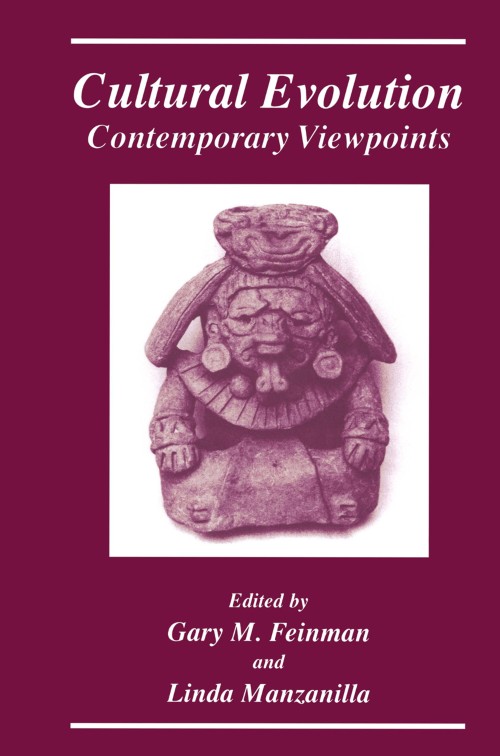
245 10|aCultural Evolution|h[electronic resource] :|bContemporary Viewpoints /|cedited by Gary M. Feinman, Linda Manzanilla.
250 |a1st ed. 2000.
264 1|aNew York, NY :|bSpringer US :|bImprint: Springer,|c2000.
300 |aXV, 269 p.|bonline resource.
336 |atext|btxt|2rdacontent
337 |acomputer|bc|2rdamedia
338 |aonline resource|bcr|2rdacarrier
347 |atext file|bPDF|2rda
505 0 |aI. Introduction -- 1. Cultural Evolutionary Approaches and Archaeology: Past, Present, and Future -- II. Technological Change and Economic Specialization -- 2. Guilá Naquitz Revisited: Agricultural Origins in Oaxaca, Mexico -- 3. The Evolution of theTipití: A Study in the Process of Invention -- 4. Accelerated Technological Change in Archaeology and Ancient History -- 5. High-Intensity Household-Scale Production in Ancient Mesoamerica: A Perspective from Ejutla, Oaxaca -- III. Political Complexity and Its Emergence -- 6. Lightning and Jaguars: Iconography, Ideology, and Politics in Formative Cuicatlán, Oaxaca -- 7. Games, Players, Rules, and Circumstances: Looking for Understandings of Social Change at Different Levels -- 8. Modeling Tributary Economies and Hierarchical Polities: A Prologue -- 9. The Development of Administration from Collective to Centralized Economies in the Mesopotamian World: The Transformation of an Institution from System-Serving to Self-Serving -- IV. Conclusions -- 10. A Concluding Perspective on the Theoretical Contributions of Kent V. Flannery: Tenets for the Next Century of U.S. Archaeology -- Postscript -- Comprehensive Bibliography of Kent V. Flannery.
520 |aDrawing on Kent Flannery's forty years of cross-cultural research in the area, the contributors to this collection reflect the current diversity of contemporary approaches to the study of cultural evolutionary processes. Collectively the volume expresses the richness of the issues being investigated by comparative theorists interested in long-term change, as well as the wide variety of data, approaches, and ideas that researchers are employing to examine these questions.
532 8 |aAccessibility summary: This PDF is not accessible. It is based on scanned pages and does not support features such as screen reader compatibility or described non-text content (images, graphs etc). However, it likely supports searchable and selectable text based on OCR (Optical Character Recognition). Users with accessibility needs may not be able to use this content effectively. Please contact us at accessibilitysupport@springernature.com if you require assistance or an alternative format.
532 8 |aInaccessible, or known limited accessibility
532 8 |aNo reading system accessibility options actively disabled
532 8 |aPublisher contact for further accessibility information: accessibilitysupport@springernature.com
650 0|aArchaeology.
650 0|aAnthropology.
650 14|aArchaeology.
650 24|aAnthropology.
700 1 |aFeinman, Gary M.|eeditor.|4edt|4http://id.loc.gov/vocabulary/relators/edt
700 1 |aManzanilla, Linda.|eeditor.|4edt|4http://id.loc.gov/vocabulary/relators/edt
710 2 |aSpringerLink (Online service)
773 0 |tSpringer Nature eBook
776 08|iPrinted edition:|z9780306462405
776 08|iPrinted edition:|z9781461541745
776 08|iPrinted edition:|z9781461368717
856 40|uhttps://doi.org/10.1007/978-1-4615-4173-8
912 |aZDB-2-SHU
912 |aZDB-2-SXS
912 |aZDB-2-BAE
950 |aHumanities, Social Sciences and Law (SpringerNature-11648)
950 |aSocial Sciences (R0) (SpringerNature-43726)