

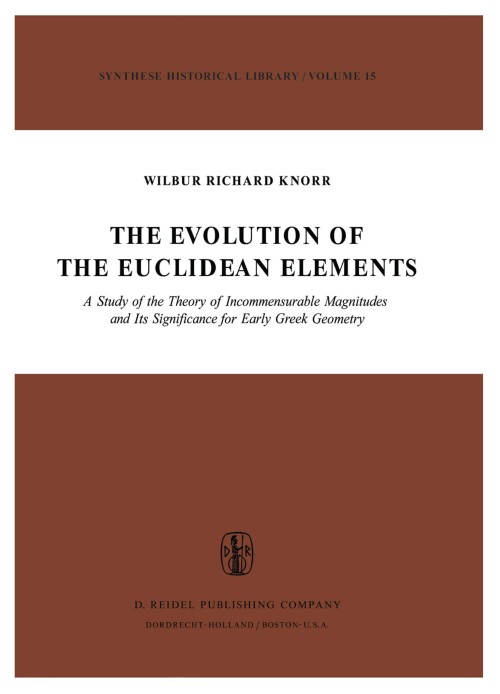
The Evolution of the Euclidean Elements [electronic resource] : A Study of the Theory of Incommensurable Magnitudes and Its Significance for Early Greek Geometry / by W.R. Knorr.
Erişim Adresi
ISBN
9789401017541
Dil Kodu
İngilizce
Yer Numarası
DK/8488
Yazar
Basım Bildirimi
1st ed. 1975.
Yayın Bilgisi
Dordrecht : Springer Netherlands : Imprint: Springer, 1975.
Fiziksel Niteleme
XI, 379 p. online resource.
Dizi
Synthese Historical Library ; 15
İçindekiler Notu
I / Introduction -- I. The Pre-Euclidean Theory of Incommensurable Magnitudes -- II. General Methodological Observations -- III. Indispensable Definitions -- II / The Side and the Diameter of the Square -- I. The Received Proof of the Incommensurability of the Side and Diameter of the Square -- II. Anthyphairesis and the Side and Diameter -- III. Impact of the Discovery of Incommensurability -- IV. Summary of the Early Studies -- III / Plato’s Account of the Work Of Theodorus -- I. Formulation of the Problem: ????µ??? -- II. The Role of Diagrams: ??????? -- III. The Ideal of Demonstration: ?????????? -- IV. Why Separate Cases? -- V. Why Stop at Seventeen? -- VI. The Theorems of Theaetetus -- VII. Theodoras’ Style of Geometry -- VIII. Summary of Interpretive Criteria -- IV / A Critical Review of Reconstructions of Theodorus’ Proofs -- I. Reconstruction via Approximation Techniques -- II. Algebraic Reconstruction -- III. Anthyphairetic Reconstruction -- V / The Pythagorean Arithmetic of the Fifth Century -- I. Pythagorean Studies of the Odd and the Even -- II. The Pebble-Representation of Numbers -- III. The Pebble-Methods Applied to the Study of the Odd and the Even -- IV. The Theory of Figured Numbers -- V. Properties of Pythagorean Number Triples -- VI / The Early Study of Incommensurable Magnitudes: Theodorus -- I. Numbers Represented as Magnitudes -- II. Right Triangles and the Discovery of Incommensurability -- III. The Lesson of Theodorus -- IV. Theodorus and Elements II -- VII / The Arithmetic of Incommensurability: Theaetetus and Archytas -- I. The Theorem of Archytas on Epimoric Ratios -- II. The Theorems of Theaetetus -- III. The Arithmetic Proofs of the Theorems of Theaetetus -- IV. The Arithmetic Basis of Theaetetus’ Theory -- V. Observations on Pre-EuclideanArithmetic -- VIII / The geometry of incommensurability: Theaetetus and Eudoxus -- I. The Theorems of Theaetetus: Proofs of the Geometric Part -- II. Anthyphairesis and the Theory of Proportions -- III. The Theory of Proportions in Elements X -- IV. Theaetetus and Eudoxus -- V. Summary of the Development of the Theory of Irrationals -- IX / Conclusions and Syntheses -- I. The Pre-Euclidean Theory of Incommensurable Magnitudes -- II. The Editing of the Elements -- III. The Pre-Euclidean Foundations-Crises -- Appendices -- A. On the Extension of Theodoras’ Method -- B. On the Anthyphairetic Proportion Theory -- A List of the Theorems in Chapters V-VIII and the Appendices -- Referencing Conventions and Bibliography -- I. Referencing Conventions -- II. Abbreviations used in the Notes and the Bibliography -- III. Bibliography of Works Consulted: Ancient Authors -- IV. Modern Works: Books -- V. Modern Works: Articles -- Index of Names -- Index of Passages Cited from Ancient Works.
Özet, vb.
The present work has three principal objectives: (1) to fix the chronology of the development of the pre-Euclidean theory of incommensurable magnitudes beginning from the first discoveries by fifth-century Pythago reans, advancing through the achievements of Theodorus of Cyrene, Theaetetus, Archytas and Eudoxus, and culminating in the formal theory of Elements X; (2) to correlate the stages of this developing theory with the evolution of the Elements as a whole; and (3) to establish that the high standards of rigor characteristic of this evolution were intrinsic to the mathematicians' work. In this third point, we wish to counterbalance a prevalent thesis that the impulse toward mathematical rigor was purely a response to the dialecticians' critique of foundations; on the contrary, we shall see that not until Eudoxus does there appear work which may be described as purely foundational in its intent. Through the examination of these problems, the present work will either alter or set in a new light virtually every standard thesis about the fourth-century Greek geometry. I. THE PRE-EUCLIDEAN THEORY OF INCOMMENSURABLE MAGNITUDES The Euclidean theory of incommensurable magnitudes, as preserved in Book X of the Elements, is a synthetic masterwork. Yet there are detect able seams in its structure, seams revealed both through terminology and through the historical clues provided by the neo-Platonist commentator Proclus.
Konu
Philosophy, Ancient.
Ancient Philosophy / Classical Philosophy.
Ancient Philosophy / Classical Philosophy.
Kurum Adı
Eseri Alıntıla
Referansları kullanmadan önce gözden geçirmeniz ve varsa gerekli düzeltmeleri yapmanız önerilir.
Dijital Kaynak
MARC Görünümü
LEADER 06763nam a22005295i 4500
001 807195
003 TR_AnAIT
005 20260127003625
007 cr nn 008mamaa
008 121227s1975 ne | s |||| 0|eng d
020 |a9789401017541|9978-94-010-1754-1
024 7 |a10.1007/978-94-010-1754-1|2doi
041 |aeng
049 |aTürk Tarih Kurumu Kütüphanesi
050 4|aB108-708
072 7|aHPCA|2bicssc
072 7|aPHI002000|2bisacsh
072 7|aQDHA|2thema
082 04|a180.0901|223
090 |aDK/8488
100 1 |aKnorr, W.R.|eauthor.|4aut|4http://id.loc.gov/vocabulary/relators/aut
245 14|aThe Evolution of the Euclidean Elements|h[electronic resource] :|bA Study of the Theory of Incommensurable Magnitudes and Its Significance for Early Greek Geometry /|cby W.R. Knorr.
250 |a1st ed. 1975.
264 1|aDordrecht :|bSpringer Netherlands :|bImprint: Springer,|c1975.
300 |aXI, 379 p.|bonline resource.
336 |atext|btxt|2rdacontent
337 |acomputer|bc|2rdamedia
338 |aonline resource|bcr|2rdacarrier
347 |atext file|bPDF|2rda
490 1 |aSynthese Historical Library ;|v15
505 0 |aI / Introduction -- I. The Pre-Euclidean Theory of Incommensurable Magnitudes -- II. General Methodological Observations -- III. Indispensable Definitions -- II / The Side and the Diameter of the Square -- I. The Received Proof of the Incommensurability of the Side and Diameter of the Square -- II. Anthyphairesis and the Side and Diameter -- III. Impact of the Discovery of Incommensurability -- IV. Summary of the Early Studies -- III / Plato’s Account of the Work Of Theodorus -- I. Formulation of the Problem: ????µ??? -- II. The Role of Diagrams: ??????? -- III. The Ideal of Demonstration: ?????????? -- IV. Why Separate Cases? -- V. Why Stop at Seventeen? -- VI. The Theorems of Theaetetus -- VII. Theodoras’ Style of Geometry -- VIII. Summary of Interpretive Criteria -- IV / A Critical Review of Reconstructions of Theodorus’ Proofs -- I. Reconstruction via Approximation Techniques -- II. Algebraic Reconstruction -- III. Anthyphairetic Reconstruction -- V / The Pythagorean Arithmetic of the Fifth Century -- I. Pythagorean Studies of the Odd and the Even -- II. The Pebble-Representation of Numbers -- III. The Pebble-Methods Applied to the Study of the Odd and the Even -- IV. The Theory of Figured Numbers -- V. Properties of Pythagorean Number Triples -- VI / The Early Study of Incommensurable Magnitudes: Theodorus -- I. Numbers Represented as Magnitudes -- II. Right Triangles and the Discovery of Incommensurability -- III. The Lesson of Theodorus -- IV. Theodorus and Elements II -- VII / The Arithmetic of Incommensurability: Theaetetus and Archytas -- I. The Theorem of Archytas on Epimoric Ratios -- II. The Theorems of Theaetetus -- III. The Arithmetic Proofs of the Theorems of Theaetetus -- IV. The Arithmetic Basis of Theaetetus’ Theory -- V. Observations on Pre-EuclideanArithmetic -- VIII / The geometry of incommensurability: Theaetetus and Eudoxus -- I. The Theorems of Theaetetus: Proofs of the Geometric Part -- II. Anthyphairesis and the Theory of Proportions -- III. The Theory of Proportions in Elements X -- IV. Theaetetus and Eudoxus -- V. Summary of the Development of the Theory of Irrationals -- IX / Conclusions and Syntheses -- I. The Pre-Euclidean Theory of Incommensurable Magnitudes -- II. The Editing of the Elements -- III. The Pre-Euclidean Foundations-Crises -- Appendices -- A. On the Extension of Theodoras’ Method -- B. On the Anthyphairetic Proportion Theory -- A List of the Theorems in Chapters V-VIII and the Appendices -- Referencing Conventions and Bibliography -- I. Referencing Conventions -- II. Abbreviations used in the Notes and the Bibliography -- III. Bibliography of Works Consulted: Ancient Authors -- IV. Modern Works: Books -- V. Modern Works: Articles -- Index of Names -- Index of Passages Cited from Ancient Works.
520 |aThe present work has three principal objectives: (1) to fix the chronology of the development of the pre-Euclidean theory of incommensurable magnitudes beginning from the first discoveries by fifth-century Pythago reans, advancing through the achievements of Theodorus of Cyrene, Theaetetus, Archytas and Eudoxus, and culminating in the formal theory of Elements X; (2) to correlate the stages of this developing theory with the evolution of the Elements as a whole; and (3) to establish that the high standards of rigor characteristic of this evolution were intrinsic to the mathematicians' work. In this third point, we wish to counterbalance a prevalent thesis that the impulse toward mathematical rigor was purely a response to the dialecticians' critique of foundations; on the contrary, we shall see that not until Eudoxus does there appear work which may be described as purely foundational in its intent. Through the examination of these problems, the present work will either alter or set in a new light virtually every standard thesis about the fourth-century Greek geometry. I. THE PRE-EUCLIDEAN THEORY OF INCOMMENSURABLE MAGNITUDES The Euclidean theory of incommensurable magnitudes, as preserved in Book X of the Elements, is a synthetic masterwork. Yet there are detect able seams in its structure, seams revealed both through terminology and through the historical clues provided by the neo-Platonist commentator Proclus.
532 8 |aAccessibility summary: This PDF is not accessible. It is based on scanned pages and does not support features such as screen reader compatibility or described non-text content (images, graphs etc). However, it likely supports searchable and selectable text based on OCR (Optical Character Recognition). Users with accessibility needs may not be able to use this content effectively. Please contact us at accessibilitysupport@springernature.com if you require assistance or an alternative format.
532 8 |aInaccessible, or known limited accessibility
532 8 |aNo reading system accessibility options actively disabled
532 8 |aPublisher contact for further accessibility information: accessibilitysupport@springernature.com
650 0|aPhilosophy, Ancient.
650 14|aAncient Philosophy / Classical Philosophy.
710 2 |aSpringerLink (Online service)
773 0 |tSpringer Nature eBook
776 08|iPrinted edition:|z9789027705099
776 08|iPrinted edition:|z9789027711922
776 08|iPrinted edition:|z9789401017558
830 0|aSynthese Historical Library ;|v15
856 40|uhttps://doi.org/10.1007/978-94-010-1754-1
912 |aZDB-2-SHU
912 |aZDB-2-SXPR
912 |aZDB-2-BAE
950 |aHumanities, Social Sciences and Law (SpringerNature-11648)
950 |aPhilosophy and Religion (R0) (SpringerNature-43725)
001 807195
003 TR_AnAIT
005 20260127003625
007 cr nn 008mamaa
008 121227s1975 ne | s |||| 0|eng d
020 |a9789401017541|9978-94-010-1754-1
024 7 |a10.1007/978-94-010-1754-1|2doi
041 |aeng
049 |aTürk Tarih Kurumu Kütüphanesi
050 4|aB108-708
072 7|aHPCA|2bicssc
072 7|aPHI002000|2bisacsh
072 7|aQDHA|2thema
082 04|a180.0901|223
090 |aDK/8488
100 1 |aKnorr, W.R.|eauthor.|4aut|4http://id.loc.gov/vocabulary/relators/aut
245 14|aThe Evolution of the Euclidean Elements|h[electronic resource] :|bA Study of the Theory of Incommensurable Magnitudes and Its Significance for Early Greek Geometry /|cby W.R. Knorr.
250 |a1st ed. 1975.
264 1|aDordrecht :|bSpringer Netherlands :|bImprint: Springer,|c1975.
300 |aXI, 379 p.|bonline resource.
336 |atext|btxt|2rdacontent
337 |acomputer|bc|2rdamedia
338 |aonline resource|bcr|2rdacarrier
347 |atext file|bPDF|2rda
490 1 |aSynthese Historical Library ;|v15
505 0 |aI / Introduction -- I. The Pre-Euclidean Theory of Incommensurable Magnitudes -- II. General Methodological Observations -- III. Indispensable Definitions -- II / The Side and the Diameter of the Square -- I. The Received Proof of the Incommensurability of the Side and Diameter of the Square -- II. Anthyphairesis and the Side and Diameter -- III. Impact of the Discovery of Incommensurability -- IV. Summary of the Early Studies -- III / Plato’s Account of the Work Of Theodorus -- I. Formulation of the Problem: ????µ??? -- II. The Role of Diagrams: ??????? -- III. The Ideal of Demonstration: ?????????? -- IV. Why Separate Cases? -- V. Why Stop at Seventeen? -- VI. The Theorems of Theaetetus -- VII. Theodoras’ Style of Geometry -- VIII. Summary of Interpretive Criteria -- IV / A Critical Review of Reconstructions of Theodorus’ Proofs -- I. Reconstruction via Approximation Techniques -- II. Algebraic Reconstruction -- III. Anthyphairetic Reconstruction -- V / The Pythagorean Arithmetic of the Fifth Century -- I. Pythagorean Studies of the Odd and the Even -- II. The Pebble-Representation of Numbers -- III. The Pebble-Methods Applied to the Study of the Odd and the Even -- IV. The Theory of Figured Numbers -- V. Properties of Pythagorean Number Triples -- VI / The Early Study of Incommensurable Magnitudes: Theodorus -- I. Numbers Represented as Magnitudes -- II. Right Triangles and the Discovery of Incommensurability -- III. The Lesson of Theodorus -- IV. Theodorus and Elements II -- VII / The Arithmetic of Incommensurability: Theaetetus and Archytas -- I. The Theorem of Archytas on Epimoric Ratios -- II. The Theorems of Theaetetus -- III. The Arithmetic Proofs of the Theorems of Theaetetus -- IV. The Arithmetic Basis of Theaetetus’ Theory -- V. Observations on Pre-EuclideanArithmetic -- VIII / The geometry of incommensurability: Theaetetus and Eudoxus -- I. The Theorems of Theaetetus: Proofs of the Geometric Part -- II. Anthyphairesis and the Theory of Proportions -- III. The Theory of Proportions in Elements X -- IV. Theaetetus and Eudoxus -- V. Summary of the Development of the Theory of Irrationals -- IX / Conclusions and Syntheses -- I. The Pre-Euclidean Theory of Incommensurable Magnitudes -- II. The Editing of the Elements -- III. The Pre-Euclidean Foundations-Crises -- Appendices -- A. On the Extension of Theodoras’ Method -- B. On the Anthyphairetic Proportion Theory -- A List of the Theorems in Chapters V-VIII and the Appendices -- Referencing Conventions and Bibliography -- I. Referencing Conventions -- II. Abbreviations used in the Notes and the Bibliography -- III. Bibliography of Works Consulted: Ancient Authors -- IV. Modern Works: Books -- V. Modern Works: Articles -- Index of Names -- Index of Passages Cited from Ancient Works.
520 |aThe present work has three principal objectives: (1) to fix the chronology of the development of the pre-Euclidean theory of incommensurable magnitudes beginning from the first discoveries by fifth-century Pythago reans, advancing through the achievements of Theodorus of Cyrene, Theaetetus, Archytas and Eudoxus, and culminating in the formal theory of Elements X; (2) to correlate the stages of this developing theory with the evolution of the Elements as a whole; and (3) to establish that the high standards of rigor characteristic of this evolution were intrinsic to the mathematicians' work. In this third point, we wish to counterbalance a prevalent thesis that the impulse toward mathematical rigor was purely a response to the dialecticians' critique of foundations; on the contrary, we shall see that not until Eudoxus does there appear work which may be described as purely foundational in its intent. Through the examination of these problems, the present work will either alter or set in a new light virtually every standard thesis about the fourth-century Greek geometry. I. THE PRE-EUCLIDEAN THEORY OF INCOMMENSURABLE MAGNITUDES The Euclidean theory of incommensurable magnitudes, as preserved in Book X of the Elements, is a synthetic masterwork. Yet there are detect able seams in its structure, seams revealed both through terminology and through the historical clues provided by the neo-Platonist commentator Proclus.
532 8 |aAccessibility summary: This PDF is not accessible. It is based on scanned pages and does not support features such as screen reader compatibility or described non-text content (images, graphs etc). However, it likely supports searchable and selectable text based on OCR (Optical Character Recognition). Users with accessibility needs may not be able to use this content effectively. Please contact us at accessibilitysupport@springernature.com if you require assistance or an alternative format.
532 8 |aInaccessible, or known limited accessibility
532 8 |aNo reading system accessibility options actively disabled
532 8 |aPublisher contact for further accessibility information: accessibilitysupport@springernature.com
650 0|aPhilosophy, Ancient.
650 14|aAncient Philosophy / Classical Philosophy.
710 2 |aSpringerLink (Online service)
773 0 |tSpringer Nature eBook
776 08|iPrinted edition:|z9789027705099
776 08|iPrinted edition:|z9789027711922
776 08|iPrinted edition:|z9789401017558
830 0|aSynthese Historical Library ;|v15
856 40|uhttps://doi.org/10.1007/978-94-010-1754-1
912 |aZDB-2-SHU
912 |aZDB-2-SXPR
912 |aZDB-2-BAE
950 |aHumanities, Social Sciences and Law (SpringerNature-11648)
950 |aPhilosophy and Religion (R0) (SpringerNature-43725)
Materyaller
Depodan talep edilen materyal sadece kütüphane içerisinde kullanılmaktadır.
Materyal dışarıya ödünç verilmemektedir.
Materyal dışarıya ödünç verilmemektedir.
