

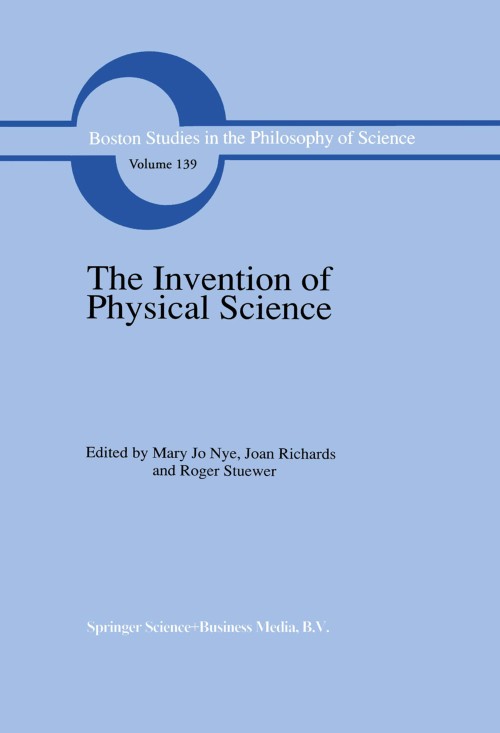
The Invention of Physical Science [electronic resource] : Intersections of Mathematics, Theology and Natural Philosophy Since the Seventeenth Century Essays in Honor of Erwin N. Hiebert / edited by M.J. Nye, J. Richards, R. Stuewer.
Erişim Adresi
ISBN
9789401124881
Dil Kodu
İngilizce
Yer Numarası
DK/8513
Basım Bildirimi
1st ed. 1992.
Yayın Bilgisi
Dordrecht : Springer Netherlands : Imprint: Springer, 1992.
Fiziksel Niteleme
XXXIV, 278 p. online resource.
Dizi
Boston Studies in the Philosophy and History of Science, 2214-7942 ; 139
İçindekiler Notu
I. Natural Theology, Natural Philosophy and the Certainty of Mathematics -- Devils’ Hells and Astronomers’ Heavens: Religion, Method, and Popular Culture in Speculations about Life on Comets -- The Doctrine of Chances without Chance: Determinism, Mathematical Probability, and Quantification in the Seventeenth Century -- God, Truth, and Mathematics in Nineteenth-Century England -- II. Problems of Contingency, Coherence, and Truth -- Theologians, Science, and Theories of Truth in Nineteenth-Century Germany -- Equivalence, Pragmatic Platonism, and Discovery of the Calculus -- III. The Aims and Foundations of Physical Science: The Cases of Electrical Physics, Psychophysics, and Physical Chemistry -- The Training of German Research Physicist Heinrich Hertz -- From Psychophysics to Phenomenalism: Mach and Hering on Color Vision -- A Usable Past: Creating Disciplinary Space for Physical Chemistry -- IV. Explanation and Discovery: The Claims of Chemistry, Physics, and Fortran -- Physics and Chemistry: Commensurate or Incommensurate Sciences? -- FORTRAN, Physics, and Human Nature -- APPENDIX I. Erwin N. Hiebert’s Doctoral Students and Directed Dissertations -- APPENDIX II. Erwin N. Hiebert. Selected List of Publications -- Notes on Contributors -- Name Index.
Özet, vb.
Modern physical science is constituted by specialized scientific fields rooted in experimental laboratory work and in rational and mathematical representations. Contemporary scientific explanation is rigorously differentiated from religious interpretation, although, to be sure, scientists sometimes do the philosophical work of interpreting the metaphysics of space, time, and matter. However, it is rare that either theologians or philosophers convincingly claim that they are doing the scientific work of physical scientists and mathematicians. The rigidity of these divisions and differentiations is relatively new. Modern physical science was invented slowly and gradually through interactions of the aims and contents of mathematics, theology, and natural philosophy since the seventeenth century. In essays ranging in focus from seventeenth-century interpretations of heavenly comets to twentieth-century explanations of tracks in bubble chambers, ten historians of science demonstrate metaphysical and theological threads continuing to underpin the epistemology and practice of the physical sciences and mathematics, even while they became disciplinary specialties during the last three centuries. The volume is prefaced by tributes to Erwin N. Hiebert, whose teaching and scholarship have addressed and inspired attention to these issues.
Konu
Science __ Philosophy.
History.
Philosophy of Science.
History.
History.
Philosophy of Science.
History.
Diğer Yazarlar
Kurum Adı
Eseri Alıntıla
Referansları kullanmadan önce gözden geçirmeniz ve varsa gerekli düzeltmeleri yapmanız önerilir.
Dijital Kaynak
MARC Görünümü
LEADER 05499nam a22005895i 4500
001 807220
003 TR_AnAIT
005 20260127003655
007 cr nn 008mamaa
008 121227s1992 ne | s |||| 0|eng d
020 |a9789401124881|9978-94-011-2488-1
024 7 |a10.1007/978-94-011-2488-1|2doi
041 |aeng
049 |aTürk Tarih Kurumu Kütüphanesi
050 4|aQ174-175.3
050 4|aB67
072 7|aPDA|2bicssc
072 7|aSCI075000|2bisacsh
072 7|aPDA|2thema
082 04|a501|223
090 |aDK/8513
245 14|aThe Invention of Physical Science|h[electronic resource] :|bIntersections of Mathematics, Theology and Natural Philosophy Since the Seventeenth Century Essays in Honor of Erwin N. Hiebert /|cedited by M.J. Nye, J. Richards, R. Stuewer.
250 |a1st ed. 1992.
264 1|aDordrecht :|bSpringer Netherlands :|bImprint: Springer,|c1992.
300 |aXXXIV, 278 p.|bonline resource.
336 |atext|btxt|2rdacontent
337 |acomputer|bc|2rdamedia
338 |aonline resource|bcr|2rdacarrier
347 |atext file|bPDF|2rda
490 1 |aBoston Studies in the Philosophy and History of Science,|x2214-7942 ;|v139
505 0 |aI. Natural Theology, Natural Philosophy and the Certainty of Mathematics -- Devils’ Hells and Astronomers’ Heavens: Religion, Method, and Popular Culture in Speculations about Life on Comets -- The Doctrine of Chances without Chance: Determinism, Mathematical Probability, and Quantification in the Seventeenth Century -- God, Truth, and Mathematics in Nineteenth-Century England -- II. Problems of Contingency, Coherence, and Truth -- Theologians, Science, and Theories of Truth in Nineteenth-Century Germany -- Equivalence, Pragmatic Platonism, and Discovery of the Calculus -- III. The Aims and Foundations of Physical Science: The Cases of Electrical Physics, Psychophysics, and Physical Chemistry -- The Training of German Research Physicist Heinrich Hertz -- From Psychophysics to Phenomenalism: Mach and Hering on Color Vision -- A Usable Past: Creating Disciplinary Space for Physical Chemistry -- IV. Explanation and Discovery: The Claims of Chemistry, Physics, and Fortran -- Physics and Chemistry: Commensurate or Incommensurate Sciences? -- FORTRAN, Physics, and Human Nature -- APPENDIX I. Erwin N. Hiebert’s Doctoral Students and Directed Dissertations -- APPENDIX II. Erwin N. Hiebert. Selected List of Publications -- Notes on Contributors -- Name Index.
520 |aModern physical science is constituted by specialized scientific fields rooted in experimental laboratory work and in rational and mathematical representations. Contemporary scientific explanation is rigorously differentiated from religious interpretation, although, to be sure, scientists sometimes do the philosophical work of interpreting the metaphysics of space, time, and matter. However, it is rare that either theologians or philosophers convincingly claim that they are doing the scientific work of physical scientists and mathematicians. The rigidity of these divisions and differentiations is relatively new. Modern physical science was invented slowly and gradually through interactions of the aims and contents of mathematics, theology, and natural philosophy since the seventeenth century. In essays ranging in focus from seventeenth-century interpretations of heavenly comets to twentieth-century explanations of tracks in bubble chambers, ten historians of science demonstrate metaphysical and theological threads continuing to underpin the epistemology and practice of the physical sciences and mathematics, even while they became disciplinary specialties during the last three centuries. The volume is prefaced by tributes to Erwin N. Hiebert, whose teaching and scholarship have addressed and inspired attention to these issues.
532 8 |aAccessibility summary: This PDF is not accessible. It is based on scanned pages and does not support features such as screen reader compatibility or described non-text content (images, graphs etc). However, it likely supports searchable and selectable text based on OCR (Optical Character Recognition). Users with accessibility needs may not be able to use this content effectively. Please contact us at accessibilitysupport@springernature.com if you require assistance or an alternative format.
532 8 |aInaccessible, or known limited accessibility
532 8 |aNo reading system accessibility options actively disabled
532 8 |aPublisher contact for further accessibility information: accessibilitysupport@springernature.com
650 0|aScience|xPhilosophy.
650 0|aHistory.
650 14|aPhilosophy of Science.
650 24|aHistory.
700 1 |aNye, M.J.|eeditor.|4edt|4http://id.loc.gov/vocabulary/relators/edt
700 1 |aRichards, J.|eeditor.|4edt|4http://id.loc.gov/vocabulary/relators/edt
700 1 |aStuewer, R.|eeditor.|4edt|4http://id.loc.gov/vocabulary/relators/edt
710 2 |aSpringerLink (Online service)
773 0 |tSpringer Nature eBook
776 08|iPrinted edition:|z9780792317531
776 08|iPrinted edition:|z9789401124898
776 08|iPrinted edition:|z9789401050975
830 0|aBoston Studies in the Philosophy and History of Science,|x2214-7942 ;|v139
856 40|uhttps://doi.org/10.1007/978-94-011-2488-1
912 |aZDB-2-SHU
912 |aZDB-2-SXPR
912 |aZDB-2-BAE
950 |aHumanities, Social Sciences and Law (SpringerNature-11648)
950 |aPhilosophy and Religion (R0) (SpringerNature-43725)
001 807220
003 TR_AnAIT
005 20260127003655
007 cr nn 008mamaa
008 121227s1992 ne | s |||| 0|eng d
020 |a9789401124881|9978-94-011-2488-1
024 7 |a10.1007/978-94-011-2488-1|2doi
041 |aeng
049 |aTürk Tarih Kurumu Kütüphanesi
050 4|aQ174-175.3
050 4|aB67
072 7|aPDA|2bicssc
072 7|aSCI075000|2bisacsh
072 7|aPDA|2thema
082 04|a501|223
090 |aDK/8513
245 14|aThe Invention of Physical Science|h[electronic resource] :|bIntersections of Mathematics, Theology and Natural Philosophy Since the Seventeenth Century Essays in Honor of Erwin N. Hiebert /|cedited by M.J. Nye, J. Richards, R. Stuewer.
250 |a1st ed. 1992.
264 1|aDordrecht :|bSpringer Netherlands :|bImprint: Springer,|c1992.
300 |aXXXIV, 278 p.|bonline resource.
336 |atext|btxt|2rdacontent
337 |acomputer|bc|2rdamedia
338 |aonline resource|bcr|2rdacarrier
347 |atext file|bPDF|2rda
490 1 |aBoston Studies in the Philosophy and History of Science,|x2214-7942 ;|v139
505 0 |aI. Natural Theology, Natural Philosophy and the Certainty of Mathematics -- Devils’ Hells and Astronomers’ Heavens: Religion, Method, and Popular Culture in Speculations about Life on Comets -- The Doctrine of Chances without Chance: Determinism, Mathematical Probability, and Quantification in the Seventeenth Century -- God, Truth, and Mathematics in Nineteenth-Century England -- II. Problems of Contingency, Coherence, and Truth -- Theologians, Science, and Theories of Truth in Nineteenth-Century Germany -- Equivalence, Pragmatic Platonism, and Discovery of the Calculus -- III. The Aims and Foundations of Physical Science: The Cases of Electrical Physics, Psychophysics, and Physical Chemistry -- The Training of German Research Physicist Heinrich Hertz -- From Psychophysics to Phenomenalism: Mach and Hering on Color Vision -- A Usable Past: Creating Disciplinary Space for Physical Chemistry -- IV. Explanation and Discovery: The Claims of Chemistry, Physics, and Fortran -- Physics and Chemistry: Commensurate or Incommensurate Sciences? -- FORTRAN, Physics, and Human Nature -- APPENDIX I. Erwin N. Hiebert’s Doctoral Students and Directed Dissertations -- APPENDIX II. Erwin N. Hiebert. Selected List of Publications -- Notes on Contributors -- Name Index.
520 |aModern physical science is constituted by specialized scientific fields rooted in experimental laboratory work and in rational and mathematical representations. Contemporary scientific explanation is rigorously differentiated from religious interpretation, although, to be sure, scientists sometimes do the philosophical work of interpreting the metaphysics of space, time, and matter. However, it is rare that either theologians or philosophers convincingly claim that they are doing the scientific work of physical scientists and mathematicians. The rigidity of these divisions and differentiations is relatively new. Modern physical science was invented slowly and gradually through interactions of the aims and contents of mathematics, theology, and natural philosophy since the seventeenth century. In essays ranging in focus from seventeenth-century interpretations of heavenly comets to twentieth-century explanations of tracks in bubble chambers, ten historians of science demonstrate metaphysical and theological threads continuing to underpin the epistemology and practice of the physical sciences and mathematics, even while they became disciplinary specialties during the last three centuries. The volume is prefaced by tributes to Erwin N. Hiebert, whose teaching and scholarship have addressed and inspired attention to these issues.
532 8 |aAccessibility summary: This PDF is not accessible. It is based on scanned pages and does not support features such as screen reader compatibility or described non-text content (images, graphs etc). However, it likely supports searchable and selectable text based on OCR (Optical Character Recognition). Users with accessibility needs may not be able to use this content effectively. Please contact us at accessibilitysupport@springernature.com if you require assistance or an alternative format.
532 8 |aInaccessible, or known limited accessibility
532 8 |aNo reading system accessibility options actively disabled
532 8 |aPublisher contact for further accessibility information: accessibilitysupport@springernature.com
650 0|aScience|xPhilosophy.
650 0|aHistory.
650 14|aPhilosophy of Science.
650 24|aHistory.
700 1 |aNye, M.J.|eeditor.|4edt|4http://id.loc.gov/vocabulary/relators/edt
700 1 |aRichards, J.|eeditor.|4edt|4http://id.loc.gov/vocabulary/relators/edt
700 1 |aStuewer, R.|eeditor.|4edt|4http://id.loc.gov/vocabulary/relators/edt
710 2 |aSpringerLink (Online service)
773 0 |tSpringer Nature eBook
776 08|iPrinted edition:|z9780792317531
776 08|iPrinted edition:|z9789401124898
776 08|iPrinted edition:|z9789401050975
830 0|aBoston Studies in the Philosophy and History of Science,|x2214-7942 ;|v139
856 40|uhttps://doi.org/10.1007/978-94-011-2488-1
912 |aZDB-2-SHU
912 |aZDB-2-SXPR
912 |aZDB-2-BAE
950 |aHumanities, Social Sciences and Law (SpringerNature-11648)
950 |aPhilosophy and Religion (R0) (SpringerNature-43725)
Materyaller
Depodan talep edilen materyal sadece kütüphane içerisinde kullanılmaktadır.
Materyal dışarıya ödünç verilmemektedir.
Materyal dışarıya ödünç verilmemektedir.
