

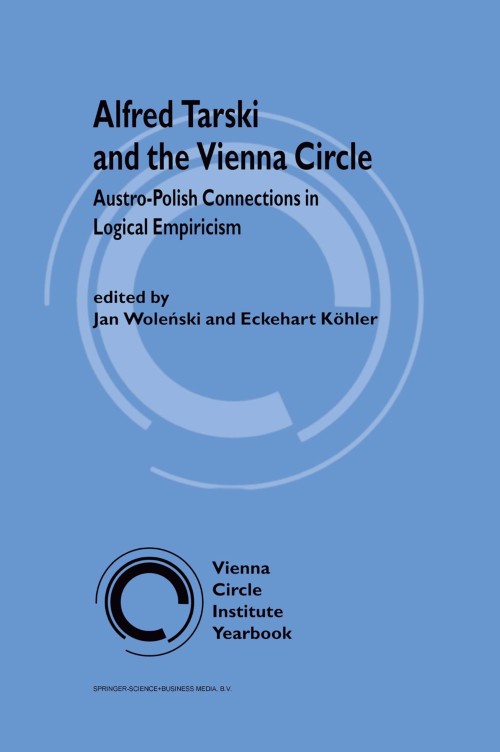
Alfred Tarski and the Vienna Circle [electronic resource] : Austro-Polish Connections in Logical Empiricism / edited by Jan Wolenski, Eckehart Köhler.
Erişim Adresi
ISBN
9789401706896
Dil Kodu
İngilizce
Yer Numarası
DK/8527
Basım Bildirimi
1st ed. 1999.
Yayın Bilgisi
Dordrecht : Springer Netherlands : Imprint: Springer, 1999.
Fiziksel Niteleme
X, 347 p. online resource.
Dizi
Vienna Circle Institute Yearbook, Institute Vienna Circle, University of Vienna Vienna Circle Society, Society for the Advancement of Scientific World Conceptions, 2215-1818 ; 6
İçindekiler Notu
Articles -- Semantic Revolution — Rudolf Carnap, Kurt Gödel, Alfred Tarski -- Theories of Truth: Vienna, Berlin, and Warsaw -- Truth Before Tarski -- How the Unity of Science Saved Alfred Tarski -- Tarski and Gödel: Between the Lines -- Carnap’s Move to Semantics: Gains and Losses -- Tarski and Carnap on Logical Truth — or: What Is Genuine Logic? -- Interplay of Philosophy and Mathematics in the Classical Theory of Truth -- Is Antipsychologism Still Tenable? -- Why Should a Physical Object Take on the Role of Truth-Bearer? -- ?ukasiewicz’ Theory of Truth, from the Quantum Logical Point of View -- Intuitionism and Logical Tolerance -- Tarski on Language and Truth -- Neurath’s Opposition to Tarskian Semantics -- Tarski and Wittgenstein on Semantics of Geometrical Figures -- Tarski’s Truth Condition Revisited -- Undefinability vs. Definability of Satisfaction and Truth -- Tarski’s Guilty Secret: Compositionality -- Should Tarski’s Idea of Consequence Operation be Revised? -- Remarks on a Carnapian Extension of S5 -- Report — Documentation -- Letters to Kurt Gödel, 1942–1947 (Translated and edited by Jan Tarski) -- Neo-Positivism and Italian Philosophy (1924–1973) -- Review Essay -- Critical Idealism Revisited — Recent Work on Cassirer’s Philosophy of Science -- Ronald N. Giere/Alan W. Richardson (eds.) Origins of Logical Empiricism, 1996 -- Hao Wang, A Logical Journey. From Gödel to Philosophy, 1996 -- Werner DePauli-Schimanovich/ Peter Weibel, Kurt Gödel. Ein mathematischer Mythos, 1997 -- John Earman, Bangs, Crunches, Whimpers, and Shrieks. Singularities and Acausalities in Relativistic Spacetimes, 1995 -- Anne Harrington, Reenchanted Science: Holism in German Culture from Wilhelm II to Hitler, 1996 -- Martin Kusch, Psychologism. A Case Study in the Sociology ofPhilosophical Knowledge -- Mauthner, Fritz, Das Philosophische Werk in 10 Bänden (ed. Ludger Lütkehaus) and Wörterbuch der Philosophie. Neue Beiträge zu einer Kritik der Sprache, 1997 -- Activities of the Institute Vienna Circle -- Survey 1998–1999 -- Preview 2000 -- Index of Names.
Özet, vb.
The larger part of Yearbook 6 of the Institute Vienna Circle constitutes the proceedings of a symposium on Alfred Tarski and his influence on and interchanges with the Vienna Circle, especially those on and with Rudolf Carnap and Kurt Gödel. It is the first time that this topic has been treated on such a scale and in such depth. Attention is mainly paid to the origins, development and subsequent role of Tarski's definition of truth. Some contributions are primarily historical, others analyze logical aspects of the concept of truth. Contributors include Anita and Saul Feferman, Jan Wolenski, Jan Tarski and Hans Sluga. Several Polish logicians contributed: Gzegorczyk, Wójcicki, Murawski and Rojszczak. The volume presents entirely new biographical material on Tarski, both from his Polish period and on his influential career in the United States: at Harvard, in Princeton, at Hunter, and at the University of California at Berkeley. The high point of the analysis involves Tarski's influence on Carnap's evolution from a narrow syntactical view of language, to the ontologically more sophisticated but more controversial semantical view. Another highlight involves the interchange between Tarski and Gödel on the connection between truth and proof and on the nature of metalanguages. The concluding part of Yearbook 6 includes documentation, book reviews and a summary of current activities of the Institute Vienna Circle. Jan Tarski introduces letters written by his father to Gödel; Paolo Parrini reports on the Vienna Circle's influence in Italy; several reviews cover recent books on logical empiricism, on Gödel, on cosmology, on holistic approaches in Germany, and on Mauthner.
Konu
Science __ Philosophy.
Logic.
Mathematics.
History.
Mathematical logic.
Semiotics.
Philosophy of Science.
Logic.
History of Mathematical Sciences.
Mathematical Logic and Foundations.
Semiotics.
Logic.
Mathematics.
History.
Mathematical logic.
Semiotics.
Philosophy of Science.
Logic.
History of Mathematical Sciences.
Mathematical Logic and Foundations.
Semiotics.
Diğer Yazarlar
Kurum Adı
Eseri Alıntıla
Referansları kullanmadan önce gözden geçirmeniz ve varsa gerekli düzeltmeleri yapmanız önerilir.
Dijital Kaynak
MARC Görünümü
LEADER 06976nam a22006615i 4500
001 807234
003 TR_AnAIT
005 20260127003712
007 cr nn 008mamaa
008 130125s1999 ne | s |||| 0|eng d
020 |a9789401706896|9978-94-017-0689-6
024 7 |a10.1007/978-94-017-0689-6|2doi
041 |aeng
049 |aTürk Tarih Kurumu Kütüphanesi
050 4|aQ174-175.3
050 4|aB67
072 7|aPDA|2bicssc
072 7|aSCI075000|2bisacsh
072 7|aPDA|2thema
082 04|a501|223
090 |aDK/8527
245 10|aAlfred Tarski and the Vienna Circle|h[electronic resource] :|bAustro-Polish Connections in Logical Empiricism /|cedited by Jan Wolenski, Eckehart Köhler.
250 |a1st ed. 1999.
264 1|aDordrecht :|bSpringer Netherlands :|bImprint: Springer,|c1999.
300 |aX, 347 p.|bonline resource.
336 |atext|btxt|2rdacontent
337 |acomputer|bc|2rdamedia
338 |aonline resource|bcr|2rdacarrier
347 |atext file|bPDF|2rda
490 1 |aVienna Circle Institute Yearbook, Institute Vienna Circle, University of Vienna Vienna Circle Society, Society for the Advancement of Scientific World Conceptions,|x2215-1818 ;|v6
505 0 |aArticles -- Semantic Revolution — Rudolf Carnap, Kurt Gödel, Alfred Tarski -- Theories of Truth: Vienna, Berlin, and Warsaw -- Truth Before Tarski -- How the Unity of Science Saved Alfred Tarski -- Tarski and Gödel: Between the Lines -- Carnap’s Move to Semantics: Gains and Losses -- Tarski and Carnap on Logical Truth — or: What Is Genuine Logic? -- Interplay of Philosophy and Mathematics in the Classical Theory of Truth -- Is Antipsychologism Still Tenable? -- Why Should a Physical Object Take on the Role of Truth-Bearer? -- ?ukasiewicz’ Theory of Truth, from the Quantum Logical Point of View -- Intuitionism and Logical Tolerance -- Tarski on Language and Truth -- Neurath’s Opposition to Tarskian Semantics -- Tarski and Wittgenstein on Semantics of Geometrical Figures -- Tarski’s Truth Condition Revisited -- Undefinability vs. Definability of Satisfaction and Truth -- Tarski’s Guilty Secret: Compositionality -- Should Tarski’s Idea of Consequence Operation be Revised? -- Remarks on a Carnapian Extension of S5 -- Report — Documentation -- Letters to Kurt Gödel, 1942–1947 (Translated and edited by Jan Tarski) -- Neo-Positivism and Italian Philosophy (1924–1973) -- Review Essay -- Critical Idealism Revisited — Recent Work on Cassirer’s Philosophy of Science -- Ronald N. Giere/Alan W. Richardson (eds.) Origins of Logical Empiricism, 1996 -- Hao Wang, A Logical Journey. From Gödel to Philosophy, 1996 -- Werner DePauli-Schimanovich/ Peter Weibel, Kurt Gödel. Ein mathematischer Mythos, 1997 -- John Earman, Bangs, Crunches, Whimpers, and Shrieks. Singularities and Acausalities in Relativistic Spacetimes, 1995 -- Anne Harrington, Reenchanted Science: Holism in German Culture from Wilhelm II to Hitler, 1996 -- Martin Kusch, Psychologism. A Case Study in the Sociology ofPhilosophical Knowledge -- Mauthner, Fritz, Das Philosophische Werk in 10 Bänden (ed. Ludger Lütkehaus) and Wörterbuch der Philosophie. Neue Beiträge zu einer Kritik der Sprache, 1997 -- Activities of the Institute Vienna Circle -- Survey 1998–1999 -- Preview 2000 -- Index of Names.
520 |aThe larger part of Yearbook 6 of the Institute Vienna Circle constitutes the proceedings of a symposium on Alfred Tarski and his influence on and interchanges with the Vienna Circle, especially those on and with Rudolf Carnap and Kurt Gödel. It is the first time that this topic has been treated on such a scale and in such depth. Attention is mainly paid to the origins, development and subsequent role of Tarski's definition of truth. Some contributions are primarily historical, others analyze logical aspects of the concept of truth. Contributors include Anita and Saul Feferman, Jan Wolenski, Jan Tarski and Hans Sluga. Several Polish logicians contributed: Gzegorczyk, Wójcicki, Murawski and Rojszczak. The volume presents entirely new biographical material on Tarski, both from his Polish period and on his influential career in the United States: at Harvard, in Princeton, at Hunter, and at the University of California at Berkeley. The high point of the analysis involves Tarski's influence on Carnap's evolution from a narrow syntactical view of language, to the ontologically more sophisticated but more controversial semantical view. Another highlight involves the interchange between Tarski and Gödel on the connection between truth and proof and on the nature of metalanguages. The concluding part of Yearbook 6 includes documentation, book reviews and a summary of current activities of the Institute Vienna Circle. Jan Tarski introduces letters written by his father to Gödel; Paolo Parrini reports on the Vienna Circle's influence in Italy; several reviews cover recent books on logical empiricism, on Gödel, on cosmology, on holistic approaches in Germany, and on Mauthner.
532 8 |aAccessibility summary: This PDF is not accessible. It is based on scanned pages and does not support features such as screen reader compatibility or described non-text content (images, graphs etc). However, it likely supports searchable and selectable text based on OCR (Optical Character Recognition). Users with accessibility needs may not be able to use this content effectively. Please contact us at accessibilitysupport@springernature.com if you require assistance or an alternative format.
532 8 |aInaccessible, or known limited accessibility
532 8 |aNo reading system accessibility options actively disabled
532 8 |aPublisher contact for further accessibility information: accessibilitysupport@springernature.com
650 0|aScience|xPhilosophy.
650 0|aLogic.
650 0|aMathematics.
650 0|aHistory.
650 0|aMathematical logic.
650 0|aSemiotics.
650 14|aPhilosophy of Science.
650 24|aLogic.
650 24|aHistory of Mathematical Sciences.
650 24|aMathematical Logic and Foundations.
650 24|aSemiotics.
700 1 |aWolenski, Jan.|eeditor.|4edt|4http://id.loc.gov/vocabulary/relators/edt
700 1 |aKöhler, Eckehart.|eeditor.|4edt|4http://id.loc.gov/vocabulary/relators/edt
710 2 |aSpringerLink (Online service)
773 0 |tSpringer Nature eBook
776 08|iPrinted edition:|z9780792355380
776 08|iPrinted edition:|z9789048151615
776 08|iPrinted edition:|z9789401706902
830 0|aVienna Circle Institute Yearbook, Institute Vienna Circle, University of Vienna Vienna Circle Society, Society for the Advancement of Scientific World Conceptions,|x2215-1818 ;|v6
856 40|uhttps://doi.org/10.1007/978-94-017-0689-6
912 |aZDB-2-SHU
912 |aZDB-2-SXPR
912 |aZDB-2-BAE
950 |aHumanities, Social Sciences and Law (SpringerNature-11648)
950 |aPhilosophy and Religion (R0) (SpringerNature-43725)
001 807234
003 TR_AnAIT
005 20260127003712
007 cr nn 008mamaa
008 130125s1999 ne | s |||| 0|eng d
020 |a9789401706896|9978-94-017-0689-6
024 7 |a10.1007/978-94-017-0689-6|2doi
041 |aeng
049 |aTürk Tarih Kurumu Kütüphanesi
050 4|aQ174-175.3
050 4|aB67
072 7|aPDA|2bicssc
072 7|aSCI075000|2bisacsh
072 7|aPDA|2thema
082 04|a501|223
090 |aDK/8527
245 10|aAlfred Tarski and the Vienna Circle|h[electronic resource] :|bAustro-Polish Connections in Logical Empiricism /|cedited by Jan Wolenski, Eckehart Köhler.
250 |a1st ed. 1999.
264 1|aDordrecht :|bSpringer Netherlands :|bImprint: Springer,|c1999.
300 |aX, 347 p.|bonline resource.
336 |atext|btxt|2rdacontent
337 |acomputer|bc|2rdamedia
338 |aonline resource|bcr|2rdacarrier
347 |atext file|bPDF|2rda
490 1 |aVienna Circle Institute Yearbook, Institute Vienna Circle, University of Vienna Vienna Circle Society, Society for the Advancement of Scientific World Conceptions,|x2215-1818 ;|v6
505 0 |aArticles -- Semantic Revolution — Rudolf Carnap, Kurt Gödel, Alfred Tarski -- Theories of Truth: Vienna, Berlin, and Warsaw -- Truth Before Tarski -- How the Unity of Science Saved Alfred Tarski -- Tarski and Gödel: Between the Lines -- Carnap’s Move to Semantics: Gains and Losses -- Tarski and Carnap on Logical Truth — or: What Is Genuine Logic? -- Interplay of Philosophy and Mathematics in the Classical Theory of Truth -- Is Antipsychologism Still Tenable? -- Why Should a Physical Object Take on the Role of Truth-Bearer? -- ?ukasiewicz’ Theory of Truth, from the Quantum Logical Point of View -- Intuitionism and Logical Tolerance -- Tarski on Language and Truth -- Neurath’s Opposition to Tarskian Semantics -- Tarski and Wittgenstein on Semantics of Geometrical Figures -- Tarski’s Truth Condition Revisited -- Undefinability vs. Definability of Satisfaction and Truth -- Tarski’s Guilty Secret: Compositionality -- Should Tarski’s Idea of Consequence Operation be Revised? -- Remarks on a Carnapian Extension of S5 -- Report — Documentation -- Letters to Kurt Gödel, 1942–1947 (Translated and edited by Jan Tarski) -- Neo-Positivism and Italian Philosophy (1924–1973) -- Review Essay -- Critical Idealism Revisited — Recent Work on Cassirer’s Philosophy of Science -- Ronald N. Giere/Alan W. Richardson (eds.) Origins of Logical Empiricism, 1996 -- Hao Wang, A Logical Journey. From Gödel to Philosophy, 1996 -- Werner DePauli-Schimanovich/ Peter Weibel, Kurt Gödel. Ein mathematischer Mythos, 1997 -- John Earman, Bangs, Crunches, Whimpers, and Shrieks. Singularities and Acausalities in Relativistic Spacetimes, 1995 -- Anne Harrington, Reenchanted Science: Holism in German Culture from Wilhelm II to Hitler, 1996 -- Martin Kusch, Psychologism. A Case Study in the Sociology ofPhilosophical Knowledge -- Mauthner, Fritz, Das Philosophische Werk in 10 Bänden (ed. Ludger Lütkehaus) and Wörterbuch der Philosophie. Neue Beiträge zu einer Kritik der Sprache, 1997 -- Activities of the Institute Vienna Circle -- Survey 1998–1999 -- Preview 2000 -- Index of Names.
520 |aThe larger part of Yearbook 6 of the Institute Vienna Circle constitutes the proceedings of a symposium on Alfred Tarski and his influence on and interchanges with the Vienna Circle, especially those on and with Rudolf Carnap and Kurt Gödel. It is the first time that this topic has been treated on such a scale and in such depth. Attention is mainly paid to the origins, development and subsequent role of Tarski's definition of truth. Some contributions are primarily historical, others analyze logical aspects of the concept of truth. Contributors include Anita and Saul Feferman, Jan Wolenski, Jan Tarski and Hans Sluga. Several Polish logicians contributed: Gzegorczyk, Wójcicki, Murawski and Rojszczak. The volume presents entirely new biographical material on Tarski, both from his Polish period and on his influential career in the United States: at Harvard, in Princeton, at Hunter, and at the University of California at Berkeley. The high point of the analysis involves Tarski's influence on Carnap's evolution from a narrow syntactical view of language, to the ontologically more sophisticated but more controversial semantical view. Another highlight involves the interchange between Tarski and Gödel on the connection between truth and proof and on the nature of metalanguages. The concluding part of Yearbook 6 includes documentation, book reviews and a summary of current activities of the Institute Vienna Circle. Jan Tarski introduces letters written by his father to Gödel; Paolo Parrini reports on the Vienna Circle's influence in Italy; several reviews cover recent books on logical empiricism, on Gödel, on cosmology, on holistic approaches in Germany, and on Mauthner.
532 8 |aAccessibility summary: This PDF is not accessible. It is based on scanned pages and does not support features such as screen reader compatibility or described non-text content (images, graphs etc). However, it likely supports searchable and selectable text based on OCR (Optical Character Recognition). Users with accessibility needs may not be able to use this content effectively. Please contact us at accessibilitysupport@springernature.com if you require assistance or an alternative format.
532 8 |aInaccessible, or known limited accessibility
532 8 |aNo reading system accessibility options actively disabled
532 8 |aPublisher contact for further accessibility information: accessibilitysupport@springernature.com
650 0|aScience|xPhilosophy.
650 0|aLogic.
650 0|aMathematics.
650 0|aHistory.
650 0|aMathematical logic.
650 0|aSemiotics.
650 14|aPhilosophy of Science.
650 24|aLogic.
650 24|aHistory of Mathematical Sciences.
650 24|aMathematical Logic and Foundations.
650 24|aSemiotics.
700 1 |aWolenski, Jan.|eeditor.|4edt|4http://id.loc.gov/vocabulary/relators/edt
700 1 |aKöhler, Eckehart.|eeditor.|4edt|4http://id.loc.gov/vocabulary/relators/edt
710 2 |aSpringerLink (Online service)
773 0 |tSpringer Nature eBook
776 08|iPrinted edition:|z9780792355380
776 08|iPrinted edition:|z9789048151615
776 08|iPrinted edition:|z9789401706902
830 0|aVienna Circle Institute Yearbook, Institute Vienna Circle, University of Vienna Vienna Circle Society, Society for the Advancement of Scientific World Conceptions,|x2215-1818 ;|v6
856 40|uhttps://doi.org/10.1007/978-94-017-0689-6
912 |aZDB-2-SHU
912 |aZDB-2-SXPR
912 |aZDB-2-BAE
950 |aHumanities, Social Sciences and Law (SpringerNature-11648)
950 |aPhilosophy and Religion (R0) (SpringerNature-43725)
Materyaller
Depodan talep edilen materyal sadece kütüphane içerisinde kullanılmaktadır.
Materyal dışarıya ödünç verilmemektedir.
Materyal dışarıya ödünç verilmemektedir.
