

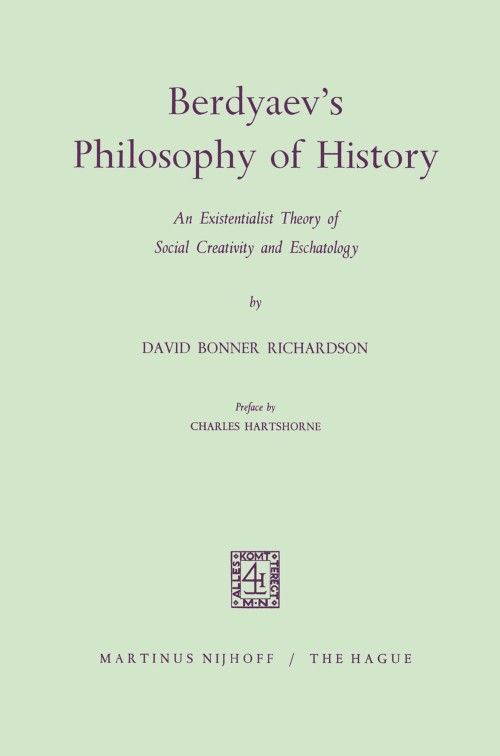
Berdyaev’s Philosophy of History [electronic resource] : An Existentialist Theory of Social Creativity and Eschatology / by David Bonner Richardson.
Erişim Adresi
ISBN
9789401188708
Dil Kodu
İngilizce
Yer Numarası
DK/8554
Basım Bildirimi
1st ed. 1968.
Yayın Bilgisi
Dordrecht : Springer Netherlands : Imprint: Springer, 1968.
Fiziksel Niteleme
192 p. 1 illus. online resource.
İçindekiler Notu
I: Berdyaev’s Philosophy of History -- A. Introduction -- B. The “historical” and the philosophy of history -- C. Philosophy of history and metaphysics of history -- D. The philosophy of history and the end of history -- E. Philosophy of history in respect to time -- F. Philosophy of history and the doctrine of godmanhood -- G. Summary -- II: Godmanhood, Freedom and Philosophy of History -- A. Introduction -- B. The doctrine of godmanhood -- C. Godmanhood and the freedom of man -- D. Some consequences of the doctrine of godmanhood -- E. Summary -- III: Existentialism: A Personalist Philosophy of History -- A. Introduction -- B. Personalism: the existent and the ego -- C. Personality is spirit: an existentialism of spirit -- D. Personality: the concrete and universal existent -- E. Personality and existence not isolated from the thou and the we -- F. Personality: the microcosm -- G. Summary -- IV: Epistemology and Philosophy of History Conclusion -- A. Introduction -- B. The rejection of the subject-object relationship -- C. Knowledge not anti-rational, but super-rational -- D. Knowledge an identity -- E. True knowing is communal in character -- F. True knowing is loving and creative in character -- G. Image, symbol and mystical experience: concrete and creative knowing -- H. Summary -- Conclusion -- Bibliography of Sources.
Özet, vb.
BERDYAEV AS A PHILOSOPHER How shall a non-Russian, above all a North American, assimilate the extraordinary assemblage of ideas which is Berdyaev's philosophy? Dr. Richardson does not exaggerate the difficulties. And he introduces us with great care (and what a formidable task it must have been) precisely to what is most strange in this writer, his fusion of historical .. eschatological-metaphysical-mystical-Christian conceptions. By some standards Berdyaev is a theologian rather than a philosopher; for he takes the truth of the Christian revelation for granted and his work can readily be viewed as an elaborate apologetic for one religion against all others and against irreligion. Yet I incline to sympathize with him in his claim to be a philosopher. What an eccentric one, however! There are indeed some partial analogies in the general European tradition. Certainly this Russian is a disciple of Kant, and strong traces of Kantianism survive in him. He also moved away from Kant somewhat as did Fichte, Hegel, and, above all, Schelling in his last period. His sympathetic response to Heracleitos and Boehme recalls Hegel. The interest in Boehme and Schelling is found also in Tillich. Like the late German-American, Berdyaev rejects conceptual in favor of symbolic speech about God. Like Bergson, he stresses intuition and makes a radical distinction between scientific logical analytic thought and the mode of apprehension by which, he believes, metaphysical truth is to be appropriated. Here one thinks also of Heidegger.
Konu
Philosophy, Modern.
Philosophy __ History.
Early Modern Philosophy.
History of Philosophy.
Philosophy __ History.
Early Modern Philosophy.
History of Philosophy.
Kurum Adı
Eseri Alıntıla
Referansları kullanmadan önce gözden geçirmeniz ve varsa gerekli düzeltmeleri yapmanız önerilir.
Dijital Kaynak
MARC Görünümü
LEADER 05309nam a22005175i 4500
001 807261
003 TR_AnAIT
005 20260127003746
007 cr nn 008mamaa
008 121227s1968 ne | s |||| 0|eng d
020 |a9789401188708|9978-94-011-8870-8
024 7 |a10.1007/978-94-011-8870-8|2doi
041 |aeng
049 |aTürk Tarih Kurumu Kütüphanesi
050 4|aB800.2-804
072 7|aHPCD|2bicssc
072 7|aPHI016000|2bisacsh
072 7|aQDH|2thema
082 04|a190.903|223
090 |aDK/8554
100 1 |aRichardson, David Bonner.|eauthor.|4aut|4http://id.loc.gov/vocabulary/relators/aut
245 10|aBerdyaev’s Philosophy of History|h[electronic resource] :|bAn Existentialist Theory of Social Creativity and Eschatology /|cby David Bonner Richardson.
250 |a1st ed. 1968.
264 1|aDordrecht :|bSpringer Netherlands :|bImprint: Springer,|c1968.
300 |a192 p. 1 illus.|bonline resource.
336 |atext|btxt|2rdacontent
337 |acomputer|bc|2rdamedia
338 |aonline resource|bcr|2rdacarrier
347 |atext file|bPDF|2rda
505 0 |aI: Berdyaev’s Philosophy of History -- A. Introduction -- B. The “historical” and the philosophy of history -- C. Philosophy of history and metaphysics of history -- D. The philosophy of history and the end of history -- E. Philosophy of history in respect to time -- F. Philosophy of history and the doctrine of godmanhood -- G. Summary -- II: Godmanhood, Freedom and Philosophy of History -- A. Introduction -- B. The doctrine of godmanhood -- C. Godmanhood and the freedom of man -- D. Some consequences of the doctrine of godmanhood -- E. Summary -- III: Existentialism: A Personalist Philosophy of History -- A. Introduction -- B. Personalism: the existent and the ego -- C. Personality is spirit: an existentialism of spirit -- D. Personality: the concrete and universal existent -- E. Personality and existence not isolated from the thou and the we -- F. Personality: the microcosm -- G. Summary -- IV: Epistemology and Philosophy of History Conclusion -- A. Introduction -- B. The rejection of the subject-object relationship -- C. Knowledge not anti-rational, but super-rational -- D. Knowledge an identity -- E. True knowing is communal in character -- F. True knowing is loving and creative in character -- G. Image, symbol and mystical experience: concrete and creative knowing -- H. Summary -- Conclusion -- Bibliography of Sources.
520 |aBERDYAEV AS A PHILOSOPHER How shall a non-Russian, above all a North American, assimilate the extraordinary assemblage of ideas which is Berdyaev's philosophy? Dr. Richardson does not exaggerate the difficulties. And he introduces us with great care (and what a formidable task it must have been) precisely to what is most strange in this writer, his fusion of historical .. eschatological-metaphysical-mystical-Christian conceptions. By some standards Berdyaev is a theologian rather than a philosopher; for he takes the truth of the Christian revelation for granted and his work can readily be viewed as an elaborate apologetic for one religion against all others and against irreligion. Yet I incline to sympathize with him in his claim to be a philosopher. What an eccentric one, however! There are indeed some partial analogies in the general European tradition. Certainly this Russian is a disciple of Kant, and strong traces of Kantianism survive in him. He also moved away from Kant somewhat as did Fichte, Hegel, and, above all, Schelling in his last period. His sympathetic response to Heracleitos and Boehme recalls Hegel. The interest in Boehme and Schelling is found also in Tillich. Like the late German-American, Berdyaev rejects conceptual in favor of symbolic speech about God. Like Bergson, he stresses intuition and makes a radical distinction between scientific logical analytic thought and the mode of apprehension by which, he believes, metaphysical truth is to be appropriated. Here one thinks also of Heidegger.
532 8 |aAccessibility summary: This PDF is not accessible. It is based on scanned pages and does not support features such as screen reader compatibility or described non-text content (images, graphs etc). However, it likely supports searchable and selectable text based on OCR (Optical Character Recognition). Users with accessibility needs may not be able to use this content effectively. Please contact us at accessibilitysupport@springernature.com if you require assistance or an alternative format.
532 8 |aInaccessible, or known limited accessibility
532 8 |aNo reading system accessibility options actively disabled
532 8 |aPublisher contact for further accessibility information: accessibilitysupport@springernature.com
650 0|aPhilosophy, Modern.
650 0|aPhilosophy|xHistory.
650 14|aEarly Modern Philosophy.
650 24|aHistory of Philosophy.
710 2 |aSpringerLink (Online service)
773 0 |tSpringer Nature eBook
776 08|iPrinted edition:|z9789401182102
776 08|iPrinted edition:|z9789401188715
856 40|uhttps://doi.org/10.1007/978-94-011-8870-8
912 |aZDB-2-SHU
912 |aZDB-2-SXPR
912 |aZDB-2-BAE
950 |aHumanities, Social Sciences and Law (SpringerNature-11648)
950 |aPhilosophy and Religion (R0) (SpringerNature-43725)
001 807261
003 TR_AnAIT
005 20260127003746
007 cr nn 008mamaa
008 121227s1968 ne | s |||| 0|eng d
020 |a9789401188708|9978-94-011-8870-8
024 7 |a10.1007/978-94-011-8870-8|2doi
041 |aeng
049 |aTürk Tarih Kurumu Kütüphanesi
050 4|aB800.2-804
072 7|aHPCD|2bicssc
072 7|aPHI016000|2bisacsh
072 7|aQDH|2thema
082 04|a190.903|223
090 |aDK/8554
100 1 |aRichardson, David Bonner.|eauthor.|4aut|4http://id.loc.gov/vocabulary/relators/aut
245 10|aBerdyaev’s Philosophy of History|h[electronic resource] :|bAn Existentialist Theory of Social Creativity and Eschatology /|cby David Bonner Richardson.
250 |a1st ed. 1968.
264 1|aDordrecht :|bSpringer Netherlands :|bImprint: Springer,|c1968.
300 |a192 p. 1 illus.|bonline resource.
336 |atext|btxt|2rdacontent
337 |acomputer|bc|2rdamedia
338 |aonline resource|bcr|2rdacarrier
347 |atext file|bPDF|2rda
505 0 |aI: Berdyaev’s Philosophy of History -- A. Introduction -- B. The “historical” and the philosophy of history -- C. Philosophy of history and metaphysics of history -- D. The philosophy of history and the end of history -- E. Philosophy of history in respect to time -- F. Philosophy of history and the doctrine of godmanhood -- G. Summary -- II: Godmanhood, Freedom and Philosophy of History -- A. Introduction -- B. The doctrine of godmanhood -- C. Godmanhood and the freedom of man -- D. Some consequences of the doctrine of godmanhood -- E. Summary -- III: Existentialism: A Personalist Philosophy of History -- A. Introduction -- B. Personalism: the existent and the ego -- C. Personality is spirit: an existentialism of spirit -- D. Personality: the concrete and universal existent -- E. Personality and existence not isolated from the thou and the we -- F. Personality: the microcosm -- G. Summary -- IV: Epistemology and Philosophy of History Conclusion -- A. Introduction -- B. The rejection of the subject-object relationship -- C. Knowledge not anti-rational, but super-rational -- D. Knowledge an identity -- E. True knowing is communal in character -- F. True knowing is loving and creative in character -- G. Image, symbol and mystical experience: concrete and creative knowing -- H. Summary -- Conclusion -- Bibliography of Sources.
520 |aBERDYAEV AS A PHILOSOPHER How shall a non-Russian, above all a North American, assimilate the extraordinary assemblage of ideas which is Berdyaev's philosophy? Dr. Richardson does not exaggerate the difficulties. And he introduces us with great care (and what a formidable task it must have been) precisely to what is most strange in this writer, his fusion of historical .. eschatological-metaphysical-mystical-Christian conceptions. By some standards Berdyaev is a theologian rather than a philosopher; for he takes the truth of the Christian revelation for granted and his work can readily be viewed as an elaborate apologetic for one religion against all others and against irreligion. Yet I incline to sympathize with him in his claim to be a philosopher. What an eccentric one, however! There are indeed some partial analogies in the general European tradition. Certainly this Russian is a disciple of Kant, and strong traces of Kantianism survive in him. He also moved away from Kant somewhat as did Fichte, Hegel, and, above all, Schelling in his last period. His sympathetic response to Heracleitos and Boehme recalls Hegel. The interest in Boehme and Schelling is found also in Tillich. Like the late German-American, Berdyaev rejects conceptual in favor of symbolic speech about God. Like Bergson, he stresses intuition and makes a radical distinction between scientific logical analytic thought and the mode of apprehension by which, he believes, metaphysical truth is to be appropriated. Here one thinks also of Heidegger.
532 8 |aAccessibility summary: This PDF is not accessible. It is based on scanned pages and does not support features such as screen reader compatibility or described non-text content (images, graphs etc). However, it likely supports searchable and selectable text based on OCR (Optical Character Recognition). Users with accessibility needs may not be able to use this content effectively. Please contact us at accessibilitysupport@springernature.com if you require assistance or an alternative format.
532 8 |aInaccessible, or known limited accessibility
532 8 |aNo reading system accessibility options actively disabled
532 8 |aPublisher contact for further accessibility information: accessibilitysupport@springernature.com
650 0|aPhilosophy, Modern.
650 0|aPhilosophy|xHistory.
650 14|aEarly Modern Philosophy.
650 24|aHistory of Philosophy.
710 2 |aSpringerLink (Online service)
773 0 |tSpringer Nature eBook
776 08|iPrinted edition:|z9789401182102
776 08|iPrinted edition:|z9789401188715
856 40|uhttps://doi.org/10.1007/978-94-011-8870-8
912 |aZDB-2-SHU
912 |aZDB-2-SXPR
912 |aZDB-2-BAE
950 |aHumanities, Social Sciences and Law (SpringerNature-11648)
950 |aPhilosophy and Religion (R0) (SpringerNature-43725)
Materyaller
Depodan talep edilen materyal sadece kütüphane içerisinde kullanılmaktadır.
Materyal dışarıya ödünç verilmemektedir.
Materyal dışarıya ödünç verilmemektedir.
