

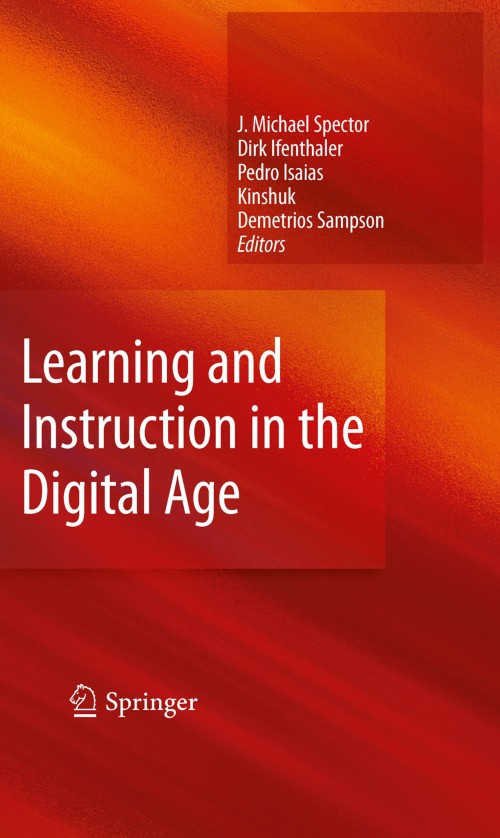
Learning and Instruction in the Digital Age [electronic resource] / edited by J. Michael Spector, Dirk Ifenthaler, Kinshuk.
Erişim Adresi
ISBN
9781441915511
Dil Kodu
İngilizce
Yer Numarası
DK/8610
Basım Bildirimi
1st ed. 2010.
Yayın Bilgisi
New York, NY : Springer US : Imprint: Springer, 2010.
Fiziksel Niteleme
XVI, 404 p. online resource.
İçindekiler Notu
Cognitive Approaches to Learning and Instruction (Spector) -- Learning and Instruction in the Digital Age -- Cognition and Student-Centered, Web-Based Learning: Issues and Implications for Research and Theory -- Testing as Feedback to Inform Teaching -- Enhancing Learning from Informatics Texts -- Knowledge Representation and Mental Models (Ifenthaler) -- Model-Based Knowledge Mapping -- Prototype for the Knowledge Representation Supporting Inter-institutional Knowledge Flow Analysis -- The Role of Supportive Information in the Development and Progression of Mental Models -- The Qualitative Study on Contents Analysis/Construction Method for e-Learning -- Technology–Facilitated Tools and Techniques (Isaías) -- VideoClipQuests as a New Setup for Learning -- Research on Computer-Supported Collaborative Learning in Transdisciplinary Groups -- Improving Teacher Performance Using an Enhanced Digital Video Reflection Technique -- Experiencing and Learning with 3D Virtual Worlds -- Communications and Methods (Kinshuk) -- CARTE: An Observation Station to Regulate Activity in a Learning Context -- Acceptance of Model-Based Instruction Among Students in Spanish and Mathematics -- Communities of Learners -- Supporting the Implementation of Case Activities Using e-Learning Technologies -- Practices in Old Age ICT Education -- Integrative Methods and Online Learning (Sampson) -- Cultural Features of e-Learning -- Case Study on Student Blogs in a Blended Learning Course -- Self-Assessment: An Important Process in e-Training -- A Design Framework for an Online English Writing Course -- Catering for Different Learning Styles in e-Learning -- Learning and Instruction in the Digital Age.
Özet, vb.
Instruction tailored to the individual student, learning and teaching outside the limits of time and space—ideas that were once considered science fiction are now educational reality, with the prospect of an intelligent Web 3.0 not far distant. Alongside these innovations exists an emerging set of critical-thinking challenges, as Internet users create content and learners (and teachers) take increased responsibility in their work. Learning and Instruction in the Digital Age nimbly balances the technological and pedagogical aspects of these rapid changes, gathering papers from noted researchers on a wealth of topics relating to cognitive approaches to learning and teaching, mental models, online learning, communications, and innovative educational technologies, among them: Cognition and student-centered, Web-based learning The progression of mental models throughout a course of instruction Experiencing education with 3D virtual worlds Expanding educational boundaries through multi-school collaboration Adapting e-learning to different learning styles The student blog as reflective diary With its blend of timely ideas and forward thinking, Learning and Instruction in the Digital Age will enrich the work of researchers in educational psychology, educational technology, and cognitive science.
Konu
Learning, Psychology of.
Education __ Data processing.
Educational psychology.
Instructional Psychology.
Computers and Education.
Educational Psychology.
Education __ Data processing.
Educational psychology.
Instructional Psychology.
Computers and Education.
Educational Psychology.
Diğer Yazarlar
Kurum Adı
Eseri Alıntıla
Referansları kullanmadan önce gözden geçirmeniz ve varsa gerekli düzeltmeleri yapmanız önerilir.
Dijital Kaynak
MARC Görünümü
LEADER 05039nam a22005175i 4500
001 807317
003 TR_AnAIT
005 20260127003854
007 cr nn 008mamaa
008 100316s2010 xxu| s |||| 0|eng d
020 |a9781441915511|9978-1-4419-1551-1
024 7 |a10.1007/978-1-4419-1551-1|2doi
041 |aeng
049 |aTürk Tarih Kurumu Kütüphanesi
050 4|aLB1060-1077
072 7|aJNC|2bicssc
072 7|aEDU009000|2bisacsh
072 7|aJNC|2thema
082 04|a370.15|223
090 |aDK/8610
245 10|aLearning and Instruction in the Digital Age|h[electronic resource] /|cedited by J. Michael Spector, Dirk Ifenthaler, Kinshuk.
250 |a1st ed. 2010.
264 1|aNew York, NY :|bSpringer US :|bImprint: Springer,|c2010.
300 |aXVI, 404 p.|bonline resource.
336 |atext|btxt|2rdacontent
337 |acomputer|bc|2rdamedia
338 |aonline resource|bcr|2rdacarrier
347 |atext file|bPDF|2rda
505 0 |aCognitive Approaches to Learning and Instruction (Spector) -- Learning and Instruction in the Digital Age -- Cognition and Student-Centered, Web-Based Learning: Issues and Implications for Research and Theory -- Testing as Feedback to Inform Teaching -- Enhancing Learning from Informatics Texts -- Knowledge Representation and Mental Models (Ifenthaler) -- Model-Based Knowledge Mapping -- Prototype for the Knowledge Representation Supporting Inter-institutional Knowledge Flow Analysis -- The Role of Supportive Information in the Development and Progression of Mental Models -- The Qualitative Study on Contents Analysis/Construction Method for e-Learning -- Technology–Facilitated Tools and Techniques (Isaías) -- VideoClipQuests as a New Setup for Learning -- Research on Computer-Supported Collaborative Learning in Transdisciplinary Groups -- Improving Teacher Performance Using an Enhanced Digital Video Reflection Technique -- Experiencing and Learning with 3D Virtual Worlds -- Communications and Methods (Kinshuk) -- CARTE: An Observation Station to Regulate Activity in a Learning Context -- Acceptance of Model-Based Instruction Among Students in Spanish and Mathematics -- Communities of Learners -- Supporting the Implementation of Case Activities Using e-Learning Technologies -- Practices in Old Age ICT Education -- Integrative Methods and Online Learning (Sampson) -- Cultural Features of e-Learning -- Case Study on Student Blogs in a Blended Learning Course -- Self-Assessment: An Important Process in e-Training -- A Design Framework for an Online English Writing Course -- Catering for Different Learning Styles in e-Learning -- Learning and Instruction in the Digital Age.
520 |aInstruction tailored to the individual student, learning and teaching outside the limits of time and space—ideas that were once considered science fiction are now educational reality, with the prospect of an intelligent Web 3.0 not far distant. Alongside these innovations exists an emerging set of critical-thinking challenges, as Internet users create content and learners (and teachers) take increased responsibility in their work. Learning and Instruction in the Digital Age nimbly balances the technological and pedagogical aspects of these rapid changes, gathering papers from noted researchers on a wealth of topics relating to cognitive approaches to learning and teaching, mental models, online learning, communications, and innovative educational technologies, among them: Cognition and student-centered, Web-based learning The progression of mental models throughout a course of instruction Experiencing education with 3D virtual worlds Expanding educational boundaries through multi-school collaboration Adapting e-learning to different learning styles The student blog as reflective diary With its blend of timely ideas and forward thinking, Learning and Instruction in the Digital Age will enrich the work of researchers in educational psychology, educational technology, and cognitive science.
650 0|aLearning, Psychology of.
650 0|aEducation|xData processing.
650 0|aEducational psychology.
650 14|aInstructional Psychology.
650 24|aComputers and Education.
650 24|aEducational Psychology.
700 1 |aSpector, J. Michael.|eeditor.|0(orcid)0000-0002-6270-3073|1https://orcid.org/0000-0002-6270-3073|4edt|4http://id.loc.gov/vocabulary/relators/edt
700 1 |aIfenthaler, Dirk.|eeditor.|0(orcid)0000-0002-2446-6548|1https://orcid.org/0000-0002-2446-6548|4edt|4http://id.loc.gov/vocabulary/relators/edt
700 1 |aKinshuk.|eeditor.|4edt|4http://id.loc.gov/vocabulary/relators/edt
710 2 |aSpringerLink (Online service)
773 0 |tSpringer Nature eBook
776 08|iPrinted edition:|z9781441915504
776 08|iPrinted edition:|z9781441915580
776 08|iPrinted edition:|z9781489984616
856 40|uhttps://doi.org/10.1007/978-1-4419-1551-1
912 |aZDB-2-SHU
912 |aZDB-2-SXED
950 |aHumanities, Social Sciences and Law (SpringerNature-11648)
950 |aEducation (R0) (SpringerNature-43721)
001 807317
003 TR_AnAIT
005 20260127003854
007 cr nn 008mamaa
008 100316s2010 xxu| s |||| 0|eng d
020 |a9781441915511|9978-1-4419-1551-1
024 7 |a10.1007/978-1-4419-1551-1|2doi
041 |aeng
049 |aTürk Tarih Kurumu Kütüphanesi
050 4|aLB1060-1077
072 7|aJNC|2bicssc
072 7|aEDU009000|2bisacsh
072 7|aJNC|2thema
082 04|a370.15|223
090 |aDK/8610
245 10|aLearning and Instruction in the Digital Age|h[electronic resource] /|cedited by J. Michael Spector, Dirk Ifenthaler, Kinshuk.
250 |a1st ed. 2010.
264 1|aNew York, NY :|bSpringer US :|bImprint: Springer,|c2010.
300 |aXVI, 404 p.|bonline resource.
336 |atext|btxt|2rdacontent
337 |acomputer|bc|2rdamedia
338 |aonline resource|bcr|2rdacarrier
347 |atext file|bPDF|2rda
505 0 |aCognitive Approaches to Learning and Instruction (Spector) -- Learning and Instruction in the Digital Age -- Cognition and Student-Centered, Web-Based Learning: Issues and Implications for Research and Theory -- Testing as Feedback to Inform Teaching -- Enhancing Learning from Informatics Texts -- Knowledge Representation and Mental Models (Ifenthaler) -- Model-Based Knowledge Mapping -- Prototype for the Knowledge Representation Supporting Inter-institutional Knowledge Flow Analysis -- The Role of Supportive Information in the Development and Progression of Mental Models -- The Qualitative Study on Contents Analysis/Construction Method for e-Learning -- Technology–Facilitated Tools and Techniques (Isaías) -- VideoClipQuests as a New Setup for Learning -- Research on Computer-Supported Collaborative Learning in Transdisciplinary Groups -- Improving Teacher Performance Using an Enhanced Digital Video Reflection Technique -- Experiencing and Learning with 3D Virtual Worlds -- Communications and Methods (Kinshuk) -- CARTE: An Observation Station to Regulate Activity in a Learning Context -- Acceptance of Model-Based Instruction Among Students in Spanish and Mathematics -- Communities of Learners -- Supporting the Implementation of Case Activities Using e-Learning Technologies -- Practices in Old Age ICT Education -- Integrative Methods and Online Learning (Sampson) -- Cultural Features of e-Learning -- Case Study on Student Blogs in a Blended Learning Course -- Self-Assessment: An Important Process in e-Training -- A Design Framework for an Online English Writing Course -- Catering for Different Learning Styles in e-Learning -- Learning and Instruction in the Digital Age.
520 |aInstruction tailored to the individual student, learning and teaching outside the limits of time and space—ideas that were once considered science fiction are now educational reality, with the prospect of an intelligent Web 3.0 not far distant. Alongside these innovations exists an emerging set of critical-thinking challenges, as Internet users create content and learners (and teachers) take increased responsibility in their work. Learning and Instruction in the Digital Age nimbly balances the technological and pedagogical aspects of these rapid changes, gathering papers from noted researchers on a wealth of topics relating to cognitive approaches to learning and teaching, mental models, online learning, communications, and innovative educational technologies, among them: Cognition and student-centered, Web-based learning The progression of mental models throughout a course of instruction Experiencing education with 3D virtual worlds Expanding educational boundaries through multi-school collaboration Adapting e-learning to different learning styles The student blog as reflective diary With its blend of timely ideas and forward thinking, Learning and Instruction in the Digital Age will enrich the work of researchers in educational psychology, educational technology, and cognitive science.
650 0|aLearning, Psychology of.
650 0|aEducation|xData processing.
650 0|aEducational psychology.
650 14|aInstructional Psychology.
650 24|aComputers and Education.
650 24|aEducational Psychology.
700 1 |aSpector, J. Michael.|eeditor.|0(orcid)0000-0002-6270-3073|1https://orcid.org/0000-0002-6270-3073|4edt|4http://id.loc.gov/vocabulary/relators/edt
700 1 |aIfenthaler, Dirk.|eeditor.|0(orcid)0000-0002-2446-6548|1https://orcid.org/0000-0002-2446-6548|4edt|4http://id.loc.gov/vocabulary/relators/edt
700 1 |aKinshuk.|eeditor.|4edt|4http://id.loc.gov/vocabulary/relators/edt
710 2 |aSpringerLink (Online service)
773 0 |tSpringer Nature eBook
776 08|iPrinted edition:|z9781441915504
776 08|iPrinted edition:|z9781441915580
776 08|iPrinted edition:|z9781489984616
856 40|uhttps://doi.org/10.1007/978-1-4419-1551-1
912 |aZDB-2-SHU
912 |aZDB-2-SXED
950 |aHumanities, Social Sciences and Law (SpringerNature-11648)
950 |aEducation (R0) (SpringerNature-43721)
Materyaller
Depodan talep edilen materyal sadece kütüphane içerisinde kullanılmaktadır.
Materyal dışarıya ödünç verilmemektedir.
Materyal dışarıya ödünç verilmemektedir.
