LEADER 03967nam a22005535i 4500
001 807342
003 TR_AnAIT
005 20260127003926
007 cr nn 008mamaa
008 121227s1972 ne | s |||| 0|eng d
020 |a9789401029056|9978-94-010-2905-6
024 7 |a10.1007/978-94-010-2905-6|2doi
041 |aeng
049 |aTürk Tarih Kurumu Kütüphanesi
050 4|aB1-5802
072 7|aHPC|2bicssc
072 7|aPHI009000|2bisacsh
072 7|aQDH|2thema
082 04|a109|223
090 |aDK/8635
100 1 |aRotenstreich, Nathan.|eauthor.|4aut|4http://id.loc.gov/vocabulary/relators/aut
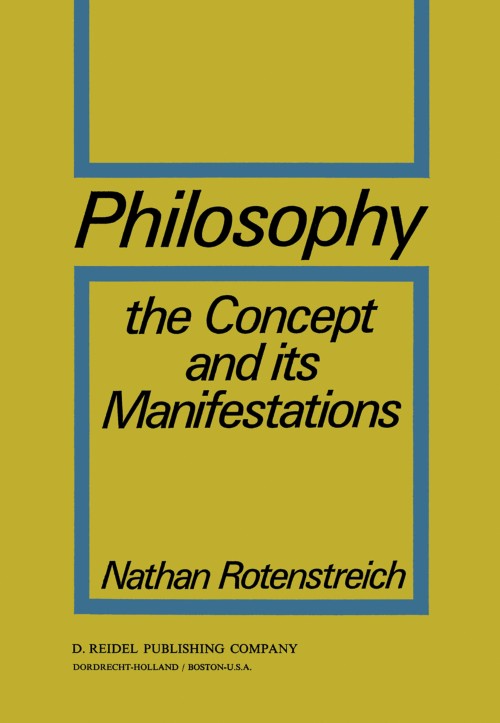
245 10|aPhilosophy|h[electronic resource] :|bThe Concept and its Manifestations /|cby Nathan Rotenstreich.
250 |a1st ed. 1972.
264 1|aDordrecht :|bSpringer Netherlands :|bImprint: Springer,|c1972.
300 |aX, 258 p.|bonline resource.
336 |atext|btxt|2rdacontent
337 |acomputer|bc|2rdamedia
338 |aonline resource|bcr|2rdacarrier
347 |atext file|bPDF|2rda
505 0 |aI / Changing Concepts -- I. Deliberate Knowledge -- II. The Knowledge of the All -- III. Knowledge, Interpretation and Congruence -- IV. Knowledge as Method -- V. The Justification of Knowledge and the Knowledge of Ends -- VI. Continuations and Developments -- II / Background and Consequences -- VII. The Origins of Philosophy -- VIII. Philosophy and Life -- IX. Philosophy and Its History -- X. Science and Philosophy -- XI. Religion and Philosophy -- Index of Names -- Index of Subjects.
520 |aThe present book is concerned with the nature of philosophy and with the scope of philosophical interest. It combines an analysis of the major types of philosophical thinking as they emerged in the history of philosophical ideas with an attempt to examine problems which recurrent ly emerge in philosophical discourse. It is from this point of view that the historical and the systematic approaches are meant to be mutually reinforcing. I am grateful to my friends who helped me to formulate the line of thinking expressed in this book: Z. Bar-On, A. Margalit, E. I. I. Poznanski, Z. Werblovsky and E. Zemach. Some years ago when I visited the Center for the Study of Democratic Institutions in Santa Barbara, Dr. Robert M. Hutchins encouraged me to write the present book. I am dedicating the book to him not only because of that encouragement but more importantly because as an educational thinker Dr. Hutchins represents the position which assigns to the great ideas of the past validity and value in the analysis of topical problems of the present.
532 8 |aAccessibility summary: This PDF is not accessible. It is based on scanned pages and does not support features such as screen reader compatibility or described non-text content (images, graphs etc). However, it likely supports searchable and selectable text based on OCR (Optical Character Recognition). Users with accessibility needs may not be able to use this content effectively. Please contact us at accessibilitysupport@springernature.com if you require assistance or an alternative format.
532 8 |aInaccessible, or known limited accessibility
532 8 |aNo reading system accessibility options actively disabled
532 8 |aPublisher contact for further accessibility information: accessibilitysupport@springernature.com
650 0|aPhilosophy|xHistory.
650 0|aLogic.
650 0|aPhilosophy.
650 14|aHistory of Philosophy.
650 24|aLogic.
650 24|aPhilosophy.
710 2 |aSpringerLink (Online service)
773 0 |tSpringer Nature eBook
776 08|iPrinted edition:|z9789027702364
776 08|iPrinted edition:|z9789027702845
776 08|iPrinted edition:|z9789401029063
856 40|uhttps://doi.org/10.1007/978-94-010-2905-6
912 |aZDB-2-SHU
912 |aZDB-2-SXPR
912 |aZDB-2-BAE
950 |aHumanities, Social Sciences and Law (SpringerNature-11648)
950 |aPhilosophy and Religion (R0) (SpringerNature-43725)