

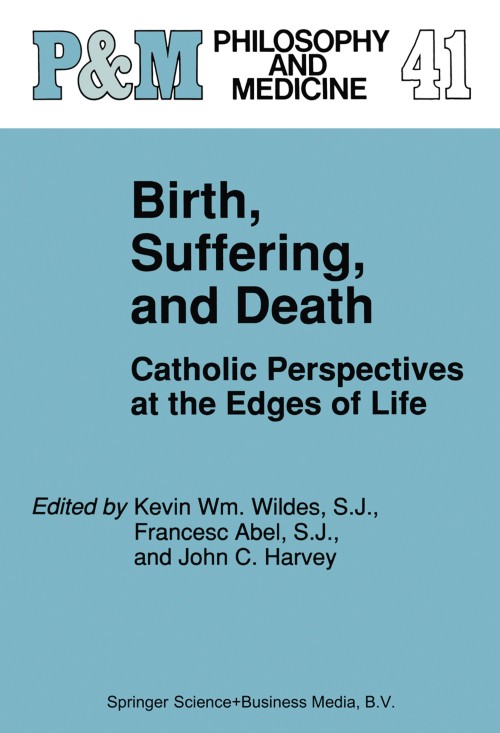
Birth, Suffering, and Death [electronic resource] : Catholic Perspectives at the Edges of Life / edited by Kevin Wm. Wildes S.J., Francesc Abel S.J., John Collins Harvey.
Erişim Adresi
ISBN
9789401129084
Dil Kodu
İngilizce
Yer Numarası
DK/8677
Basım Bildirimi
1st ed. 1992.
Yayın Bilgisi
Dordrecht : Springer Netherlands : Imprint: Springer, 1992.
Fiziksel Niteleme
XV, 236 p. online resource.
Dizi
Philosophy and Medicine, 2215-0080 ; 41
İçindekiler Notu
Finitude, Religion, and Medicine: The Search for Meaning in the Post-Modem World -- Edges of Life: The Consequences of Prenatal Assessment, Diagnosis and Treatment -- The Frail Elderly Person and Those Suffering From Dementia -- The HIV Infection -- Artificial Feeding and Hydration in Advanced Illness -- Dignity, Solidarity, and the Sanctity of Human Life -- Dominion or Stewardship?: Theological Reflections -- Sharing Responsibility at the Edges of Life -- When the Dying Person Looks Me in the Face: An Ethics of Responsibility for Dealing With the Problem of the Patient in a Persistently Vegetative State -- Life as a Good and Our Obligations to Persistently Vegetative Patients -- Pain Relief: Ethical Issues and Catholic Teaching -- Why Almost Any Cost To Others To Preserve The Life Of The Irreversibly Comatose Constitutes An Extraordinary Burden -- The Catholic Tradition on the Use of Nutrition and Fluids -- Appendix A: Pope Pius XII / The Prolongation Of Life -- Appendix B: Sacred Congregation For The Doctrine Of The Faith / Declaration On Euthanasia -- Notes On Contributors.
Özet, vb.
For centuries the Roman Catholic Church has been concerned with the moral implications of medical practice. Indeed, until two decades ago, Catholic moral theologians were the major source of moral guidance, scholarly reflection and teaching on a variety of medical-moral topics, particularly those bearing on human life. Many, not only those within the Catholic communion, turned to the Church for guidance as each new possibility for altering the conditions of human life posed new challenges to long held moral values. Two decades ago, the center of gravity of ethical reflection shifted sharply from theologians and Christian philosophers to more secular thinkers. A confluence of forces was responsible for this metamorphosi- an exponential rate of increase in medical technologies, expanded education of the public, the growth of participatory democracy, the entry of courts and legislation into what had previously been private matters, the trend of morality towards pluralism and individual freedom and the depreciation of church and religious doctrines generally. Most significant was the entry of professional philosophers into the debate, for the first time. It is a curious paradox that, until the mid-sixties, professional philosophers largely ignored medical ethics. Today they are the most influential shapers of public and professional opinion.
Konu
Philosophy.
Religion.
Medical sciences.
Medicine __ Philosophy.
Ethics.
Medicine __ History.
Philosophy.
Religion.
Health Sciences.
Philosophy of Medicine.
Moral Philosophy and Applied Ethics.
History of Medicine.
Religion.
Medical sciences.
Medicine __ Philosophy.
Ethics.
Medicine __ History.
Philosophy.
Religion.
Health Sciences.
Philosophy of Medicine.
Moral Philosophy and Applied Ethics.
History of Medicine.
Kurum Adı
Eseri Alıntıla
Referansları kullanmadan önce gözden geçirmeniz ve varsa gerekli düzeltmeleri yapmanız önerilir.
Dijital Kaynak
MARC Görünümü
LEADER 05479nam a22006735i 4500
001 807384
003 TR_AnAIT
005 20260127004013
007 cr nn 008mamaa
008 121227s1992 ne | s |||| 0|eng d
020 |a9789401129084|9978-94-011-2908-4
024 7 |a10.1007/978-94-011-2908-4|2doi
041 |aeng
049 |aTürk Tarih Kurumu Kütüphanesi
050 4|aB1-5802
072 7|aHP|2bicssc
072 7|aPHI000000|2bisacsh
072 7|aQD|2thema
082 04|a100|223
090 |aDK/8677
245 10|aBirth, Suffering, and Death|h[electronic resource] :|bCatholic Perspectives at the Edges of Life /|cedited by Kevin Wm. Wildes S.J., Francesc Abel S.J., John Collins Harvey.
250 |a1st ed. 1992.
264 1|aDordrecht :|bSpringer Netherlands :|bImprint: Springer,|c1992.
300 |aXV, 236 p.|bonline resource.
336 |atext|btxt|2rdacontent
337 |acomputer|bc|2rdamedia
338 |aonline resource|bcr|2rdacarrier
347 |atext file|bPDF|2rda
490 1 |aPhilosophy and Medicine,|x2215-0080 ;|v41
505 0 |aFinitude, Religion, and Medicine: The Search for Meaning in the Post-Modem World -- Edges of Life: The Consequences of Prenatal Assessment, Diagnosis and Treatment -- The Frail Elderly Person and Those Suffering From Dementia -- The HIV Infection -- Artificial Feeding and Hydration in Advanced Illness -- Dignity, Solidarity, and the Sanctity of Human Life -- Dominion or Stewardship?: Theological Reflections -- Sharing Responsibility at the Edges of Life -- When the Dying Person Looks Me in the Face: An Ethics of Responsibility for Dealing With the Problem of the Patient in a Persistently Vegetative State -- Life as a Good and Our Obligations to Persistently Vegetative Patients -- Pain Relief: Ethical Issues and Catholic Teaching -- Why Almost Any Cost To Others To Preserve The Life Of The Irreversibly Comatose Constitutes An Extraordinary Burden -- The Catholic Tradition on the Use of Nutrition and Fluids -- Appendix A: Pope Pius XII / The Prolongation Of Life -- Appendix B: Sacred Congregation For The Doctrine Of The Faith / Declaration On Euthanasia -- Notes On Contributors.
520 |aFor centuries the Roman Catholic Church has been concerned with the moral implications of medical practice. Indeed, until two decades ago, Catholic moral theologians were the major source of moral guidance, scholarly reflection and teaching on a variety of medical-moral topics, particularly those bearing on human life. Many, not only those within the Catholic communion, turned to the Church for guidance as each new possibility for altering the conditions of human life posed new challenges to long held moral values. Two decades ago, the center of gravity of ethical reflection shifted sharply from theologians and Christian philosophers to more secular thinkers. A confluence of forces was responsible for this metamorphosi- an exponential rate of increase in medical technologies, expanded education of the public, the growth of participatory democracy, the entry of courts and legislation into what had previously been private matters, the trend of morality towards pluralism and individual freedom and the depreciation of church and religious doctrines generally. Most significant was the entry of professional philosophers into the debate, for the first time. It is a curious paradox that, until the mid-sixties, professional philosophers largely ignored medical ethics. Today they are the most influential shapers of public and professional opinion.
532 8 |aAccessibility summary: This PDF is not accessible. It is based on scanned pages and does not support features such as screen reader compatibility or described non-text content (images, graphs etc). However, it likely supports searchable and selectable text based on OCR (Optical Character Recognition). Users with accessibility needs may not be able to use this content effectively. Please contact us at accessibilitysupport@springernature.com if you require assistance or an alternative format.
532 8 |aInaccessible, or known limited accessibility
532 8 |aNo reading system accessibility options actively disabled
532 8 |aPublisher contact for further accessibility information: accessibilitysupport@springernature.com
650 0|aPhilosophy.
650 0|aReligion.
650 0|aMedical sciences.
650 0|aMedicine|xPhilosophy.
650 0|aEthics.
650 0|aMedicine|xHistory.
650 14|aPhilosophy.
650 24|aReligion.
650 24|aHealth Sciences.
650 24|aPhilosophy of Medicine.
650 24|aMoral Philosophy and Applied Ethics.
650 24|aHistory of Medicine.
700 1 |aWildes S.J., Kevin Wm.|eeditor.|4edt|4http://id.loc.gov/vocabulary/relators/edt
700 1 |aAbel S.J., Francesc.|eeditor.|4edt|4http://id.loc.gov/vocabulary/relators/edt
700 1 |aHarvey, John Collins.|eeditor.|4edt|4http://id.loc.gov/vocabulary/relators/edt
710 2 |aSpringerLink (Online service)
773 0 |tSpringer Nature eBook
776 08|iPrinted edition:|z9780792315476
776 08|iPrinted edition:|z9780792325451
776 08|iPrinted edition:|z9789401129091
830 0|aPhilosophy and Medicine,|x2215-0080 ;|v41
856 40|uhttps://doi.org/10.1007/978-94-011-2908-4
912 |aZDB-2-SHU
912 |aZDB-2-SXPR
912 |aZDB-2-BAE
950 |aHumanities, Social Sciences and Law (SpringerNature-11648)
950 |aPhilosophy and Religion (R0) (SpringerNature-43725)
001 807384
003 TR_AnAIT
005 20260127004013
007 cr nn 008mamaa
008 121227s1992 ne | s |||| 0|eng d
020 |a9789401129084|9978-94-011-2908-4
024 7 |a10.1007/978-94-011-2908-4|2doi
041 |aeng
049 |aTürk Tarih Kurumu Kütüphanesi
050 4|aB1-5802
072 7|aHP|2bicssc
072 7|aPHI000000|2bisacsh
072 7|aQD|2thema
082 04|a100|223
090 |aDK/8677
245 10|aBirth, Suffering, and Death|h[electronic resource] :|bCatholic Perspectives at the Edges of Life /|cedited by Kevin Wm. Wildes S.J., Francesc Abel S.J., John Collins Harvey.
250 |a1st ed. 1992.
264 1|aDordrecht :|bSpringer Netherlands :|bImprint: Springer,|c1992.
300 |aXV, 236 p.|bonline resource.
336 |atext|btxt|2rdacontent
337 |acomputer|bc|2rdamedia
338 |aonline resource|bcr|2rdacarrier
347 |atext file|bPDF|2rda
490 1 |aPhilosophy and Medicine,|x2215-0080 ;|v41
505 0 |aFinitude, Religion, and Medicine: The Search for Meaning in the Post-Modem World -- Edges of Life: The Consequences of Prenatal Assessment, Diagnosis and Treatment -- The Frail Elderly Person and Those Suffering From Dementia -- The HIV Infection -- Artificial Feeding and Hydration in Advanced Illness -- Dignity, Solidarity, and the Sanctity of Human Life -- Dominion or Stewardship?: Theological Reflections -- Sharing Responsibility at the Edges of Life -- When the Dying Person Looks Me in the Face: An Ethics of Responsibility for Dealing With the Problem of the Patient in a Persistently Vegetative State -- Life as a Good and Our Obligations to Persistently Vegetative Patients -- Pain Relief: Ethical Issues and Catholic Teaching -- Why Almost Any Cost To Others To Preserve The Life Of The Irreversibly Comatose Constitutes An Extraordinary Burden -- The Catholic Tradition on the Use of Nutrition and Fluids -- Appendix A: Pope Pius XII / The Prolongation Of Life -- Appendix B: Sacred Congregation For The Doctrine Of The Faith / Declaration On Euthanasia -- Notes On Contributors.
520 |aFor centuries the Roman Catholic Church has been concerned with the moral implications of medical practice. Indeed, until two decades ago, Catholic moral theologians were the major source of moral guidance, scholarly reflection and teaching on a variety of medical-moral topics, particularly those bearing on human life. Many, not only those within the Catholic communion, turned to the Church for guidance as each new possibility for altering the conditions of human life posed new challenges to long held moral values. Two decades ago, the center of gravity of ethical reflection shifted sharply from theologians and Christian philosophers to more secular thinkers. A confluence of forces was responsible for this metamorphosi- an exponential rate of increase in medical technologies, expanded education of the public, the growth of participatory democracy, the entry of courts and legislation into what had previously been private matters, the trend of morality towards pluralism and individual freedom and the depreciation of church and religious doctrines generally. Most significant was the entry of professional philosophers into the debate, for the first time. It is a curious paradox that, until the mid-sixties, professional philosophers largely ignored medical ethics. Today they are the most influential shapers of public and professional opinion.
532 8 |aAccessibility summary: This PDF is not accessible. It is based on scanned pages and does not support features such as screen reader compatibility or described non-text content (images, graphs etc). However, it likely supports searchable and selectable text based on OCR (Optical Character Recognition). Users with accessibility needs may not be able to use this content effectively. Please contact us at accessibilitysupport@springernature.com if you require assistance or an alternative format.
532 8 |aInaccessible, or known limited accessibility
532 8 |aNo reading system accessibility options actively disabled
532 8 |aPublisher contact for further accessibility information: accessibilitysupport@springernature.com
650 0|aPhilosophy.
650 0|aReligion.
650 0|aMedical sciences.
650 0|aMedicine|xPhilosophy.
650 0|aEthics.
650 0|aMedicine|xHistory.
650 14|aPhilosophy.
650 24|aReligion.
650 24|aHealth Sciences.
650 24|aPhilosophy of Medicine.
650 24|aMoral Philosophy and Applied Ethics.
650 24|aHistory of Medicine.
700 1 |aWildes S.J., Kevin Wm.|eeditor.|4edt|4http://id.loc.gov/vocabulary/relators/edt
700 1 |aAbel S.J., Francesc.|eeditor.|4edt|4http://id.loc.gov/vocabulary/relators/edt
700 1 |aHarvey, John Collins.|eeditor.|4edt|4http://id.loc.gov/vocabulary/relators/edt
710 2 |aSpringerLink (Online service)
773 0 |tSpringer Nature eBook
776 08|iPrinted edition:|z9780792315476
776 08|iPrinted edition:|z9780792325451
776 08|iPrinted edition:|z9789401129091
830 0|aPhilosophy and Medicine,|x2215-0080 ;|v41
856 40|uhttps://doi.org/10.1007/978-94-011-2908-4
912 |aZDB-2-SHU
912 |aZDB-2-SXPR
912 |aZDB-2-BAE
950 |aHumanities, Social Sciences and Law (SpringerNature-11648)
950 |aPhilosophy and Religion (R0) (SpringerNature-43725)
Materyaller
Depodan talep edilen materyal sadece kütüphane içerisinde kullanılmaktadır.
Materyal dışarıya ödünç verilmemektedir.
Materyal dışarıya ödünç verilmemektedir.
