LEADER 03810nam a22005655i 4500
001 807395
003 TR_AnAIT
005 20260127004026
007 cr nn 008mamaa
008 100301s2008 ne | s |||| 0|eng d
020 |a9781402083754|9978-1-4020-8375-4
024 7 |a10.1007/978-1-4020-8375-4|2doi
041 |aeng
049 |aTürk Tarih Kurumu Kütüphanesi
050 4|aBC1-199
072 7|aHPL|2bicssc
072 7|aPHI011000|2bisacsh
072 7|aQDTL|2thema
082 04|a160|223
090 |aDK/8688
100 1 |aBRENNER, JOSEPH.|eauthor.|4aut|4http://id.loc.gov/vocabulary/relators/aut
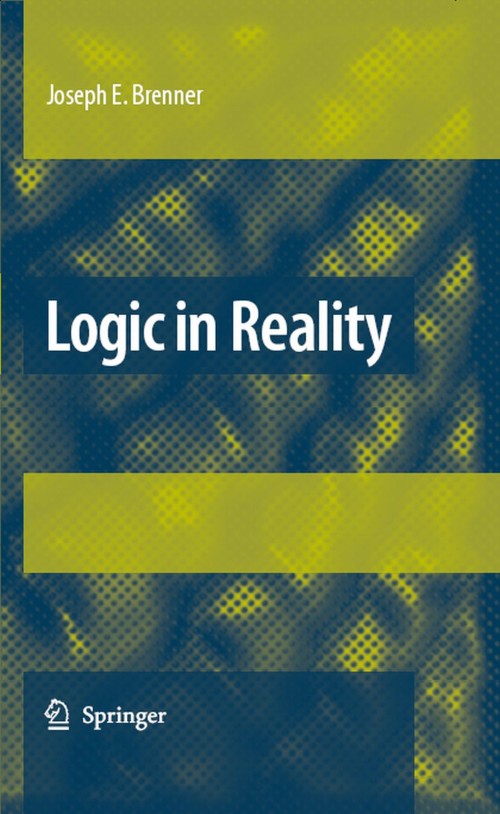
245 10|aLogic in Reality|h[electronic resource] /|cby JOSEPH BRENNER.
250 |a1st ed. 2008.
264 1|aDordrecht :|bSpringer Netherlands :|bImprint: Springer,|c2008.
300 |aXXII, 362 p.|bonline resource.
336 |atext|btxt|2rdacontent
337 |acomputer|bc|2rdamedia
338 |aonline resource|bcr|2rdacarrier
347 |atext file|bPDF|2rda
505 0 |aLogic in Reality (LIR) as a Formal Logic -- LIR as a Formal System -- LIR as a Formal Ontology -- The Categories of LIR -- The Core Thesis of LIR: Structure and Explanation -- LIR, Metaphysics and Philosophy -- LIR and Physical Science: Time, Space and Cosmology -- Emergence, Living Systems and Closure.
520 |aLogic in Reality argues that the fundamental physical structure of the world is logical as well as mathematical. The applicable formal logic of and in reality proposed (LIR) represents a radical departure from the standard notion of logic and its function. The book establishes LIR as a non-propositional logic with a unique calculus, one however that can be used intuitively with minimum symbolism. A new relational ontology is developed that demonstrates the fit of the LIR axioms with modern physics. The axioms and ontology of LIR together constitute a framework for describing and explaining complex real world processes, entities and events. Examples from the literature of on-going issues in philosophy, metaphysics and ontology are analyzed accordingly, including problems of causality, time and space, emergence and evolution. This book is at the interface of logic, philosophy and science. It is intended for readers with interest and/or current involvement in process philosophy, ontology and in the philosophy or metaphysical aspects of science, especially, quantum physics, biology and cosmology. The content requires competence in reasoning, but not detailed knowledge of the fields discussed. The critical extension in LIR of categorial non-separability to macroscopic interactive processes defines dynamic structural principles that underlie both scientific theories and their domains. LIR thus provides logical support for current metaphysical versions of structural realism. The author encourages readers to exercise a "new skepticism", since LIR is a way to interpret and accept dichotomies and contradictory explanations and to manage inconsistency in both philosophy and science.
650 0|aLogic.
650 0|aMetaphysics.
650 0|aPhilosophy, Modern.
650 0|aOntology.
650 0|aPhilosophy of nature.
650 0|aScience|xPhilosophy.
650 14|aLogic.
650 24|aMetaphysics.
650 24|aEarly Modern Philosophy.
650 24|aOntology.
650 24|aPhilosophy of Nature.
650 24|aPhilosophy of Science.
710 2 |aSpringerLink (Online service)
773 0 |tSpringer Nature eBook
776 08|iPrinted edition:|z9781402083747
776 08|iPrinted edition:|z9789048117499
776 08|iPrinted edition:|z9789048178605
856 40|uhttps://doi.org/10.1007/978-1-4020-8375-4
912 |aZDB-2-SHU
912 |aZDB-2-SXPR
950 |aHumanities, Social Sciences and Law (SpringerNature-11648)
950 |aPhilosophy and Religion (R0) (SpringerNature-43725)