

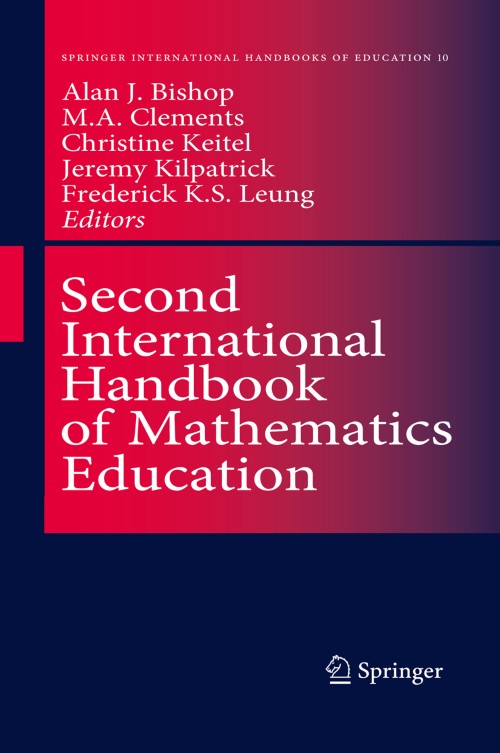
Second International Handbook of Mathematics Education [electronic resource] / edited by Alan Bishop, M.A. (Ken) Clements, Christine Keitel-Kreidt, Jeremy Kilpatrick, Frederick Koon-Shing Leung.
Erişim Adresi
ISBN
9789401002738
Dil Kodu
İngilizce
Yer Numarası
DK/8746
Basım Bildirimi
1st ed. 2003.
Yayın Bilgisi
Dordrecht : Springer Netherlands : Imprint: Springer, 2003.
Fiziksel Niteleme
XIV, 982 p. online resource.
Dizi
Springer International Handbooks of Education, 2197-196X ; 10
İçindekiler Notu
One -- 1 Introduction -- 2 Mathematics, mathematics education and economic conditions -- 3 Is mathematics for all? -- 4 Mathematical literacy -- 5 Lifelong mathematics education -- 6 International comparative research in mathematics education -- 7 Mathematics education in international and global contexts -- 8 Introduction -- 9 Technology and mathematics education: a multidimensional overview of recent research and innovation -- 10 Influence of technology on the mathematics curriculum -- 11 What can digital technologies take from and bring to research in mathematics education -- 12 Technology as a tool for teaching undergraduate mathematics -- 13 Mathematics teacher education and technology -- Two -- 14 Introduction -- 15 Getting the description right and making it count -- 16 The impact of educational research on mathematics education -- 17 Preparing mathematics education researchers for disciplined inquiry -- 18 Mathematics teachers as researchers -- 19 Researching mathematics education in situations of social and political conflict -- 20 Obstacles to the dissemination of mathematics education research -- 21 Introduction -- 22 Challenging and changing mathematics teaching classroom practices -- 23 Towards a didactic model for assessment design in mathematics education -- 24 Values in mathematics teaching — The hidden persuaders? -- 25 Regulating the entry of teachers of mathematics into the profession: Challenges, new models, and glimpses into the future -- 26 Examining the mathematics in mathematics teacher education -- 27 Educating new mathematics teachers: Integrating theory and practice, and the roles of practising teachers -- 28 Professional development in mathematics education: Trends and tasks -- List of Principal Authors -- Index of Names -- Index of Subjects.
Özet, vb.
ALAN 1. BISHOP The first International Handbook on Mathematics Education was published by Kluwer Academic Publishers in 1996. However, most of the writing for that handbook was done in 1995 and generally reflected the main research and development foci prior to 1994. There were four sections, 36 chapters, and some 150 people contributed to the final volume either as author, reviewer, editor, or critical friend. The task was a monumental one, attempting to cover the major research and practice developments in the international field of mathematics education as it appeared to the contributors in 1995. Inevitably there were certain omissions, some developments were only starting to emerge, and some literatures were only sketchy and speculative. However that Handbook has had to be reprinted three times, so it clearly fulfilled a need and I personally hope that it lived up to what I wrote in its Introduction: The Handbook thus attempts not merely to present a description of the international 'state-of-the-field', but also to offer synthetic and reflective overviews on the different directions being taken by the field, on the gaps existing in our present knowledge, on the current problems being faced, and on the future possibilities for development. (Bishop et aI. , 1996) Since that time there has been even more activity in our field, and now seems a good time to take stock again, to reflect on what has happened since 1995, and to create a second Handbook with the same overall goals.
Konu
Mathematics __ Study and teaching .
Education __ Curricula.
Teachers __ Training of.
Mathematics Education.
Curriculum Studies.
Teaching and Teacher Education.
Education __ Curricula.
Teachers __ Training of.
Mathematics Education.
Curriculum Studies.
Teaching and Teacher Education.
Diğer Yazarlar
Kurum Adı
Eseri Alıntıla
Referansları kullanmadan önce gözden geçirmeniz ve varsa gerekli düzeltmeleri yapmanız önerilir.
Dijital Kaynak
MARC Görünümü
LEADER 06486nam a22006495i 4500
001 807453
003 TR_AnAIT
005 20260127004135
007 cr nn 008mamaa
008 121227s2003 ne | s |||| 0|eng d
020 |a9789401002738|9978-94-010-0273-8
024 7 |a10.1007/978-94-010-0273-8|2doi
041 |aeng
049 |aTürk Tarih Kurumu Kütüphanesi
050 4|aQA10.92-20
072 7|aJNU|2bicssc
072 7|aPB|2bicssc
072 7|aEDU029010|2bisacsh
072 7|aJNU|2thema
072 7|aPB|2thema
082 04|a510.71|223
090 |aDK/8746
245 10|aSecond International Handbook of Mathematics Education|h[electronic resource] /|cedited by Alan Bishop, M.A. (Ken) Clements, Christine Keitel-Kreidt, Jeremy Kilpatrick, Frederick Koon-Shing Leung.
250 |a1st ed. 2003.
264 1|aDordrecht :|bSpringer Netherlands :|bImprint: Springer,|c2003.
300 |aXIV, 982 p.|bonline resource.
336 |atext|btxt|2rdacontent
337 |acomputer|bc|2rdamedia
338 |aonline resource|bcr|2rdacarrier
347 |atext file|bPDF|2rda
490 1 |aSpringer International Handbooks of Education,|x2197-196X ;|v10
505 0 |aOne -- 1 Introduction -- 2 Mathematics, mathematics education and economic conditions -- 3 Is mathematics for all? -- 4 Mathematical literacy -- 5 Lifelong mathematics education -- 6 International comparative research in mathematics education -- 7 Mathematics education in international and global contexts -- 8 Introduction -- 9 Technology and mathematics education: a multidimensional overview of recent research and innovation -- 10 Influence of technology on the mathematics curriculum -- 11 What can digital technologies take from and bring to research in mathematics education -- 12 Technology as a tool for teaching undergraduate mathematics -- 13 Mathematics teacher education and technology -- Two -- 14 Introduction -- 15 Getting the description right and making it count -- 16 The impact of educational research on mathematics education -- 17 Preparing mathematics education researchers for disciplined inquiry -- 18 Mathematics teachers as researchers -- 19 Researching mathematics education in situations of social and political conflict -- 20 Obstacles to the dissemination of mathematics education research -- 21 Introduction -- 22 Challenging and changing mathematics teaching classroom practices -- 23 Towards a didactic model for assessment design in mathematics education -- 24 Values in mathematics teaching — The hidden persuaders? -- 25 Regulating the entry of teachers of mathematics into the profession: Challenges, new models, and glimpses into the future -- 26 Examining the mathematics in mathematics teacher education -- 27 Educating new mathematics teachers: Integrating theory and practice, and the roles of practising teachers -- 28 Professional development in mathematics education: Trends and tasks -- List of Principal Authors -- Index of Names -- Index of Subjects.
520 |aALAN 1. BISHOP The first International Handbook on Mathematics Education was published by Kluwer Academic Publishers in 1996. However, most of the writing for that handbook was done in 1995 and generally reflected the main research and development foci prior to 1994. There were four sections, 36 chapters, and some 150 people contributed to the final volume either as author, reviewer, editor, or critical friend. The task was a monumental one, attempting to cover the major research and practice developments in the international field of mathematics education as it appeared to the contributors in 1995. Inevitably there were certain omissions, some developments were only starting to emerge, and some literatures were only sketchy and speculative. However that Handbook has had to be reprinted three times, so it clearly fulfilled a need and I personally hope that it lived up to what I wrote in its Introduction: The Handbook thus attempts not merely to present a description of the international 'state-of-the-field', but also to offer synthetic and reflective overviews on the different directions being taken by the field, on the gaps existing in our present knowledge, on the current problems being faced, and on the future possibilities for development. (Bishop et aI. , 1996) Since that time there has been even more activity in our field, and now seems a good time to take stock again, to reflect on what has happened since 1995, and to create a second Handbook with the same overall goals.
532 8 |aAccessibility summary: This PDF is not accessible. It is based on scanned pages and does not support features such as screen reader compatibility or described non-text content (images, graphs etc). However, it likely supports searchable and selectable text based on OCR (Optical Character Recognition). Users with accessibility needs may not be able to use this content effectively. Please contact us at accessibilitysupport@springernature.com if you require assistance or an alternative format.
532 8 |aInaccessible, or known limited accessibility
532 8 |aNo reading system accessibility options actively disabled
532 8 |aPublisher contact for further accessibility information: accessibilitysupport@springernature.com
650 0|aMathematics|xStudy and teaching .
650 0|aEducation|xCurricula.
650 0|aTeachers|xTraining of.
650 14|aMathematics Education.
650 24|aCurriculum Studies.
650 24|aTeaching and Teacher Education.
700 1 |aBishop, Alan.|eeditor.|4edt|4http://id.loc.gov/vocabulary/relators/edt
700 1 |aClements, M.A. (Ken).|eeditor.|4edt|4http://id.loc.gov/vocabulary/relators/edt
700 1 |aKeitel-Kreidt, Christine.|eeditor.|4edt|4http://id.loc.gov/vocabulary/relators/edt
700 1 |aKilpatrick, Jeremy.|eeditor.|4edt|4http://id.loc.gov/vocabulary/relators/edt
700 1 |aLeung, Frederick Koon-Shing.|eeditor.|4edt|4http://id.loc.gov/vocabulary/relators/edt
710 2 |aSpringerLink (Online service)
773 0 |tSpringer Nature eBook
776 08|iPrinted edition:|z9781402010088
776 08|iPrinted edition:|z9789401002745
776 08|iPrinted edition:|z9789401039512
830 0|aSpringer International Handbooks of Education,|x2197-196X ;|v10
856 40|uhttps://doi.org/10.1007/978-94-010-0273-8
912 |aZDB-2-SHU
912 |aZDB-2-SXED
912 |aZDB-2-BAE
950 |aHumanities, Social Sciences and Law (SpringerNature-11648)
950 |aEducation (R0) (SpringerNature-43721)
001 807453
003 TR_AnAIT
005 20260127004135
007 cr nn 008mamaa
008 121227s2003 ne | s |||| 0|eng d
020 |a9789401002738|9978-94-010-0273-8
024 7 |a10.1007/978-94-010-0273-8|2doi
041 |aeng
049 |aTürk Tarih Kurumu Kütüphanesi
050 4|aQA10.92-20
072 7|aJNU|2bicssc
072 7|aPB|2bicssc
072 7|aEDU029010|2bisacsh
072 7|aJNU|2thema
072 7|aPB|2thema
082 04|a510.71|223
090 |aDK/8746
245 10|aSecond International Handbook of Mathematics Education|h[electronic resource] /|cedited by Alan Bishop, M.A. (Ken) Clements, Christine Keitel-Kreidt, Jeremy Kilpatrick, Frederick Koon-Shing Leung.
250 |a1st ed. 2003.
264 1|aDordrecht :|bSpringer Netherlands :|bImprint: Springer,|c2003.
300 |aXIV, 982 p.|bonline resource.
336 |atext|btxt|2rdacontent
337 |acomputer|bc|2rdamedia
338 |aonline resource|bcr|2rdacarrier
347 |atext file|bPDF|2rda
490 1 |aSpringer International Handbooks of Education,|x2197-196X ;|v10
505 0 |aOne -- 1 Introduction -- 2 Mathematics, mathematics education and economic conditions -- 3 Is mathematics for all? -- 4 Mathematical literacy -- 5 Lifelong mathematics education -- 6 International comparative research in mathematics education -- 7 Mathematics education in international and global contexts -- 8 Introduction -- 9 Technology and mathematics education: a multidimensional overview of recent research and innovation -- 10 Influence of technology on the mathematics curriculum -- 11 What can digital technologies take from and bring to research in mathematics education -- 12 Technology as a tool for teaching undergraduate mathematics -- 13 Mathematics teacher education and technology -- Two -- 14 Introduction -- 15 Getting the description right and making it count -- 16 The impact of educational research on mathematics education -- 17 Preparing mathematics education researchers for disciplined inquiry -- 18 Mathematics teachers as researchers -- 19 Researching mathematics education in situations of social and political conflict -- 20 Obstacles to the dissemination of mathematics education research -- 21 Introduction -- 22 Challenging and changing mathematics teaching classroom practices -- 23 Towards a didactic model for assessment design in mathematics education -- 24 Values in mathematics teaching — The hidden persuaders? -- 25 Regulating the entry of teachers of mathematics into the profession: Challenges, new models, and glimpses into the future -- 26 Examining the mathematics in mathematics teacher education -- 27 Educating new mathematics teachers: Integrating theory and practice, and the roles of practising teachers -- 28 Professional development in mathematics education: Trends and tasks -- List of Principal Authors -- Index of Names -- Index of Subjects.
520 |aALAN 1. BISHOP The first International Handbook on Mathematics Education was published by Kluwer Academic Publishers in 1996. However, most of the writing for that handbook was done in 1995 and generally reflected the main research and development foci prior to 1994. There were four sections, 36 chapters, and some 150 people contributed to the final volume either as author, reviewer, editor, or critical friend. The task was a monumental one, attempting to cover the major research and practice developments in the international field of mathematics education as it appeared to the contributors in 1995. Inevitably there were certain omissions, some developments were only starting to emerge, and some literatures were only sketchy and speculative. However that Handbook has had to be reprinted three times, so it clearly fulfilled a need and I personally hope that it lived up to what I wrote in its Introduction: The Handbook thus attempts not merely to present a description of the international 'state-of-the-field', but also to offer synthetic and reflective overviews on the different directions being taken by the field, on the gaps existing in our present knowledge, on the current problems being faced, and on the future possibilities for development. (Bishop et aI. , 1996) Since that time there has been even more activity in our field, and now seems a good time to take stock again, to reflect on what has happened since 1995, and to create a second Handbook with the same overall goals.
532 8 |aAccessibility summary: This PDF is not accessible. It is based on scanned pages and does not support features such as screen reader compatibility or described non-text content (images, graphs etc). However, it likely supports searchable and selectable text based on OCR (Optical Character Recognition). Users with accessibility needs may not be able to use this content effectively. Please contact us at accessibilitysupport@springernature.com if you require assistance or an alternative format.
532 8 |aInaccessible, or known limited accessibility
532 8 |aNo reading system accessibility options actively disabled
532 8 |aPublisher contact for further accessibility information: accessibilitysupport@springernature.com
650 0|aMathematics|xStudy and teaching .
650 0|aEducation|xCurricula.
650 0|aTeachers|xTraining of.
650 14|aMathematics Education.
650 24|aCurriculum Studies.
650 24|aTeaching and Teacher Education.
700 1 |aBishop, Alan.|eeditor.|4edt|4http://id.loc.gov/vocabulary/relators/edt
700 1 |aClements, M.A. (Ken).|eeditor.|4edt|4http://id.loc.gov/vocabulary/relators/edt
700 1 |aKeitel-Kreidt, Christine.|eeditor.|4edt|4http://id.loc.gov/vocabulary/relators/edt
700 1 |aKilpatrick, Jeremy.|eeditor.|4edt|4http://id.loc.gov/vocabulary/relators/edt
700 1 |aLeung, Frederick Koon-Shing.|eeditor.|4edt|4http://id.loc.gov/vocabulary/relators/edt
710 2 |aSpringerLink (Online service)
773 0 |tSpringer Nature eBook
776 08|iPrinted edition:|z9781402010088
776 08|iPrinted edition:|z9789401002745
776 08|iPrinted edition:|z9789401039512
830 0|aSpringer International Handbooks of Education,|x2197-196X ;|v10
856 40|uhttps://doi.org/10.1007/978-94-010-0273-8
912 |aZDB-2-SHU
912 |aZDB-2-SXED
912 |aZDB-2-BAE
950 |aHumanities, Social Sciences and Law (SpringerNature-11648)
950 |aEducation (R0) (SpringerNature-43721)
Materyaller
Depodan talep edilen materyal sadece kütüphane içerisinde kullanılmaktadır.
Materyal dışarıya ödünç verilmemektedir.
Materyal dışarıya ödünç verilmemektedir.
