LEADER 04096nam a22005535i 4500
001 807487
003 TR_AnAIT
005 20260127004216
007 cr nn 008mamaa
008 130428s2013 ne | s |||| 0|eng d
020 |a9789400727120|9978-94-007-2712-0
024 7 |a10.1007/978-94-007-2712-0|2doi
041 |aeng
049 |aTürk Tarih Kurumu Kütüphanesi
050 4|aQA10.92-20
072 7|aJNU|2bicssc
072 7|aPB|2bicssc
072 7|aEDU029010|2bisacsh
072 7|aJNU|2thema
072 7|aPB|2thema
082 04|a510.71|223
090 |aDK/8780
100 1 |aRivera, Ferdinand.|eauthor.|4aut|4http://id.loc.gov/vocabulary/relators/aut
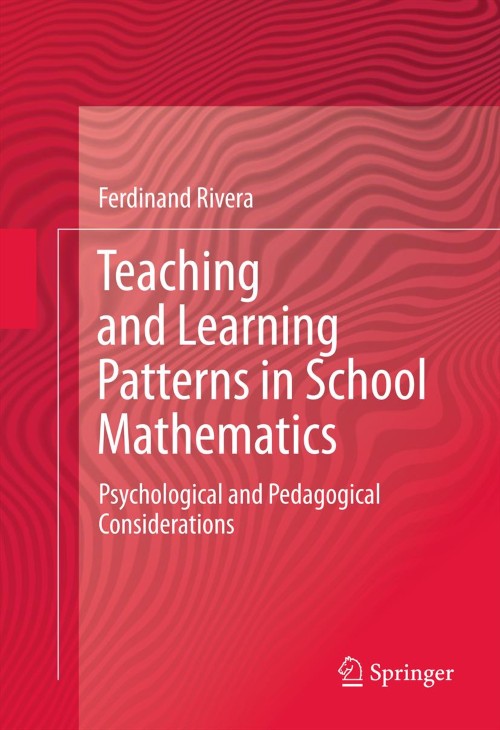
245 10|aTeaching and Learning Patterns in School Mathematics|h[electronic resource] :|bPsychological and Pedagogical Considerations /|cby Ferdinand Rivera.
250 |a1st ed. 2013.
264 1|aDordrecht :|bSpringer Netherlands :|bImprint: Springer,|c2013.
300 |aIX, 216 p.|bonline resource.
336 |atext|btxt|2rdacontent
337 |acomputer|bc|2rdamedia
338 |aonline resource|bcr|2rdacarrier
347 |atext file|bPDF|2rda
520 |aThis book draws on research findings on patterns in the last twenty years or so in order to argue for a theory of graded representations in pattern generalization. Pattern generalization encompasses the construction and justification of structures that give meanings to sequences of numerical and figural objects. While empirical studies conducted with different age-level groups have sufficiently demonstrated varying shifts in structural awareness and competence, which influence the eventual shape of an intended generalization, such shifts, however, are not necessarily permanent but parallel and graded, adaptive, and fundamentally distributed among a variety of cognitive and noncognitive sources that mutually influence each other. Thus, the emergence and complexity of the pattern generalization process cannot be reduced to a simple narrative of cognitive shifts from the arithmetic to the algebraic, from the recursive to the functional, from discerning details to perceiving properties, and so on and so forth. In this book, we pursue an alternative view of pattern generalization processing, that is, one that is not about permanent shifts or transition phases but graded and multimodal depending on individual learners’ experiences with patterns and, especially, the manner in which they perceive, think about, and act on them. A nonlinear graded perspective offers a much more robust and dynamic understanding of the similarities and differences in patterning competence since it is sensitive to, and acknowledges, the varying learning conditions and opportunities that shape generalization processing and representational conversion. Empirical evidence from a variety of sources will be provided to demonstrate this emergent perspective. Further, instructional implications commingle with research knowledge throughout the book, providing researchers andteachers with usable information that will help them cope with issues they may encounter when they use patterns to engage learners in generalization activity, which involves various aspects of abstract, quantitative, model-driven, structural, and regularity thinking. .
650 0|aMathematics|xStudy and teaching .
650 0|aEducational psychology.
650 0|aLearning, Psychology of.
650 0|aEducation|xCurricula.
650 0|aTeachers|xTraining of.
650 14|aMathematics Education.
650 24|aEducational Psychology.
650 24|aInstructional Psychology.
650 24|aCurriculum Studies.
650 24|aTeaching and Teacher Education.
710 2 |aSpringerLink (Online service)
773 0 |tSpringer Nature eBook
776 08|iPrinted edition:|z9789400727113
776 08|iPrinted edition:|z9789400727137
776 08|iPrinted edition:|z9789400794283
856 40|uhttps://doi.org/10.1007/978-94-007-2712-0
912 |aZDB-2-SHU
912 |aZDB-2-SXED
950 |aHumanities, Social Sciences and Law (SpringerNature-11648)
950 |aEducation (R0) (SpringerNature-43721)