

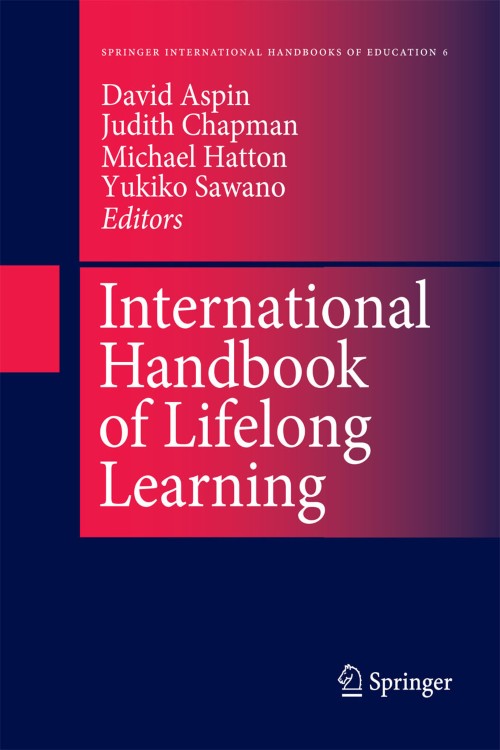
International Handbook of Lifelong Learning [electronic resource] / edited by David N. Aspin, Judith Chapman, Michael Hatton, Yukiko Sawano.
Erişim Adresi
ISBN
9789401009164
Dil Kodu
İngilizce
Yer Numarası
DK/8784
Basım Bildirimi
1st ed. 2001.
Yayın Bilgisi
Dordrecht : Springer Netherlands : Imprint: Springer, 2001.
Fiziksel Niteleme
LVIII, 820 p. online resource.
Dizi
Springer International Handbooks of Education, 2197-196X ; 6
İçindekiler Notu
Section 1: Lifelong Learning: Conceptual, Philosophical And Values Issues -- 1.1 Towards a Philosophy of Lifelong Learning -- 1.2 Locating Lifelong Learning and Education in Contemporary Currents of Thought and Culture -- 1.3 Lifelong Learning and Personal Fulfillment -- 1.4 Political Inclusion, Democratic Empowerment and Lifelong Learning -- 1.5 Lifelong Learning and the Contribution of Informal Learning -- 1.6 Lifelong Learning, Changing Economies and the World of Work -- 1.7 From Adult Education to Lifelong Learning -- 1.8 Caring for the Adult Self -- 1.9 Lifelong Learning for a Learning Democracy -- 1.10 Lifelong Education: Some Deweyan Themes -- 1.11 Lifelong Learning in the Postmodem -- 1.12 Lifelong Learning: Small Adjustment or Paradigm Shift? -- Section 2: The Policy Challenge -- 2.1 Lifelong Learning Policies in Low Development Contexts: An African Perspective -- 2.2 Lifelong Learning and Developing Society -- 2.3 Lifelong Learning Policies in Transition Countries -- 2.4 Trends in and Objectives of Adult Higher Education in China -- 2.5 Lifelong Learning and the Leisure-Oriented Society: The Development and Challenges in the Far East -- 2.6 The Swedish Adult Education Initiative: From Recurrent Education to Lifelong Learning -- 2.7 Towards New Lifelong Learning Contracts in Sweden -- 2.8 How to Make Lifelong Learning a Reality: Implications for the Planning of Educational Provision in Australia -- 2.9 Lifelong Learning: a Monitoring Framework and Trends in Participation -- Section 3: Structures and Programs in Lifelong Learning -- 3.1 Schools and the Learning Community: Laying the Basis for Learning Across the Lifespan -- 3.2 Integrity, Completeness and Comprehensiveness of the Learning Environment: Meeting the Basic Learning Needs Of All Throughout Life -- 3.3 Innovative Teachers: Promoting Lifelong Learning for All -- 3.4 Lifelong Learning and Tertiary Education: The Learning University Revisited -- 3.5 Universities as Centres for Lifelong Learning: Opportunities and Threats at the Institutional Level -- 3.6 Islands and Bridges: Lifelong Learning and Complex Systems of Higher Education in Canada -- 3.7 The Impact of the Dearing Report on UK Higher Education -- 3.8 Lifelong Learning and Technical and Further Education -- 3.9 Learning Communities for a Learning Century -- 3.10 Lifelong Learning and the Learning Organization -- Section 4: The Practice: Formal, Informal and Non-formal Initiatives in Learning Across the Lifespan -- 4.1 Community Colleges and Lifelong Learning: Canadian Experiences -- 4.2 From Literacy to Lifelong Learning in Tanzania -- 4.3 Lifelong Learning and the Private Sector -- 4.4 Recent Trends in the Practice of Lifelong Learning and Adult Education in Russia -- 4.5 Community Empowerment Through Lifelong Community Learning in Developing Countries -- 4.6 Lifelong Learning, the Individual and Community Self-help -- 4.7 New Lives for Old: Lifelong Learning Among the Indigenous Peoples of Taiwan and Canada -- 4.8 Promoting Lifelong Learning in Developing Countries: The Institutional Environment -- 4.9 Learning in the Third Age -- Index of Names -- Index of Subjects.
Özet, vb.
Recent changes in the world effected by the transformations of information technology, globalisation, and the move towards a knowledge economy over the last thirty years have been as radical and fundamental as the changes resulting from the invention of the wheel and the printing press. We are now living in a new age in which the demands are so complex, so multifarious and so rapidly changing that the only way in which we shall be able to survive them is by committing to a process of individual, communal, and global learning throughout the lifespan of all of us. A number of international bodies and agencies have taken cognisance of these transformations and the demands they impose upon societies and communities of the twenty-first century and have developed and articulated policies intended to enable all citizens of the world in the twenty-first century to face these challenges. It is now a declared policy of many governments and international agencies that the only vehicle for such preparation is `education, education, education', and that preparing for the knowledge economy and the learning society of the future has to be a lifelong undertaking, an investment in the future that is not restricted merely to the domain of economic advancement but also to those of social inclusion and personal growth. Realising this, policy-makers across the international arena are grappling with the need to move from systems that emphasise education and training to the radically more unworked construct of lifelong learning. In this volume the editors and authors analyse, criticise, and rework the ideas, principles, and theories underpinning policies and programs of lifelong learning, re-interpreting them in the light of examples of `best practice' found in a range of educating institutions around the world. We believe that students of educational change and community development will find it useful and helpful to have available in this volumesome of the most up-to-date thinking on the chief concepts, theories, and values of increasing policy interest in lifelong learning, together with a review of some significant examples of the different forms, focuses, and nexuses of thought and practice on this topic. All this enables us to offer some policy recommendations and practical suggestions as to ways forward in the endeavour to make lifelong learning a reality for all.
Konu
School management and organization.
School administration.
International education .
Comparative education.
Continuing education.
Organization and Leadership.
International and Comparative Education.
Lifelong Learning.
School administration.
International education .
Comparative education.
Continuing education.
Organization and Leadership.
International and Comparative Education.
Lifelong Learning.
Kurum Adı
Eseri Alıntıla
Referansları kullanmadan önce gözden geçirmeniz ve varsa gerekli düzeltmeleri yapmanız önerilir.
Dijital Kaynak
MARC Görünümü
LEADER 08594nam a22006375i 4500
001 807491
003 TR_AnAIT
005 20260127004220
007 cr nn 008mamaa
008 121227s2001 ne | s |||| 0|eng d
020 |a9789401009164|9978-94-010-0916-4
024 7 |a10.1007/978-94-010-0916-4|2doi
041 |aeng
049 |aTürk Tarih Kurumu Kütüphanesi
050 4|aLB2801-3095
072 7|aJNK|2bicssc
072 7|aEDU001000|2bisacsh
072 7|aJNK|2thema
082 04|a371.2|223
090 |aDK/8784
245 10|aInternational Handbook of Lifelong Learning|h[electronic resource] /|cedited by David N. Aspin, Judith Chapman, Michael Hatton, Yukiko Sawano.
250 |a1st ed. 2001.
264 1|aDordrecht :|bSpringer Netherlands :|bImprint: Springer,|c2001.
300 |aLVIII, 820 p.|bonline resource.
336 |atext|btxt|2rdacontent
337 |acomputer|bc|2rdamedia
338 |aonline resource|bcr|2rdacarrier
347 |atext file|bPDF|2rda
490 1 |aSpringer International Handbooks of Education,|x2197-196X ;|v6
505 0 |aSection 1: Lifelong Learning: Conceptual, Philosophical And Values Issues -- 1.1 Towards a Philosophy of Lifelong Learning -- 1.2 Locating Lifelong Learning and Education in Contemporary Currents of Thought and Culture -- 1.3 Lifelong Learning and Personal Fulfillment -- 1.4 Political Inclusion, Democratic Empowerment and Lifelong Learning -- 1.5 Lifelong Learning and the Contribution of Informal Learning -- 1.6 Lifelong Learning, Changing Economies and the World of Work -- 1.7 From Adult Education to Lifelong Learning -- 1.8 Caring for the Adult Self -- 1.9 Lifelong Learning for a Learning Democracy -- 1.10 Lifelong Education: Some Deweyan Themes -- 1.11 Lifelong Learning in the Postmodem -- 1.12 Lifelong Learning: Small Adjustment or Paradigm Shift? -- Section 2: The Policy Challenge -- 2.1 Lifelong Learning Policies in Low Development Contexts: An African Perspective -- 2.2 Lifelong Learning and Developing Society -- 2.3 Lifelong Learning Policies in Transition Countries -- 2.4 Trends in and Objectives of Adult Higher Education in China -- 2.5 Lifelong Learning and the Leisure-Oriented Society: The Development and Challenges in the Far East -- 2.6 The Swedish Adult Education Initiative: From Recurrent Education to Lifelong Learning -- 2.7 Towards New Lifelong Learning Contracts in Sweden -- 2.8 How to Make Lifelong Learning a Reality: Implications for the Planning of Educational Provision in Australia -- 2.9 Lifelong Learning: a Monitoring Framework and Trends in Participation -- Section 3: Structures and Programs in Lifelong Learning -- 3.1 Schools and the Learning Community: Laying the Basis for Learning Across the Lifespan -- 3.2 Integrity, Completeness and Comprehensiveness of the Learning Environment: Meeting the Basic Learning Needs Of All Throughout Life -- 3.3 Innovative Teachers: Promoting Lifelong Learning for All -- 3.4 Lifelong Learning and Tertiary Education: The Learning University Revisited -- 3.5 Universities as Centres for Lifelong Learning: Opportunities and Threats at the Institutional Level -- 3.6 Islands and Bridges: Lifelong Learning and Complex Systems of Higher Education in Canada -- 3.7 The Impact of the Dearing Report on UK Higher Education -- 3.8 Lifelong Learning and Technical and Further Education -- 3.9 Learning Communities for a Learning Century -- 3.10 Lifelong Learning and the Learning Organization -- Section 4: The Practice: Formal, Informal and Non-formal Initiatives in Learning Across the Lifespan -- 4.1 Community Colleges and Lifelong Learning: Canadian Experiences -- 4.2 From Literacy to Lifelong Learning in Tanzania -- 4.3 Lifelong Learning and the Private Sector -- 4.4 Recent Trends in the Practice of Lifelong Learning and Adult Education in Russia -- 4.5 Community Empowerment Through Lifelong Community Learning in Developing Countries -- 4.6 Lifelong Learning, the Individual and Community Self-help -- 4.7 New Lives for Old: Lifelong Learning Among the Indigenous Peoples of Taiwan and Canada -- 4.8 Promoting Lifelong Learning in Developing Countries: The Institutional Environment -- 4.9 Learning in the Third Age -- Index of Names -- Index of Subjects.
520 |aRecent changes in the world effected by the transformations of information technology, globalisation, and the move towards a knowledge economy over the last thirty years have been as radical and fundamental as the changes resulting from the invention of the wheel and the printing press. We are now living in a new age in which the demands are so complex, so multifarious and so rapidly changing that the only way in which we shall be able to survive them is by committing to a process of individual, communal, and global learning throughout the lifespan of all of us. A number of international bodies and agencies have taken cognisance of these transformations and the demands they impose upon societies and communities of the twenty-first century and have developed and articulated policies intended to enable all citizens of the world in the twenty-first century to face these challenges. It is now a declared policy of many governments and international agencies that the only vehicle for such preparation is `education, education, education', and that preparing for the knowledge economy and the learning society of the future has to be a lifelong undertaking, an investment in the future that is not restricted merely to the domain of economic advancement but also to those of social inclusion and personal growth. Realising this, policy-makers across the international arena are grappling with the need to move from systems that emphasise education and training to the radically more unworked construct of lifelong learning. In this volume the editors and authors analyse, criticise, and rework the ideas, principles, and theories underpinning policies and programs of lifelong learning, re-interpreting them in the light of examples of `best practice' found in a range of educating institutions around the world. We believe that students of educational change and community development will find it useful and helpful to have available in this volumesome of the most up-to-date thinking on the chief concepts, theories, and values of increasing policy interest in lifelong learning, together with a review of some significant examples of the different forms, focuses, and nexuses of thought and practice on this topic. All this enables us to offer some policy recommendations and practical suggestions as to ways forward in the endeavour to make lifelong learning a reality for all.
532 8 |aAccessibility summary: This PDF is not accessible. It is based on scanned pages and does not support features such as screen reader compatibility or described non-text content (images, graphs etc). However, it likely supports searchable and selectable text based on OCR (Optical Character Recognition). Users with accessibility needs may not be able to use this content effectively. Please contact us at accessibilitysupport@springernature.com if you require assistance or an alternative format.
532 8 |aInaccessible, or known limited accessibility
532 8 |aNo reading system accessibility options actively disabled
532 8 |aPublisher contact for further accessibility information: accessibilitysupport@springernature.com
650 0|aSchool management and organization.
650 0|aSchool administration.
650 0|aInternational education .
650 0|aComparative education.
650 0|aContinuing education.
650 14|aOrganization and Leadership.
650 24|aInternational and Comparative Education.
650 24|aLifelong Learning.
700 1 |aAspin, David N.|eeditor.|4edt|4http://id.loc.gov/vocabulary/relators/edt
700 1 |aChapman, Judith.|eeditor.|4edt|4http://id.loc.gov/vocabulary/relators/edt
700 1 |aHatton, Michael.|eeditor.|4edt|4http://id.loc.gov/vocabulary/relators/edt
700 1 |aSawano, Yukiko.|eeditor.|4edt|4http://id.loc.gov/vocabulary/relators/edt
710 2 |aSpringerLink (Online service)
773 0 |tSpringer Nature eBook
776 08|iPrinted edition:|z9780792368151
776 08|iPrinted edition:|z9789401009171
776 08|iPrinted edition:|z9789401038164
830 0|aSpringer International Handbooks of Education,|x2197-196X ;|v6
856 40|uhttps://doi.org/10.1007/978-94-010-0916-4
912 |aZDB-2-SHU
912 |aZDB-2-SXED
912 |aZDB-2-BAE
950 |aHumanities, Social Sciences and Law (SpringerNature-11648)
950 |aEducation (R0) (SpringerNature-43721)
001 807491
003 TR_AnAIT
005 20260127004220
007 cr nn 008mamaa
008 121227s2001 ne | s |||| 0|eng d
020 |a9789401009164|9978-94-010-0916-4
024 7 |a10.1007/978-94-010-0916-4|2doi
041 |aeng
049 |aTürk Tarih Kurumu Kütüphanesi
050 4|aLB2801-3095
072 7|aJNK|2bicssc
072 7|aEDU001000|2bisacsh
072 7|aJNK|2thema
082 04|a371.2|223
090 |aDK/8784
245 10|aInternational Handbook of Lifelong Learning|h[electronic resource] /|cedited by David N. Aspin, Judith Chapman, Michael Hatton, Yukiko Sawano.
250 |a1st ed. 2001.
264 1|aDordrecht :|bSpringer Netherlands :|bImprint: Springer,|c2001.
300 |aLVIII, 820 p.|bonline resource.
336 |atext|btxt|2rdacontent
337 |acomputer|bc|2rdamedia
338 |aonline resource|bcr|2rdacarrier
347 |atext file|bPDF|2rda
490 1 |aSpringer International Handbooks of Education,|x2197-196X ;|v6
505 0 |aSection 1: Lifelong Learning: Conceptual, Philosophical And Values Issues -- 1.1 Towards a Philosophy of Lifelong Learning -- 1.2 Locating Lifelong Learning and Education in Contemporary Currents of Thought and Culture -- 1.3 Lifelong Learning and Personal Fulfillment -- 1.4 Political Inclusion, Democratic Empowerment and Lifelong Learning -- 1.5 Lifelong Learning and the Contribution of Informal Learning -- 1.6 Lifelong Learning, Changing Economies and the World of Work -- 1.7 From Adult Education to Lifelong Learning -- 1.8 Caring for the Adult Self -- 1.9 Lifelong Learning for a Learning Democracy -- 1.10 Lifelong Education: Some Deweyan Themes -- 1.11 Lifelong Learning in the Postmodem -- 1.12 Lifelong Learning: Small Adjustment or Paradigm Shift? -- Section 2: The Policy Challenge -- 2.1 Lifelong Learning Policies in Low Development Contexts: An African Perspective -- 2.2 Lifelong Learning and Developing Society -- 2.3 Lifelong Learning Policies in Transition Countries -- 2.4 Trends in and Objectives of Adult Higher Education in China -- 2.5 Lifelong Learning and the Leisure-Oriented Society: The Development and Challenges in the Far East -- 2.6 The Swedish Adult Education Initiative: From Recurrent Education to Lifelong Learning -- 2.7 Towards New Lifelong Learning Contracts in Sweden -- 2.8 How to Make Lifelong Learning a Reality: Implications for the Planning of Educational Provision in Australia -- 2.9 Lifelong Learning: a Monitoring Framework and Trends in Participation -- Section 3: Structures and Programs in Lifelong Learning -- 3.1 Schools and the Learning Community: Laying the Basis for Learning Across the Lifespan -- 3.2 Integrity, Completeness and Comprehensiveness of the Learning Environment: Meeting the Basic Learning Needs Of All Throughout Life -- 3.3 Innovative Teachers: Promoting Lifelong Learning for All -- 3.4 Lifelong Learning and Tertiary Education: The Learning University Revisited -- 3.5 Universities as Centres for Lifelong Learning: Opportunities and Threats at the Institutional Level -- 3.6 Islands and Bridges: Lifelong Learning and Complex Systems of Higher Education in Canada -- 3.7 The Impact of the Dearing Report on UK Higher Education -- 3.8 Lifelong Learning and Technical and Further Education -- 3.9 Learning Communities for a Learning Century -- 3.10 Lifelong Learning and the Learning Organization -- Section 4: The Practice: Formal, Informal and Non-formal Initiatives in Learning Across the Lifespan -- 4.1 Community Colleges and Lifelong Learning: Canadian Experiences -- 4.2 From Literacy to Lifelong Learning in Tanzania -- 4.3 Lifelong Learning and the Private Sector -- 4.4 Recent Trends in the Practice of Lifelong Learning and Adult Education in Russia -- 4.5 Community Empowerment Through Lifelong Community Learning in Developing Countries -- 4.6 Lifelong Learning, the Individual and Community Self-help -- 4.7 New Lives for Old: Lifelong Learning Among the Indigenous Peoples of Taiwan and Canada -- 4.8 Promoting Lifelong Learning in Developing Countries: The Institutional Environment -- 4.9 Learning in the Third Age -- Index of Names -- Index of Subjects.
520 |aRecent changes in the world effected by the transformations of information technology, globalisation, and the move towards a knowledge economy over the last thirty years have been as radical and fundamental as the changes resulting from the invention of the wheel and the printing press. We are now living in a new age in which the demands are so complex, so multifarious and so rapidly changing that the only way in which we shall be able to survive them is by committing to a process of individual, communal, and global learning throughout the lifespan of all of us. A number of international bodies and agencies have taken cognisance of these transformations and the demands they impose upon societies and communities of the twenty-first century and have developed and articulated policies intended to enable all citizens of the world in the twenty-first century to face these challenges. It is now a declared policy of many governments and international agencies that the only vehicle for such preparation is `education, education, education', and that preparing for the knowledge economy and the learning society of the future has to be a lifelong undertaking, an investment in the future that is not restricted merely to the domain of economic advancement but also to those of social inclusion and personal growth. Realising this, policy-makers across the international arena are grappling with the need to move from systems that emphasise education and training to the radically more unworked construct of lifelong learning. In this volume the editors and authors analyse, criticise, and rework the ideas, principles, and theories underpinning policies and programs of lifelong learning, re-interpreting them in the light of examples of `best practice' found in a range of educating institutions around the world. We believe that students of educational change and community development will find it useful and helpful to have available in this volumesome of the most up-to-date thinking on the chief concepts, theories, and values of increasing policy interest in lifelong learning, together with a review of some significant examples of the different forms, focuses, and nexuses of thought and practice on this topic. All this enables us to offer some policy recommendations and practical suggestions as to ways forward in the endeavour to make lifelong learning a reality for all.
532 8 |aAccessibility summary: This PDF is not accessible. It is based on scanned pages and does not support features such as screen reader compatibility or described non-text content (images, graphs etc). However, it likely supports searchable and selectable text based on OCR (Optical Character Recognition). Users with accessibility needs may not be able to use this content effectively. Please contact us at accessibilitysupport@springernature.com if you require assistance or an alternative format.
532 8 |aInaccessible, or known limited accessibility
532 8 |aNo reading system accessibility options actively disabled
532 8 |aPublisher contact for further accessibility information: accessibilitysupport@springernature.com
650 0|aSchool management and organization.
650 0|aSchool administration.
650 0|aInternational education .
650 0|aComparative education.
650 0|aContinuing education.
650 14|aOrganization and Leadership.
650 24|aInternational and Comparative Education.
650 24|aLifelong Learning.
700 1 |aAspin, David N.|eeditor.|4edt|4http://id.loc.gov/vocabulary/relators/edt
700 1 |aChapman, Judith.|eeditor.|4edt|4http://id.loc.gov/vocabulary/relators/edt
700 1 |aHatton, Michael.|eeditor.|4edt|4http://id.loc.gov/vocabulary/relators/edt
700 1 |aSawano, Yukiko.|eeditor.|4edt|4http://id.loc.gov/vocabulary/relators/edt
710 2 |aSpringerLink (Online service)
773 0 |tSpringer Nature eBook
776 08|iPrinted edition:|z9780792368151
776 08|iPrinted edition:|z9789401009171
776 08|iPrinted edition:|z9789401038164
830 0|aSpringer International Handbooks of Education,|x2197-196X ;|v6
856 40|uhttps://doi.org/10.1007/978-94-010-0916-4
912 |aZDB-2-SHU
912 |aZDB-2-SXED
912 |aZDB-2-BAE
950 |aHumanities, Social Sciences and Law (SpringerNature-11648)
950 |aEducation (R0) (SpringerNature-43721)
Materyaller
Depodan talep edilen materyal sadece kütüphane içerisinde kullanılmaktadır.
Materyal dışarıya ödünç verilmemektedir.
Materyal dışarıya ödünç verilmemektedir.
