

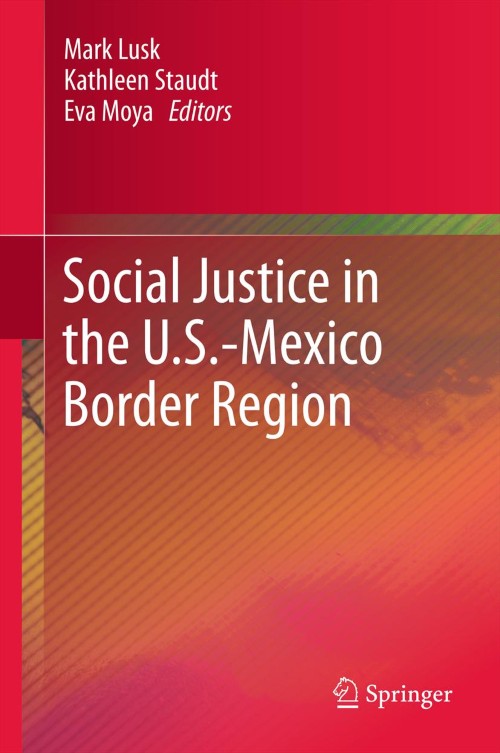
Social Justice in the U.S.-Mexico Border Region [electronic resource] / edited by Mark Lusk, Kathleen Staudt, Eva Moya.
Erişim Adresi
ISBN
9789400741508
Dil Kodu
İngilizce
Yer Numarası
DK/8785
Basım Bildirimi
1st ed. 2012.
Yayın Bilgisi
Dordrecht : Springer Netherlands : Imprint: Springer, 2012.
Fiziksel Niteleme
XII, 288 p. online resource.
İçindekiler Notu
Section I. Introduction and Conceptual Framework -- Chapter 1. Social Justice in the U.S. - Mexico Border Region: A Conceptual Framework; Mark Lusk, Kathleen Staudt, & Eva Moya -- Section II. Critical Perspectives on the Border Region -- Chapter 2. Political Economy and Social Justice in the US Mexico Border Region; Josiah Heyman.- Chapter 3. The Violence of Citizenship on the U.S.-Mexico Border: How Citizenship Creates Exclusion and Inclusion; Tony Payan -- 4. Women, Gender and Violence in La Frontera; Kathleen Staudt -- Chapter 5. A Theological Perspective on Social Justice in the U.S -- Mexico Border Region; John Stowe -- Section III. Problems and Opportunities on the U.S. - Mexico Border -- Chapter 6. Housing, Colonias and Social Justice on the Border; Guillermina Gina Núñez-Mchiri -- Chapter 7. Achieving Health Equity and Social Justice; Nuria Homedes -- Chapter 8. Mental Health Disparities and Social Justice; Griselda Villalobos & Arthur Islas.- Chapter 9. Border Health: Health Inequities, Social Determinants and the Case of Tuberculosis and HIV; Eva Moya, Oralia Loza & Mark Lusk.- Chapter 10. Environmental Injustice in the U.S. - Mexico Border Region; Sarah E. Grineski & Patricia Juarez -- Chapter 11. Migration and Discrimination: The Social Condition of Mexican Migrants who are Repatriated to Ciudad Juárez; Irasema Coronado & Héctor Padilla -- Section IV - Moving Forward: Steps in Achieving Border Justice -- Chapter 12. Education Policies: Standardized Testing, English-Language Learners, and Border Futures; Pauline Dow & Kathleen Staudt.-Chapter 13. Border Challenges and Ethnic Struggles for Social Justice: Latina/o Communities under Siege; Rosalía Solórzano Torres -- Chapter 14. Social Justice in the U.S. - Mexico Border Region: Implications for Policy and Practice; Mark Lusk, Kathleen Staudt & Eva Moya -- Afterword; Monsignor Arturo Bañuelas.
Özet, vb.
The U.S.-Mexico Border Region is among the poorest geographical areas in the United States. The region has been long characterized by dual development, poor infrastructure, weak schools, health disparities and low-wage employment. More recently, the region has been affected by the violence associated with a drug and crime war in Mexico. The premise of this book is that the U.S.-Mexico Border Region is subject to systematic oppression and that the so-called social pathologies that we see in the region are by-products of social and economic injustice in the form of labor exploitation, environmental racism, immigration militarism, institutional sexism and discrimination, health inequities, a political economy based on low-wage labor, and the globalization of labor and capital. The chapters address a variety of examples of injustice in the areas of environment, health disparity, migration unemployment, citizenship, women and gender violence, mental health, and drug violence. The book proposes a pathway to development.
Konu
Sociology.
Emigration and immigration.
Political science.
Sociology.
Human Migration.
Political Science.
Emigration and immigration.
Political science.
Sociology.
Human Migration.
Political Science.
Diğer Yazarlar
Kurum Adı
Eseri Alıntıla
Referansları kullanmadan önce gözden geçirmeniz ve varsa gerekli düzeltmeleri yapmanız önerilir.
Dijital Kaynak
MARC Görünümü
LEADER 04819nam a22005415i 4500
001 807492
003 TR_AnAIT
005 20260127004222
007 cr nn 008mamaa
008 120611s2012 ne | s |||| 0|eng d
020 |a9789400741508|9978-94-007-4150-8
024 7 |a10.1007/978-94-007-4150-8|2doi
041 |aeng
049 |aTürk Tarih Kurumu Kütüphanesi
050 4|aHM
072 7|aJHB|2bicssc
072 7|aJHB|2bicssc
072 7|aSOC026000|2bisacsh
072 7|aJHB|2thema
072 7|aJHB|2thema
082 04|a301|223
090 |aDK/8785
245 10|aSocial Justice in the U.S.-Mexico Border Region|h[electronic resource] /|cedited by Mark Lusk, Kathleen Staudt, Eva Moya.
250 |a1st ed. 2012.
264 1|aDordrecht :|bSpringer Netherlands :|bImprint: Springer,|c2012.
300 |aXII, 288 p.|bonline resource.
336 |atext|btxt|2rdacontent
337 |acomputer|bc|2rdamedia
338 |aonline resource|bcr|2rdacarrier
347 |atext file|bPDF|2rda
505 0 |aSection I. Introduction and Conceptual Framework -- Chapter 1. Social Justice in the U.S. - Mexico Border Region: A Conceptual Framework; Mark Lusk, Kathleen Staudt, & Eva Moya -- Section II. Critical Perspectives on the Border Region -- Chapter 2. Political Economy and Social Justice in the US Mexico Border Region; Josiah Heyman.- Chapter 3. The Violence of Citizenship on the U.S.-Mexico Border: How Citizenship Creates Exclusion and Inclusion; Tony Payan -- 4. Women, Gender and Violence in La Frontera; Kathleen Staudt -- Chapter 5. A Theological Perspective on Social Justice in the U.S -- Mexico Border Region; John Stowe -- Section III. Problems and Opportunities on the U.S. - Mexico Border -- Chapter 6. Housing, Colonias and Social Justice on the Border; Guillermina Gina Núñez-Mchiri -- Chapter 7. Achieving Health Equity and Social Justice; Nuria Homedes -- Chapter 8. Mental Health Disparities and Social Justice; Griselda Villalobos & Arthur Islas.- Chapter 9. Border Health: Health Inequities, Social Determinants and the Case of Tuberculosis and HIV; Eva Moya, Oralia Loza & Mark Lusk.- Chapter 10. Environmental Injustice in the U.S. - Mexico Border Region; Sarah E. Grineski & Patricia Juarez -- Chapter 11. Migration and Discrimination: The Social Condition of Mexican Migrants who are Repatriated to Ciudad Juárez; Irasema Coronado & Héctor Padilla -- Section IV - Moving Forward: Steps in Achieving Border Justice -- Chapter 12. Education Policies: Standardized Testing, English-Language Learners, and Border Futures; Pauline Dow & Kathleen Staudt.-Chapter 13. Border Challenges and Ethnic Struggles for Social Justice: Latina/o Communities under Siege; Rosalía Solórzano Torres -- Chapter 14. Social Justice in the U.S. - Mexico Border Region: Implications for Policy and Practice; Mark Lusk, Kathleen Staudt & Eva Moya -- Afterword; Monsignor Arturo Bañuelas.
520 |aThe U.S.-Mexico Border Region is among the poorest geographical areas in the United States. The region has been long characterized by dual development, poor infrastructure, weak schools, health disparities and low-wage employment. More recently, the region has been affected by the violence associated with a drug and crime war in Mexico. The premise of this book is that the U.S.-Mexico Border Region is subject to systematic oppression and that the so-called social pathologies that we see in the region are by-products of social and economic injustice in the form of labor exploitation, environmental racism, immigration militarism, institutional sexism and discrimination, health inequities, a political economy based on low-wage labor, and the globalization of labor and capital. The chapters address a variety of examples of injustice in the areas of environment, health disparity, migration unemployment, citizenship, women and gender violence, mental health, and drug violence. The book proposes a pathway to development.
650 0|aSociology.
650 0|aEmigration and immigration.
650 0|aPolitical science.
650 14|aSociology.
650 24|aHuman Migration.
650 24|aPolitical Science.
700 1 |aLusk, Mark.|eeditor.|4edt|4http://id.loc.gov/vocabulary/relators/edt
700 1 |aStaudt, Kathleen.|eeditor.|4edt|4http://id.loc.gov/vocabulary/relators/edt
700 1 |aMoya, Eva.|eeditor.|4edt|4http://id.loc.gov/vocabulary/relators/edt
710 2 |aSpringerLink (Online service)
773 0 |tSpringer Nature eBook
776 08|iPrinted edition:|z9789400741492
776 08|iPrinted edition:|z9789400741515
776 08|iPrinted edition:|z9789400793705
856 40|uhttps://doi.org/10.1007/978-94-007-4150-8
912 |aZDB-2-SHU
912 |aZDB-2-SXS
950 |aHumanities, Social Sciences and Law (SpringerNature-11648)
950 |aSocial Sciences (R0) (SpringerNature-43726)
001 807492
003 TR_AnAIT
005 20260127004222
007 cr nn 008mamaa
008 120611s2012 ne | s |||| 0|eng d
020 |a9789400741508|9978-94-007-4150-8
024 7 |a10.1007/978-94-007-4150-8|2doi
041 |aeng
049 |aTürk Tarih Kurumu Kütüphanesi
050 4|aHM
072 7|aJHB|2bicssc
072 7|aJHB|2bicssc
072 7|aSOC026000|2bisacsh
072 7|aJHB|2thema
072 7|aJHB|2thema
082 04|a301|223
090 |aDK/8785
245 10|aSocial Justice in the U.S.-Mexico Border Region|h[electronic resource] /|cedited by Mark Lusk, Kathleen Staudt, Eva Moya.
250 |a1st ed. 2012.
264 1|aDordrecht :|bSpringer Netherlands :|bImprint: Springer,|c2012.
300 |aXII, 288 p.|bonline resource.
336 |atext|btxt|2rdacontent
337 |acomputer|bc|2rdamedia
338 |aonline resource|bcr|2rdacarrier
347 |atext file|bPDF|2rda
505 0 |aSection I. Introduction and Conceptual Framework -- Chapter 1. Social Justice in the U.S. - Mexico Border Region: A Conceptual Framework; Mark Lusk, Kathleen Staudt, & Eva Moya -- Section II. Critical Perspectives on the Border Region -- Chapter 2. Political Economy and Social Justice in the US Mexico Border Region; Josiah Heyman.- Chapter 3. The Violence of Citizenship on the U.S.-Mexico Border: How Citizenship Creates Exclusion and Inclusion; Tony Payan -- 4. Women, Gender and Violence in La Frontera; Kathleen Staudt -- Chapter 5. A Theological Perspective on Social Justice in the U.S -- Mexico Border Region; John Stowe -- Section III. Problems and Opportunities on the U.S. - Mexico Border -- Chapter 6. Housing, Colonias and Social Justice on the Border; Guillermina Gina Núñez-Mchiri -- Chapter 7. Achieving Health Equity and Social Justice; Nuria Homedes -- Chapter 8. Mental Health Disparities and Social Justice; Griselda Villalobos & Arthur Islas.- Chapter 9. Border Health: Health Inequities, Social Determinants and the Case of Tuberculosis and HIV; Eva Moya, Oralia Loza & Mark Lusk.- Chapter 10. Environmental Injustice in the U.S. - Mexico Border Region; Sarah E. Grineski & Patricia Juarez -- Chapter 11. Migration and Discrimination: The Social Condition of Mexican Migrants who are Repatriated to Ciudad Juárez; Irasema Coronado & Héctor Padilla -- Section IV - Moving Forward: Steps in Achieving Border Justice -- Chapter 12. Education Policies: Standardized Testing, English-Language Learners, and Border Futures; Pauline Dow & Kathleen Staudt.-Chapter 13. Border Challenges and Ethnic Struggles for Social Justice: Latina/o Communities under Siege; Rosalía Solórzano Torres -- Chapter 14. Social Justice in the U.S. - Mexico Border Region: Implications for Policy and Practice; Mark Lusk, Kathleen Staudt & Eva Moya -- Afterword; Monsignor Arturo Bañuelas.
520 |aThe U.S.-Mexico Border Region is among the poorest geographical areas in the United States. The region has been long characterized by dual development, poor infrastructure, weak schools, health disparities and low-wage employment. More recently, the region has been affected by the violence associated with a drug and crime war in Mexico. The premise of this book is that the U.S.-Mexico Border Region is subject to systematic oppression and that the so-called social pathologies that we see in the region are by-products of social and economic injustice in the form of labor exploitation, environmental racism, immigration militarism, institutional sexism and discrimination, health inequities, a political economy based on low-wage labor, and the globalization of labor and capital. The chapters address a variety of examples of injustice in the areas of environment, health disparity, migration unemployment, citizenship, women and gender violence, mental health, and drug violence. The book proposes a pathway to development.
650 0|aSociology.
650 0|aEmigration and immigration.
650 0|aPolitical science.
650 14|aSociology.
650 24|aHuman Migration.
650 24|aPolitical Science.
700 1 |aLusk, Mark.|eeditor.|4edt|4http://id.loc.gov/vocabulary/relators/edt
700 1 |aStaudt, Kathleen.|eeditor.|4edt|4http://id.loc.gov/vocabulary/relators/edt
700 1 |aMoya, Eva.|eeditor.|4edt|4http://id.loc.gov/vocabulary/relators/edt
710 2 |aSpringerLink (Online service)
773 0 |tSpringer Nature eBook
776 08|iPrinted edition:|z9789400741492
776 08|iPrinted edition:|z9789400741515
776 08|iPrinted edition:|z9789400793705
856 40|uhttps://doi.org/10.1007/978-94-007-4150-8
912 |aZDB-2-SHU
912 |aZDB-2-SXS
950 |aHumanities, Social Sciences and Law (SpringerNature-11648)
950 |aSocial Sciences (R0) (SpringerNature-43726)
Materyaller
Depodan talep edilen materyal sadece kütüphane içerisinde kullanılmaktadır.
Materyal dışarıya ödünç verilmemektedir.
Materyal dışarıya ödünç verilmemektedir.
