

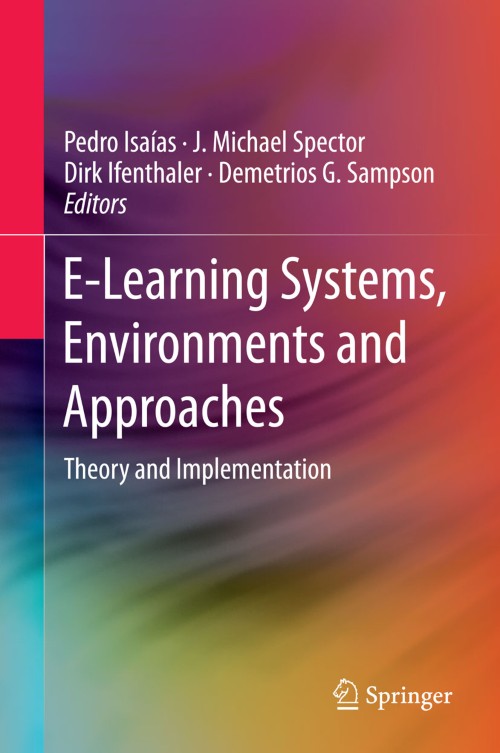
E-Learning Systems, Environments and Approaches [electronic resource] : Theory and Implementation / edited by Pedro Isaías, J. Michael Spector, Dirk Ifenthaler, Demetrios G. Sampson.
Erişim Adresi
ISBN
9783319058252
Dil Kodu
İngilizce
Yer Numarası
DK/8814
Basım Bildirimi
1st ed. 2015.
Yayın Bilgisi
Cham : Springer International Publishing : Imprint: Springer, 2015.
Fiziksel Niteleme
XXIII, 329 p. 68 illus., 43 illus. in color. online resource.
İçindekiler Notu
Part I. Exploratory Learning Technologies -- Measuring Problem Solving Skills in Portal 2 -- iPads in Inclusive Classrooms: Ecologies of Learning -- Supporting the Strengths and Activity of Children with Autism in a Technology-Enhanced Learning Environment -- The Cognitive Cost of Chatting while Attending a Lecture: A Temporal Analysis -- Learning with the Simple show -- Using Loop Learning and Critical Dialogue in Developing Innovative Literature Reviews -- The Contributions of Digital Concept Maps to Assessment for Learning Practices -- Part II. e-Learning Social Web Design -- Intelligent Tutors in Immersive Virtual Environments -- Journal of Exploration on the Way Towards Authentic Learning Environments -- The Configuration Process of a Community of Practice in the Collective Text Editor -- Context-Based Semantic Annotations in Copes: An Ontological and Rule-Based Approach -- Model of Emotional Expressions in Movements -- Student-Driven Classroom Technologies: Transmedia Navigation and Transformative Communications -- Perceived Affordances of a Technology-Enhanced Active Learning Classroom in Promoting Collaborative Problem Solving -- Using a Facebook Group as a Forum to Distribute, Answer and Discuss Content: Influence on Achievement -- Part III. Learner Communities through e-Learning Implementations -- ICT Support for Collaborative Learning - A Tale of Two Cities -- Students' Facebook Usage and Academic Achievement: A Case Study of Private University in Thailand -- The Investigation of Pre-Service Teachers' Concerns about Integrating Web 2.0 Technologies into Instruction -- Interactive Technologies for Teacher Training: Comparing Performance and Assessment in Second Life and Simschool -- A Study on Improving Information Processing Abilities Based on PBL -- Part IV. Collaborative and Student-Centered e-Learning Design -- Piaget, Inhelder and Minecraft -- Using Generic and Context-Specific Scaffolding to Support Authentic Science Inquiry -- Leverage Learning in the UniversityClassroom -- Data Challenges of Leveraging a Simulation to Assess Learning -- Self-Assessment and Reflection in a 1st Semester Course for Software Engineering Students -- Don't Waste Student Work: Using Classroom Assignments to Contribute to Online Resources -- The Ancestor Project: Aboriginal Computer Education through Storytelling -- Index.
Özet, vb.
The volume consists of twenty-five chapters selected from among peer-reviewed papers presented at the CELDA (Cognition and Exploratory Learning in the Digital Age) 2013 Conference held in Fort Worth, Texas, USA, in October 2013 and also from world class scholars in e-learning systems, environments and approaches. The following sub-topics are included: Exploratory Learning Technologies (Part I), e-Learning social web design (Part II), Learner communities through e-Learning implementations (Part III), Collaborative and student-centered e-Learning design (Part IV). E-Learning has been, since its initial stages, a synonym for flexibility. While this dynamic nature has mainly been associated with time and space it is safe to argue that currently it embraces other aspects such as the learners’ profile, the scope of subjects that can be taught electronically and the technology it employs. New technologies also widen the range of activities and skills developed in e-Learning. Electronic learning environments have evolved past the exclusive delivery of knowledge. Technology has endowed e-Learning with the possibility of remotely fomenting problem solving skills, critical thinking and team work, by investing in information exchange, collaboration, personalisation and community building.
Konu
Educational technology.
Learning, Psychology of.
Digital Education and Educational Technology.
Instructional Psychology.
Learning, Psychology of.
Digital Education and Educational Technology.
Instructional Psychology.
Diğer Yazarlar
Kurum Adı
Eseri Alıntıla
Referansları kullanmadan önce gözden geçirmeniz ve varsa gerekli düzeltmeleri yapmanız önerilir.
Dijital Kaynak
MARC Görünümü
LEADER 05762nam a22005055i 4500
001 807521
003 TR_AnAIT
005 20260127004255
007 cr nn 008mamaa
008 150312s2015 sz | s |||| 0|eng d
020 |a9783319058252|9978-3-319-05825-2
024 7 |a10.1007/978-3-319-05825-2|2doi
041 |aeng
049 |aTürk Tarih Kurumu Kütüphanesi
050 4|aLB1028.3
072 7|aJNV|2bicssc
072 7|aEDU000000|2bisacsh
072 7|aJNV|2thema
082 04|a371.33|223
090 |aDK/8814
245 10|aE-Learning Systems, Environments and Approaches|h[electronic resource] :|bTheory and Implementation /|cedited by Pedro Isaías, J. Michael Spector, Dirk Ifenthaler, Demetrios G. Sampson.
250 |a1st ed. 2015.
264 1|aCham :|bSpringer International Publishing :|bImprint: Springer,|c2015.
300 |aXXIII, 329 p. 68 illus., 43 illus. in color.|bonline resource.
336 |atext|btxt|2rdacontent
337 |acomputer|bc|2rdamedia
338 |aonline resource|bcr|2rdacarrier
347 |atext file|bPDF|2rda
505 0 |aPart I. Exploratory Learning Technologies -- Measuring Problem Solving Skills in Portal 2 -- iPads in Inclusive Classrooms: Ecologies of Learning -- Supporting the Strengths and Activity of Children with Autism in a Technology-Enhanced Learning Environment -- The Cognitive Cost of Chatting while Attending a Lecture: A Temporal Analysis -- Learning with the Simple show -- Using Loop Learning and Critical Dialogue in Developing Innovative Literature Reviews -- The Contributions of Digital Concept Maps to Assessment for Learning Practices -- Part II. e-Learning Social Web Design -- Intelligent Tutors in Immersive Virtual Environments -- Journal of Exploration on the Way Towards Authentic Learning Environments -- The Configuration Process of a Community of Practice in the Collective Text Editor -- Context-Based Semantic Annotations in Copes: An Ontological and Rule-Based Approach -- Model of Emotional Expressions in Movements -- Student-Driven Classroom Technologies: Transmedia Navigation and Transformative Communications -- Perceived Affordances of a Technology-Enhanced Active Learning Classroom in Promoting Collaborative Problem Solving -- Using a Facebook Group as a Forum to Distribute, Answer and Discuss Content: Influence on Achievement -- Part III. Learner Communities through e-Learning Implementations -- ICT Support for Collaborative Learning - A Tale of Two Cities -- Students' Facebook Usage and Academic Achievement: A Case Study of Private University in Thailand -- The Investigation of Pre-Service Teachers' Concerns about Integrating Web 2.0 Technologies into Instruction -- Interactive Technologies for Teacher Training: Comparing Performance and Assessment in Second Life and Simschool -- A Study on Improving Information Processing Abilities Based on PBL -- Part IV. Collaborative and Student-Centered e-Learning Design -- Piaget, Inhelder and Minecraft -- Using Generic and Context-Specific Scaffolding to Support Authentic Science Inquiry -- Leverage Learning in the UniversityClassroom -- Data Challenges of Leveraging a Simulation to Assess Learning -- Self-Assessment and Reflection in a 1st Semester Course for Software Engineering Students -- Don't Waste Student Work: Using Classroom Assignments to Contribute to Online Resources -- The Ancestor Project: Aboriginal Computer Education through Storytelling -- Index.
520 |aThe volume consists of twenty-five chapters selected from among peer-reviewed papers presented at the CELDA (Cognition and Exploratory Learning in the Digital Age) 2013 Conference held in Fort Worth, Texas, USA, in October 2013 and also from world class scholars in e-learning systems, environments and approaches. The following sub-topics are included: Exploratory Learning Technologies (Part I), e-Learning social web design (Part II), Learner communities through e-Learning implementations (Part III), Collaborative and student-centered e-Learning design (Part IV). E-Learning has been, since its initial stages, a synonym for flexibility. While this dynamic nature has mainly been associated with time and space it is safe to argue that currently it embraces other aspects such as the learners’ profile, the scope of subjects that can be taught electronically and the technology it employs. New technologies also widen the range of activities and skills developed in e-Learning. Electronic learning environments have evolved past the exclusive delivery of knowledge. Technology has endowed e-Learning with the possibility of remotely fomenting problem solving skills, critical thinking and team work, by investing in information exchange, collaboration, personalisation and community building.
650 0|aEducational technology.
650 0|aLearning, Psychology of.
650 14|aDigital Education and Educational Technology.
650 24|aInstructional Psychology.
700 1 |aIsaías, Pedro.|eeditor.|4edt|4http://id.loc.gov/vocabulary/relators/edt
700 1 |aSpector, J. Michael.|eeditor.|4edt|4http://id.loc.gov/vocabulary/relators/edt
700 1 |aIfenthaler, Dirk.|eeditor.|4edt|4http://id.loc.gov/vocabulary/relators/edt
700 1 |aSampson, Demetrios G.|eeditor.|0(orcid)0000-0002-0174-0137|1https://orcid.org/0000-0002-0174-0137|4edt|4http://id.loc.gov/vocabulary/relators/edt
710 2 |aSpringerLink (Online service)
773 0 |tSpringer Nature eBook
776 08|iPrinted edition:|z9783319058245
776 08|iPrinted edition:|z9783319058269
776 08|iPrinted edition:|z9783319357522
856 40|uhttps://doi.org/10.1007/978-3-319-05825-2
912 |aZDB-2-SHU
912 |aZDB-2-SXED
950 |aHumanities, Social Sciences and Law (SpringerNature-11648)
950 |aEducation (R0) (SpringerNature-43721)
001 807521
003 TR_AnAIT
005 20260127004255
007 cr nn 008mamaa
008 150312s2015 sz | s |||| 0|eng d
020 |a9783319058252|9978-3-319-05825-2
024 7 |a10.1007/978-3-319-05825-2|2doi
041 |aeng
049 |aTürk Tarih Kurumu Kütüphanesi
050 4|aLB1028.3
072 7|aJNV|2bicssc
072 7|aEDU000000|2bisacsh
072 7|aJNV|2thema
082 04|a371.33|223
090 |aDK/8814
245 10|aE-Learning Systems, Environments and Approaches|h[electronic resource] :|bTheory and Implementation /|cedited by Pedro Isaías, J. Michael Spector, Dirk Ifenthaler, Demetrios G. Sampson.
250 |a1st ed. 2015.
264 1|aCham :|bSpringer International Publishing :|bImprint: Springer,|c2015.
300 |aXXIII, 329 p. 68 illus., 43 illus. in color.|bonline resource.
336 |atext|btxt|2rdacontent
337 |acomputer|bc|2rdamedia
338 |aonline resource|bcr|2rdacarrier
347 |atext file|bPDF|2rda
505 0 |aPart I. Exploratory Learning Technologies -- Measuring Problem Solving Skills in Portal 2 -- iPads in Inclusive Classrooms: Ecologies of Learning -- Supporting the Strengths and Activity of Children with Autism in a Technology-Enhanced Learning Environment -- The Cognitive Cost of Chatting while Attending a Lecture: A Temporal Analysis -- Learning with the Simple show -- Using Loop Learning and Critical Dialogue in Developing Innovative Literature Reviews -- The Contributions of Digital Concept Maps to Assessment for Learning Practices -- Part II. e-Learning Social Web Design -- Intelligent Tutors in Immersive Virtual Environments -- Journal of Exploration on the Way Towards Authentic Learning Environments -- The Configuration Process of a Community of Practice in the Collective Text Editor -- Context-Based Semantic Annotations in Copes: An Ontological and Rule-Based Approach -- Model of Emotional Expressions in Movements -- Student-Driven Classroom Technologies: Transmedia Navigation and Transformative Communications -- Perceived Affordances of a Technology-Enhanced Active Learning Classroom in Promoting Collaborative Problem Solving -- Using a Facebook Group as a Forum to Distribute, Answer and Discuss Content: Influence on Achievement -- Part III. Learner Communities through e-Learning Implementations -- ICT Support for Collaborative Learning - A Tale of Two Cities -- Students' Facebook Usage and Academic Achievement: A Case Study of Private University in Thailand -- The Investigation of Pre-Service Teachers' Concerns about Integrating Web 2.0 Technologies into Instruction -- Interactive Technologies for Teacher Training: Comparing Performance and Assessment in Second Life and Simschool -- A Study on Improving Information Processing Abilities Based on PBL -- Part IV. Collaborative and Student-Centered e-Learning Design -- Piaget, Inhelder and Minecraft -- Using Generic and Context-Specific Scaffolding to Support Authentic Science Inquiry -- Leverage Learning in the UniversityClassroom -- Data Challenges of Leveraging a Simulation to Assess Learning -- Self-Assessment and Reflection in a 1st Semester Course for Software Engineering Students -- Don't Waste Student Work: Using Classroom Assignments to Contribute to Online Resources -- The Ancestor Project: Aboriginal Computer Education through Storytelling -- Index.
520 |aThe volume consists of twenty-five chapters selected from among peer-reviewed papers presented at the CELDA (Cognition and Exploratory Learning in the Digital Age) 2013 Conference held in Fort Worth, Texas, USA, in October 2013 and also from world class scholars in e-learning systems, environments and approaches. The following sub-topics are included: Exploratory Learning Technologies (Part I), e-Learning social web design (Part II), Learner communities through e-Learning implementations (Part III), Collaborative and student-centered e-Learning design (Part IV). E-Learning has been, since its initial stages, a synonym for flexibility. While this dynamic nature has mainly been associated with time and space it is safe to argue that currently it embraces other aspects such as the learners’ profile, the scope of subjects that can be taught electronically and the technology it employs. New technologies also widen the range of activities and skills developed in e-Learning. Electronic learning environments have evolved past the exclusive delivery of knowledge. Technology has endowed e-Learning with the possibility of remotely fomenting problem solving skills, critical thinking and team work, by investing in information exchange, collaboration, personalisation and community building.
650 0|aEducational technology.
650 0|aLearning, Psychology of.
650 14|aDigital Education and Educational Technology.
650 24|aInstructional Psychology.
700 1 |aIsaías, Pedro.|eeditor.|4edt|4http://id.loc.gov/vocabulary/relators/edt
700 1 |aSpector, J. Michael.|eeditor.|4edt|4http://id.loc.gov/vocabulary/relators/edt
700 1 |aIfenthaler, Dirk.|eeditor.|4edt|4http://id.loc.gov/vocabulary/relators/edt
700 1 |aSampson, Demetrios G.|eeditor.|0(orcid)0000-0002-0174-0137|1https://orcid.org/0000-0002-0174-0137|4edt|4http://id.loc.gov/vocabulary/relators/edt
710 2 |aSpringerLink (Online service)
773 0 |tSpringer Nature eBook
776 08|iPrinted edition:|z9783319058245
776 08|iPrinted edition:|z9783319058269
776 08|iPrinted edition:|z9783319357522
856 40|uhttps://doi.org/10.1007/978-3-319-05825-2
912 |aZDB-2-SHU
912 |aZDB-2-SXED
950 |aHumanities, Social Sciences and Law (SpringerNature-11648)
950 |aEducation (R0) (SpringerNature-43721)
Materyaller
Depodan talep edilen materyal sadece kütüphane içerisinde kullanılmaktadır.
Materyal dışarıya ödünç verilmemektedir.
Materyal dışarıya ödünç verilmemektedir.
