

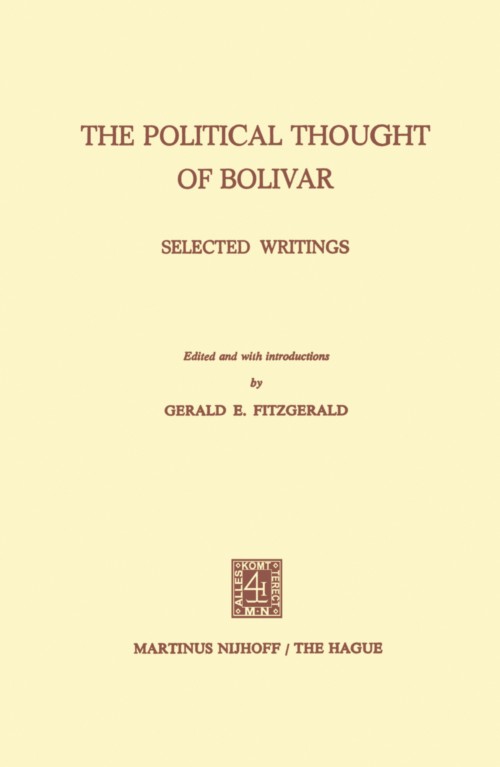
The Political Thought of Bolivar [electronic resource] : Selected Writings / edited by G.E. Fitzgerald.
Erişim Adresi
ISBN
9789401030274
Dil Kodu
İngilizce
Yer Numarası
DK/8820
Basım Bildirimi
1st ed. 1971.
Yayın Bilgisi
Dordrecht : Springer Netherlands : Imprint: Springer, 1971.
Fiziksel Niteleme
X, 143 p. online resource.
İçindekiler Notu
Life of Bolívar -- Sources of Bolívar’s Political Thought -- The Political Thought of Bolívar -- 1. The Cartagena Manifesto -- 2. Ideas on the Union of All America -- 3. The Jamaica Letter -- 4. The Angostura Discourse -- 5. A Letter to Guillermo White -- 6. Letter to General Nariño -- 7. The Congress of Panama -- Circular Letter of Invitation to the Congress of Panama -- Views on the Congress of Panama -- Letter to José Rafael Revenga -- 8. Essay on Public Education -- 9. Letters to Sucre on Federation of Colombia, Peru and Bolivia -- Letter to Sucre of May 12, 1826 -- Letter to Sucre of August 18, 1826 -- 10. Message to the Congress of Bolivia -- 11. Message to the Grand Convention of Ocaña -- 12. Letter to General Daniel O’Leary -- 13. A Panoramic View of Spanish America -- 14. Message to the Constituent Congress of the Republic of Colombia -- 15. Proclamation to the People of Colombia -- 16. Testament of Simón Bolívar.
Özet, vb.
Life of Bolivar Sim6n Bolivar was born in Caracas, Venezuela, on July 24, 1783, and died in Santa Marta, Colombia, on December 17, 1830. His life was relatively brief, but it was crowded with many activities, many hardships, many re verses, and many accomplishments. He is now revered as the Liberator of five Latin American countries: Bolivia, Colombia, Ecuador, Peru, and Venezuela. A descendant of a distinguished Creole family that originated in Biscay, Spain, the young Bolivar was orphaned at an early age and was cared for by his uncle, Carlos Palacios. As was customary, tutors were employed to edu cate the young boy. One of these was Andres Bello, later to become a distin guished scholar. Another was Sim6n Rodriguez, who was particularly influ enced by Rousseau and other eighteenth century philosophers. Later the young BoHvar was sent to Spain to continue his education. There he met Maria Teresa Rodriguez del Toro, whom he married in 1802. Bolivar and his bride returned to Caracas, where she died of yellow fever in 1803. Boli var never remarried. Returning to Europe, Bolivar went to Spain and then to France. There he found that Napoleon, the former republican, had proclaimed himself Em peror of the French. After a trip to Italy, Bolivar returned to Caracas in 1807 by way of several cities in the United States.
Konu
History.
History.
History.
Diğer Yazarlar
Kurum Adı
Eseri Alıntıla
Referansları kullanmadan önce gözden geçirmeniz ve varsa gerekli düzeltmeleri yapmanız önerilir.
Dijital Kaynak
MARC Görünümü
LEADER 04629nam a22005295i 4500
001 807527
003 TR_AnAIT
005 20260127004301
007 cr nn 008mamaa
008 121227s1971 ne | s |||| 0|eng d
020 |a9789401030274|9978-94-010-3027-4
024 7 |a10.1007/978-94-010-3027-4|2doi
041 |aeng
049 |aTürk Tarih Kurumu Kütüphanesi
050 4|aD1-2027
072 7|aHB|2bicssc
072 7|aHBAH|2bicssc
072 7|aHIS000000|2bisacsh
072 7|aNH|2thema
072 7|aNHAH|2thema
082 04|a900|223
090 |aDK/8820
245 14|aThe Political Thought of Bolivar|h[electronic resource] :|bSelected Writings /|cedited by G.E. Fitzgerald.
250 |a1st ed. 1971.
264 1|aDordrecht :|bSpringer Netherlands :|bImprint: Springer,|c1971.
300 |aX, 143 p.|bonline resource.
336 |atext|btxt|2rdacontent
337 |acomputer|bc|2rdamedia
338 |aonline resource|bcr|2rdacarrier
347 |atext file|bPDF|2rda
505 0 |aLife of Bolívar -- Sources of Bolívar’s Political Thought -- The Political Thought of Bolívar -- 1. The Cartagena Manifesto -- 2. Ideas on the Union of All America -- 3. The Jamaica Letter -- 4. The Angostura Discourse -- 5. A Letter to Guillermo White -- 6. Letter to General Nariño -- 7. The Congress of Panama -- Circular Letter of Invitation to the Congress of Panama -- Views on the Congress of Panama -- Letter to José Rafael Revenga -- 8. Essay on Public Education -- 9. Letters to Sucre on Federation of Colombia, Peru and Bolivia -- Letter to Sucre of May 12, 1826 -- Letter to Sucre of August 18, 1826 -- 10. Message to the Congress of Bolivia -- 11. Message to the Grand Convention of Ocaña -- 12. Letter to General Daniel O’Leary -- 13. A Panoramic View of Spanish America -- 14. Message to the Constituent Congress of the Republic of Colombia -- 15. Proclamation to the People of Colombia -- 16. Testament of Simón Bolívar.
520 |aLife of Bolivar Sim6n Bolivar was born in Caracas, Venezuela, on July 24, 1783, and died in Santa Marta, Colombia, on December 17, 1830. His life was relatively brief, but it was crowded with many activities, many hardships, many re verses, and many accomplishments. He is now revered as the Liberator of five Latin American countries: Bolivia, Colombia, Ecuador, Peru, and Venezuela. A descendant of a distinguished Creole family that originated in Biscay, Spain, the young Bolivar was orphaned at an early age and was cared for by his uncle, Carlos Palacios. As was customary, tutors were employed to edu cate the young boy. One of these was Andres Bello, later to become a distin guished scholar. Another was Sim6n Rodriguez, who was particularly influ enced by Rousseau and other eighteenth century philosophers. Later the young BoHvar was sent to Spain to continue his education. There he met Maria Teresa Rodriguez del Toro, whom he married in 1802. Bolivar and his bride returned to Caracas, where she died of yellow fever in 1803. Boli var never remarried. Returning to Europe, Bolivar went to Spain and then to France. There he found that Napoleon, the former republican, had proclaimed himself Em peror of the French. After a trip to Italy, Bolivar returned to Caracas in 1807 by way of several cities in the United States.
532 8 |aAccessibility summary: This PDF is not accessible. It is based on scanned pages and does not support features such as screen reader compatibility or described non-text content (images, graphs etc). However, it likely supports searchable and selectable text based on OCR (Optical Character Recognition). Users with accessibility needs may not be able to use this content effectively. Please contact us at accessibilitysupport@springernature.com if you require assistance or an alternative format.
532 8 |aInaccessible, or known limited accessibility
532 8 |aNo reading system accessibility options actively disabled
532 8 |aPublisher contact for further accessibility information: accessibilitysupport@springernature.com
650 0|aHistory.
650 14|aHistory.
700 1 |aFitzgerald, G.E.|eeditor.|4edt|4http://id.loc.gov/vocabulary/relators/edt
710 2 |aSpringerLink (Online service)
773 0 |tSpringer Nature eBook
776 08|iPrinted edition:|z9789024751136
776 08|iPrinted edition:|z9789401030281
776 08|iPrinted edition:|z9789401030298
856 40|uhttps://doi.org/10.1007/978-94-010-3027-4
912 |aZDB-2-SHU
912 |aZDB-2-SXH
912 |aZDB-2-BAE
950 |aHumanities, Social Sciences and Law (SpringerNature-11648)
950 |aHistory (R0) (SpringerNature-43722)
001 807527
003 TR_AnAIT
005 20260127004301
007 cr nn 008mamaa
008 121227s1971 ne | s |||| 0|eng d
020 |a9789401030274|9978-94-010-3027-4
024 7 |a10.1007/978-94-010-3027-4|2doi
041 |aeng
049 |aTürk Tarih Kurumu Kütüphanesi
050 4|aD1-2027
072 7|aHB|2bicssc
072 7|aHBAH|2bicssc
072 7|aHIS000000|2bisacsh
072 7|aNH|2thema
072 7|aNHAH|2thema
082 04|a900|223
090 |aDK/8820
245 14|aThe Political Thought of Bolivar|h[electronic resource] :|bSelected Writings /|cedited by G.E. Fitzgerald.
250 |a1st ed. 1971.
264 1|aDordrecht :|bSpringer Netherlands :|bImprint: Springer,|c1971.
300 |aX, 143 p.|bonline resource.
336 |atext|btxt|2rdacontent
337 |acomputer|bc|2rdamedia
338 |aonline resource|bcr|2rdacarrier
347 |atext file|bPDF|2rda
505 0 |aLife of Bolívar -- Sources of Bolívar’s Political Thought -- The Political Thought of Bolívar -- 1. The Cartagena Manifesto -- 2. Ideas on the Union of All America -- 3. The Jamaica Letter -- 4. The Angostura Discourse -- 5. A Letter to Guillermo White -- 6. Letter to General Nariño -- 7. The Congress of Panama -- Circular Letter of Invitation to the Congress of Panama -- Views on the Congress of Panama -- Letter to José Rafael Revenga -- 8. Essay on Public Education -- 9. Letters to Sucre on Federation of Colombia, Peru and Bolivia -- Letter to Sucre of May 12, 1826 -- Letter to Sucre of August 18, 1826 -- 10. Message to the Congress of Bolivia -- 11. Message to the Grand Convention of Ocaña -- 12. Letter to General Daniel O’Leary -- 13. A Panoramic View of Spanish America -- 14. Message to the Constituent Congress of the Republic of Colombia -- 15. Proclamation to the People of Colombia -- 16. Testament of Simón Bolívar.
520 |aLife of Bolivar Sim6n Bolivar was born in Caracas, Venezuela, on July 24, 1783, and died in Santa Marta, Colombia, on December 17, 1830. His life was relatively brief, but it was crowded with many activities, many hardships, many re verses, and many accomplishments. He is now revered as the Liberator of five Latin American countries: Bolivia, Colombia, Ecuador, Peru, and Venezuela. A descendant of a distinguished Creole family that originated in Biscay, Spain, the young Bolivar was orphaned at an early age and was cared for by his uncle, Carlos Palacios. As was customary, tutors were employed to edu cate the young boy. One of these was Andres Bello, later to become a distin guished scholar. Another was Sim6n Rodriguez, who was particularly influ enced by Rousseau and other eighteenth century philosophers. Later the young BoHvar was sent to Spain to continue his education. There he met Maria Teresa Rodriguez del Toro, whom he married in 1802. Bolivar and his bride returned to Caracas, where she died of yellow fever in 1803. Boli var never remarried. Returning to Europe, Bolivar went to Spain and then to France. There he found that Napoleon, the former republican, had proclaimed himself Em peror of the French. After a trip to Italy, Bolivar returned to Caracas in 1807 by way of several cities in the United States.
532 8 |aAccessibility summary: This PDF is not accessible. It is based on scanned pages and does not support features such as screen reader compatibility or described non-text content (images, graphs etc). However, it likely supports searchable and selectable text based on OCR (Optical Character Recognition). Users with accessibility needs may not be able to use this content effectively. Please contact us at accessibilitysupport@springernature.com if you require assistance or an alternative format.
532 8 |aInaccessible, or known limited accessibility
532 8 |aNo reading system accessibility options actively disabled
532 8 |aPublisher contact for further accessibility information: accessibilitysupport@springernature.com
650 0|aHistory.
650 14|aHistory.
700 1 |aFitzgerald, G.E.|eeditor.|4edt|4http://id.loc.gov/vocabulary/relators/edt
710 2 |aSpringerLink (Online service)
773 0 |tSpringer Nature eBook
776 08|iPrinted edition:|z9789024751136
776 08|iPrinted edition:|z9789401030281
776 08|iPrinted edition:|z9789401030298
856 40|uhttps://doi.org/10.1007/978-94-010-3027-4
912 |aZDB-2-SHU
912 |aZDB-2-SXH
912 |aZDB-2-BAE
950 |aHumanities, Social Sciences and Law (SpringerNature-11648)
950 |aHistory (R0) (SpringerNature-43722)
Materyaller
Depodan talep edilen materyal sadece kütüphane içerisinde kullanılmaktadır.
Materyal dışarıya ödünç verilmemektedir.
Materyal dışarıya ödünç verilmemektedir.
