

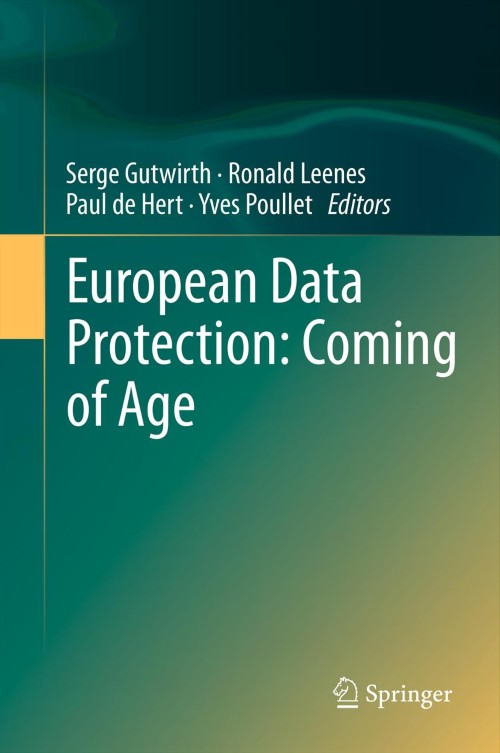
European Data Protection: Coming of Age [electronic resource] / edited by Serge Gutwirth, Ronald Leenes, Paul de Hert, Yves Poullet.
Erişim Adresi
ISBN
9789400751705
Dil Kodu
İngilizce
Yer Numarası
DK/8845
Basım Bildirimi
1st ed. 2013.
Yayın Bilgisi
Dordrecht : Springer Netherlands : Imprint: Springer, 2013.
Fiziksel Niteleme
XII, 440 p. online resource.
İçindekiler Notu
Foreword -- I. Concepts -- 1. Seven types of privacy; Rachel Finn, David Wright and Michael Friedewald -- 2. The Internet as Surveilled Workplayplace and Factory; Christian Fuchs and Daniel Trottier -- 3. From Market-Making Tool to Fundamental Right: the Role of the Court of Justice in Data Protection’s Identity Crisis; Orla Lynskey -- 4. Anonymity: a Comparison between the Legal and Computer Science Perspectives; Sergio Mascetti, Anna Monreale, Annarita Ricci and Andrea Gerino -- II. Digital natives and ageing users -- 5. Digital Natives and the Metamorphosis of European Society. The emerging behavioral trends regarding privacy and their legal implications; Norberto Andrade and Shara Monteleone -- 6. Autonomy in ICT for older persons at the crossroads between legal and care practices; Daniel Lopez Gomez, Eugenio Mantovani and Paul De Hert -- 7. Ethical implications of technologies that "support" ageing with dementia at home; Unai Díaz-Orueta and Elena Urdaneta -- III. Privacy by design -- 8. Privacy by Design: Enhanced Privacy Leadership, Methods, and Results; Ann Cavoukian -- 9. Roadmap for Privacy Protection in Mobile Sensing Applications; Delphine Christin, Matthias Hollick -- 10. Privacy enhancing techniques for the protection of mobility patterns in LBS: research issues and trends; Maria Luisa Damiani -- 11. Privacy by Design through social requirements analysis of social network sites from a user perspective; Ralf De Wolf, Rob Heyman and Jo Pierson -- IV. Surveillance, profiling and smart metering -- 12. Smart metering and privacy in Europe: lessons from the Dutch case; Colette Cuijpers and Bert-Jaap Koops -- 13. User Choice, Privacy Sensitivity, and Acceptance of Personal Information Collection; Joshua B. Hurwitz -- 14. Beyond Gut Level – Some Critical Remarks on the German Privacy Approach to Smart Metering; Frank Pallas -- 15. Surveillance as a Service? On the Use of Surveillance Data for Administrative Purposes; Martin Pekárek, Arnold Roosendaal and JasperSluijs -- 6. Computers Reading Our Minds? The benefits and risks of profiling; Jorg Polakiewicz -- Case studies -- 17. Communicating Privacy in Organisations. Catharsis and Change in the Case of the Deutsche Bahn; Daniel Guagnin, Carla Ilten and Leon Hempel -- 18. The end of independent data protection supervision in Hungary – a case study; András Jóri -- 19. Data Protection, Social Networks and Online Mass Media; Artemi Rallo and Ricard Martínez.
Özet, vb.
On 25 January 2012, the European Commission presented its long awaited new “Data protection package”. With this proposal for a drastic revision of the data protection framework in Europe, it is fair to say that we are witnessing a rebirth of European data protection, and perhaps, its passage from an impulsive youth to a more mature state. Technology advances rapidly and mobile devices are significantly changing the landscape. Increasingly, we carry powerful, connected, devices, whose location and activities can be monitored by various stakeholders. Very powerful social network sites emerged in the first half of last decade, processing personal data of many millions of users. Updating the regulatory framework was imminent and the presentation of the new package will initiate a period of intense debate in which the proposals will be thoroughly commented upon and criticized, and numerous amendments will undoubtedly be proposed. This volume brings together some 19 chapters offering conceptual analyses, highlighting issues, proposing solutions, and discussing practices regarding privacy and data protection. In the first part of the book, conceptual analyses of concepts such as privacy and anonymity are provided. The second section focuses on the contrasted positions of digital natives and ageing users in the information society. The third section provides four chapters on privacy by design, including discussions on roadmapping and concrete techniques. The fourth section is devoted to surveillance and profiling, with illustrations from the domain of smart metering, self-surveillance and the benefits and risks of profiling. The book concludes with case studies pertaining to communicating privacy in organisations, the fate of a data protection supervisor in one of the EU member states and data protection in social network sites and online media.
Konu
International law.
Computers and civilization.
Law __ Philosophy.
Technology __ Philosophy.
Public International Law.
Computers and Society.
Philosophy of Law.
Philosophy of Technology.
Computers and civilization.
Law __ Philosophy.
Technology __ Philosophy.
Public International Law.
Computers and Society.
Philosophy of Law.
Philosophy of Technology.
Diğer Yazarlar
Kurum Adı
Eseri Alıntıla
Referansları kullanmadan önce gözden geçirmeniz ve varsa gerekli düzeltmeleri yapmanız önerilir.
Dijital Kaynak
MARC Görünümü
LEADER 06450nam a22005655i 4500
001 807552
003 TR_AnAIT
005 20260127004334
007 cr nn 008mamaa
008 121205s2013 ne | s |||| 0|eng d
020 |a9789400751705|9978-94-007-5170-5
024 7 |a10.1007/978-94-007-5170-5|2doi
041 |aeng
049 |aTürk Tarih Kurumu Kütüphanesi
050 4|aKZ
072 7|aLBB|2bicssc
072 7|aLAW051000|2bisacsh
072 7|aLBB|2thema
082 04|a341|223
090 |aDK/8845
245 10|aEuropean Data Protection: Coming of Age|h[electronic resource] /|cedited by Serge Gutwirth, Ronald Leenes, Paul de Hert, Yves Poullet.
250 |a1st ed. 2013.
264 1|aDordrecht :|bSpringer Netherlands :|bImprint: Springer,|c2013.
300 |aXII, 440 p.|bonline resource.
336 |atext|btxt|2rdacontent
337 |acomputer|bc|2rdamedia
338 |aonline resource|bcr|2rdacarrier
347 |atext file|bPDF|2rda
505 0 |aForeword -- I. Concepts -- 1. Seven types of privacy; Rachel Finn, David Wright and Michael Friedewald -- 2. The Internet as Surveilled Workplayplace and Factory; Christian Fuchs and Daniel Trottier -- 3. From Market-Making Tool to Fundamental Right: the Role of the Court of Justice in Data Protection’s Identity Crisis; Orla Lynskey -- 4. Anonymity: a Comparison between the Legal and Computer Science Perspectives; Sergio Mascetti, Anna Monreale, Annarita Ricci and Andrea Gerino -- II. Digital natives and ageing users -- 5. Digital Natives and the Metamorphosis of European Society. The emerging behavioral trends regarding privacy and their legal implications; Norberto Andrade and Shara Monteleone -- 6. Autonomy in ICT for older persons at the crossroads between legal and care practices; Daniel Lopez Gomez, Eugenio Mantovani and Paul De Hert -- 7. Ethical implications of technologies that "support" ageing with dementia at home; Unai Díaz-Orueta and Elena Urdaneta -- III. Privacy by design -- 8. Privacy by Design: Enhanced Privacy Leadership, Methods, and Results; Ann Cavoukian -- 9. Roadmap for Privacy Protection in Mobile Sensing Applications; Delphine Christin, Matthias Hollick -- 10. Privacy enhancing techniques for the protection of mobility patterns in LBS: research issues and trends; Maria Luisa Damiani -- 11. Privacy by Design through social requirements analysis of social network sites from a user perspective; Ralf De Wolf, Rob Heyman and Jo Pierson -- IV. Surveillance, profiling and smart metering -- 12. Smart metering and privacy in Europe: lessons from the Dutch case; Colette Cuijpers and Bert-Jaap Koops -- 13. User Choice, Privacy Sensitivity, and Acceptance of Personal Information Collection; Joshua B. Hurwitz -- 14. Beyond Gut Level – Some Critical Remarks on the German Privacy Approach to Smart Metering; Frank Pallas -- 15. Surveillance as a Service? On the Use of Surveillance Data for Administrative Purposes; Martin Pekárek, Arnold Roosendaal and JasperSluijs -- 6. Computers Reading Our Minds? The benefits and risks of profiling; Jorg Polakiewicz -- Case studies -- 17. Communicating Privacy in Organisations. Catharsis and Change in the Case of the Deutsche Bahn; Daniel Guagnin, Carla Ilten and Leon Hempel -- 18. The end of independent data protection supervision in Hungary – a case study; András Jóri -- 19. Data Protection, Social Networks and Online Mass Media; Artemi Rallo and Ricard Martínez.
520 |aOn 25 January 2012, the European Commission presented its long awaited new “Data protection package”. With this proposal for a drastic revision of the data protection framework in Europe, it is fair to say that we are witnessing a rebirth of European data protection, and perhaps, its passage from an impulsive youth to a more mature state. Technology advances rapidly and mobile devices are significantly changing the landscape. Increasingly, we carry powerful, connected, devices, whose location and activities can be monitored by various stakeholders. Very powerful social network sites emerged in the first half of last decade, processing personal data of many millions of users. Updating the regulatory framework was imminent and the presentation of the new package will initiate a period of intense debate in which the proposals will be thoroughly commented upon and criticized, and numerous amendments will undoubtedly be proposed. This volume brings together some 19 chapters offering conceptual analyses, highlighting issues, proposing solutions, and discussing practices regarding privacy and data protection. In the first part of the book, conceptual analyses of concepts such as privacy and anonymity are provided. The second section focuses on the contrasted positions of digital natives and ageing users in the information society. The third section provides four chapters on privacy by design, including discussions on roadmapping and concrete techniques. The fourth section is devoted to surveillance and profiling, with illustrations from the domain of smart metering, self-surveillance and the benefits and risks of profiling. The book concludes with case studies pertaining to communicating privacy in organisations, the fate of a data protection supervisor in one of the EU member states and data protection in social network sites and online media.
650 0|aInternational law.
650 0|aComputers and civilization.
650 0|aLaw|xPhilosophy.
650 0|aTechnology|xPhilosophy.
650 14|aPublic International Law.
650 24|aComputers and Society.
650 24|aPhilosophy of Law.
650 24|aPhilosophy of Technology.
700 1 |aGutwirth, Serge.|eeditor.|4edt|4http://id.loc.gov/vocabulary/relators/edt
700 1 |aLeenes, Ronald.|eeditor.|4edt|4http://id.loc.gov/vocabulary/relators/edt
700 1 |ade Hert, Paul.|eeditor.|4edt|4http://id.loc.gov/vocabulary/relators/edt
700 1 |aPoullet, Yves.|eeditor.|4edt|4http://id.loc.gov/vocabulary/relators/edt
710 2 |aSpringerLink (Online service)
773 0 |tSpringer Nature eBook
776 08|iPrinted edition:|z9789400751699
776 08|iPrinted edition:|z9789400751712
776 08|iPrinted edition:|z9789400751842
776 08|iPrinted edition:|z9789400795624
856 40|uhttps://doi.org/10.1007/978-94-007-5170-5
912 |aZDB-2-SHU
912 |aZDB-2-SXLC
950 |aHumanities, Social Sciences and Law (SpringerNature-11648)
950 |aLaw and Criminology (R0) (SpringerNature-43727)
001 807552
003 TR_AnAIT
005 20260127004334
007 cr nn 008mamaa
008 121205s2013 ne | s |||| 0|eng d
020 |a9789400751705|9978-94-007-5170-5
024 7 |a10.1007/978-94-007-5170-5|2doi
041 |aeng
049 |aTürk Tarih Kurumu Kütüphanesi
050 4|aKZ
072 7|aLBB|2bicssc
072 7|aLAW051000|2bisacsh
072 7|aLBB|2thema
082 04|a341|223
090 |aDK/8845
245 10|aEuropean Data Protection: Coming of Age|h[electronic resource] /|cedited by Serge Gutwirth, Ronald Leenes, Paul de Hert, Yves Poullet.
250 |a1st ed. 2013.
264 1|aDordrecht :|bSpringer Netherlands :|bImprint: Springer,|c2013.
300 |aXII, 440 p.|bonline resource.
336 |atext|btxt|2rdacontent
337 |acomputer|bc|2rdamedia
338 |aonline resource|bcr|2rdacarrier
347 |atext file|bPDF|2rda
505 0 |aForeword -- I. Concepts -- 1. Seven types of privacy; Rachel Finn, David Wright and Michael Friedewald -- 2. The Internet as Surveilled Workplayplace and Factory; Christian Fuchs and Daniel Trottier -- 3. From Market-Making Tool to Fundamental Right: the Role of the Court of Justice in Data Protection’s Identity Crisis; Orla Lynskey -- 4. Anonymity: a Comparison between the Legal and Computer Science Perspectives; Sergio Mascetti, Anna Monreale, Annarita Ricci and Andrea Gerino -- II. Digital natives and ageing users -- 5. Digital Natives and the Metamorphosis of European Society. The emerging behavioral trends regarding privacy and their legal implications; Norberto Andrade and Shara Monteleone -- 6. Autonomy in ICT for older persons at the crossroads between legal and care practices; Daniel Lopez Gomez, Eugenio Mantovani and Paul De Hert -- 7. Ethical implications of technologies that "support" ageing with dementia at home; Unai Díaz-Orueta and Elena Urdaneta -- III. Privacy by design -- 8. Privacy by Design: Enhanced Privacy Leadership, Methods, and Results; Ann Cavoukian -- 9. Roadmap for Privacy Protection in Mobile Sensing Applications; Delphine Christin, Matthias Hollick -- 10. Privacy enhancing techniques for the protection of mobility patterns in LBS: research issues and trends; Maria Luisa Damiani -- 11. Privacy by Design through social requirements analysis of social network sites from a user perspective; Ralf De Wolf, Rob Heyman and Jo Pierson -- IV. Surveillance, profiling and smart metering -- 12. Smart metering and privacy in Europe: lessons from the Dutch case; Colette Cuijpers and Bert-Jaap Koops -- 13. User Choice, Privacy Sensitivity, and Acceptance of Personal Information Collection; Joshua B. Hurwitz -- 14. Beyond Gut Level – Some Critical Remarks on the German Privacy Approach to Smart Metering; Frank Pallas -- 15. Surveillance as a Service? On the Use of Surveillance Data for Administrative Purposes; Martin Pekárek, Arnold Roosendaal and JasperSluijs -- 6. Computers Reading Our Minds? The benefits and risks of profiling; Jorg Polakiewicz -- Case studies -- 17. Communicating Privacy in Organisations. Catharsis and Change in the Case of the Deutsche Bahn; Daniel Guagnin, Carla Ilten and Leon Hempel -- 18. The end of independent data protection supervision in Hungary – a case study; András Jóri -- 19. Data Protection, Social Networks and Online Mass Media; Artemi Rallo and Ricard Martínez.
520 |aOn 25 January 2012, the European Commission presented its long awaited new “Data protection package”. With this proposal for a drastic revision of the data protection framework in Europe, it is fair to say that we are witnessing a rebirth of European data protection, and perhaps, its passage from an impulsive youth to a more mature state. Technology advances rapidly and mobile devices are significantly changing the landscape. Increasingly, we carry powerful, connected, devices, whose location and activities can be monitored by various stakeholders. Very powerful social network sites emerged in the first half of last decade, processing personal data of many millions of users. Updating the regulatory framework was imminent and the presentation of the new package will initiate a period of intense debate in which the proposals will be thoroughly commented upon and criticized, and numerous amendments will undoubtedly be proposed. This volume brings together some 19 chapters offering conceptual analyses, highlighting issues, proposing solutions, and discussing practices regarding privacy and data protection. In the first part of the book, conceptual analyses of concepts such as privacy and anonymity are provided. The second section focuses on the contrasted positions of digital natives and ageing users in the information society. The third section provides four chapters on privacy by design, including discussions on roadmapping and concrete techniques. The fourth section is devoted to surveillance and profiling, with illustrations from the domain of smart metering, self-surveillance and the benefits and risks of profiling. The book concludes with case studies pertaining to communicating privacy in organisations, the fate of a data protection supervisor in one of the EU member states and data protection in social network sites and online media.
650 0|aInternational law.
650 0|aComputers and civilization.
650 0|aLaw|xPhilosophy.
650 0|aTechnology|xPhilosophy.
650 14|aPublic International Law.
650 24|aComputers and Society.
650 24|aPhilosophy of Law.
650 24|aPhilosophy of Technology.
700 1 |aGutwirth, Serge.|eeditor.|4edt|4http://id.loc.gov/vocabulary/relators/edt
700 1 |aLeenes, Ronald.|eeditor.|4edt|4http://id.loc.gov/vocabulary/relators/edt
700 1 |ade Hert, Paul.|eeditor.|4edt|4http://id.loc.gov/vocabulary/relators/edt
700 1 |aPoullet, Yves.|eeditor.|4edt|4http://id.loc.gov/vocabulary/relators/edt
710 2 |aSpringerLink (Online service)
773 0 |tSpringer Nature eBook
776 08|iPrinted edition:|z9789400751699
776 08|iPrinted edition:|z9789400751712
776 08|iPrinted edition:|z9789400751842
776 08|iPrinted edition:|z9789400795624
856 40|uhttps://doi.org/10.1007/978-94-007-5170-5
912 |aZDB-2-SHU
912 |aZDB-2-SXLC
950 |aHumanities, Social Sciences and Law (SpringerNature-11648)
950 |aLaw and Criminology (R0) (SpringerNature-43727)
Materyaller
Depodan talep edilen materyal sadece kütüphane içerisinde kullanılmaktadır.
Materyal dışarıya ödünç verilmemektedir.
Materyal dışarıya ödünç verilmemektedir.
