

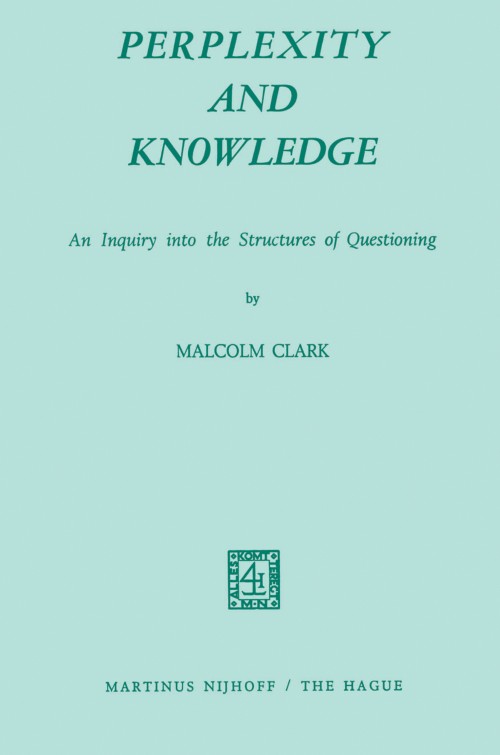
Perplexity and Knowledge [electronic resource] : An Inquiry into the Structures of Questioning / by M. Clark.
Erişim Adresi
ISBN
9789401027892
Dil Kodu
İngilizce
Yer Numarası
DK/8872
Yazar
Basım Bildirimi
1st ed. 1972.
Yayın Bilgisi
Dordrecht : Springer Netherlands : Imprint: Springer, 1972.
Fiziksel Niteleme
VIII, 246 p. online resource.
İçindekiler Notu
I The Viewpoint of Inquiry -- I: Alternative Accounts -- II: Duality and Self-Correction -- II Historical Notes on the Form of Inquiry -- III: Scepticism and Negative Proof -- IV: Plato and the Forms of Geometry -- V: Aristotle and the Forms of Life -- VI: Descartes and Reflection -- VII: Empiricists and Experience -- VIII: Kant and the Uses of Reason -- III Outlines for a Critique of Questioning -- IX: Perplexity and Progress -- X: Sense -- XI: Intellect -- XII: Practical Reason.
Özet, vb.
In making his distinction between revisionary and descriptive metaphysics, P.F. Strawson wrote that the former has some value provided that its "partial vision" is at the service of the latter, "which needs no justification at all beyond that of inquiry in general." (Individuals, p. 9) Perhaps we feel no need to ask what justification there is for inquiry in general. But if we do recognize any such need, then we discover that inquiry is self-justifying. The more I put it into question, the more I bring the theme of my inquiry to light in my performance of inquiring. Questioning is the business of philosophers. They are now content to leave the search for detailed information to experts in the various disciplines that have won their independence from philosophy. The questioning a philosopher conducts is of the 'second-order'. He asks about the status of various sorts of questions, the types of knowledge they yield and of con fusion into which they lead.
Konu
Anthropology.
Anthropology.
Anthropology.
Kurum Adı
