

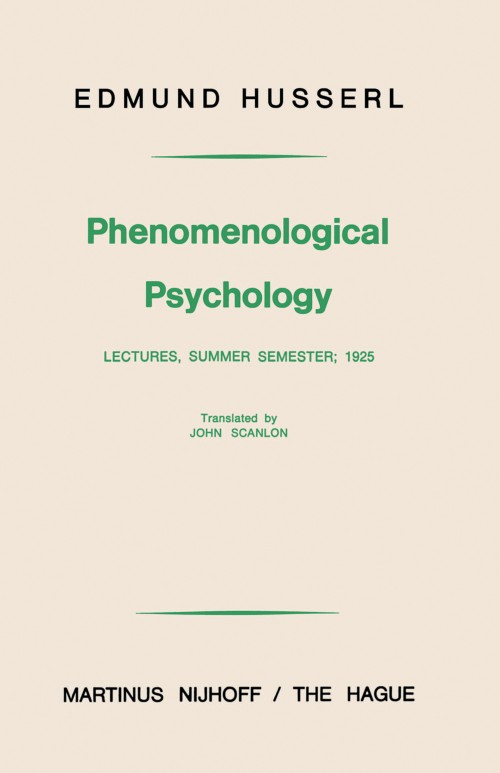
Phenomenological Psychology [electronic resource] : Lectures, Summer Semester, 1925 / by Edmund Husserl.
Erişim Adresi
ISBN
9789401010832
Dil Kodu
İngilizce
Yer Numarası
DK/8878
Yazar
Basım Bildirimi
1st ed. 1977.
Yayın Bilgisi
Dordrecht : Springer Netherlands : Imprint: Springer, 1977.
Fiziksel Niteleme
XIII, 179 p. online resource.
İçindekiler Notu
1. The development of modem psychology, Dilthey’s decisive critique and his proposals for a reform (explanatory and descriptive psychology) -- 2. The reasons for the limited influence of Dilthey upon his contemporaries: the inadequacy of their understanding and the limits of his beginning -- 3. Task and significance of the Logical Investigations -- a) Critique of psychologism; the essence of irreal (ideal) objects and of irreal (ideal) truths -- b) Researching the correlation: ideal object — psychic lived experiencing (forming of sense) by means of essential description in the reflective attitude -- c) More precise characterization of the reflection decisive for phenomenology (step by step accomplishment of the reflection) -- d) Brentano as pioneer for research in internal experience — discovery of intentionality as the fundamental character of the psychic -- e) The further development of the thought of intentionality in the Logical Investigations. The productive character of consciousness. Transition from a purely descriptive psychology to an a priori (eidetic-intuitive) psychology and its significance for the theory of knowledge -- f) The consistent expansion and deepening of the question raised by the Logical Investigations. Showing the necessity of an epistemological grounding of a priori sciences by transcendental phenomenology — the science of transcendental subjectivity -- 4. Summarizing characterization of the new psychology -- Systematic Part -- 5. Delimiting phenomenological psychology: distinguishing it from the other socio-cultural sciences and from the natural sciences. Questioning the concepts, nature and mind -- 6. Necessity of the return to the pre-scientific experiential world and to the experience in which it is given (harmony of experience) -- 7.Classifying the sciences by a return to the experiental world. The systematic connection of the sciences, based upon the structural connection of the experiential world; idea of an all-inclusive science as science of the all-inclusive world-structure and of the concrete sciences which have as their theme the individual forms of experiential objects. Significance of the empty horizons -- 8. The science of the all-inclusive world-structure as a priori science -- 9. Seeing essences as genuine method for grasping the a priori -- a) Variation as the decisive step in the dissociation from the factual by fantasy — the eidos as the invariable -- b) Variation and alteration -- c) The moments of ideation: starting with an example (model); disclosure brought about by an open infinity of variants (optional-ness of the process of forming variants); overlapping coincidence of the formation of variants in a synthetic unity; grasping what agrees as the eidos -- d) Distinguishing between empirical generalization and ideation -- e) Bringing out the sequence of levels of genera and gaining the highest genera by variation of ideas — seeing of ideas without starting from experience -- f) Summarizing characterization of the seeing of essences -- 10. The method of intuitive universalization and of ideation as instruments toward gaining the universal structural concepts of a world taken without restriction by starting from the experiential world (“natural concept of the world”). Possibility of an articulation of the sciences of the world and establishment of the signification of the science of the mind -- 11. Characterizing the science of the natural concept of the world. Differentiating this concept of experience from the Kantian concept of experience. Space and time as the most universalstructures of the world -- 12. Necessity of beginning with the experience of something singular, in which passive synthesis brings about unity -- 13. Distinguishing between self-sufficient and non-self-sufficient realities. Determination of real unity by means of causality -- 14. Order of realities in the world -- 15. Characterizing the psychophysical realities of the experiential world. Greater self-sufficiency of the corporeal vis-à-vis the psyche -- 16. The forms in which the mental makes its appearance in the experiential world. The specific character of the cultural object, which is determined in its being by a relation to a subject -- 17. Reduction to pure realities as substrates of exclusively real properties. Exclusion of irreal cultural senses -- 18. Opposition of the subjective and the objective in the attitude of the natural scientist -- 19. The true world in itself a necessary presumption -- 20. Objectivity demonstrable in intersubjective agreement. Normalcy and abnormalcy -- 21. Hierarchical structure of the psychic -- 22. Concept of physical reality as enduring substance of causal determinations -- 23. Physical causality as inductive. Uniqueness of psychic interweaving -- 24. The unity of the psychic -- 25. The idea of an all-inclusive science of nature. Dangers of the naturalistic prejudice -- 26. The subjective in the world as objective theme -- 27. The difficulty that the objective world is constituted by excluding the subjective, but that everything subjective itself belongs to the world -- 28. Carrying out the reflective turn of regard toward the subjective. The perception of physical things in the reflective attitude -- 29. Perceptual field — perceptual space -- 30. Spatial primal presence -- 31. Hyle — hyletic data as matter for intentional functions -- 32.Noticing givenness as I-related mode of givenness of the object -- 33. Objective temporality and temporality of the stream -- 34. Distinction between immanent and transcendent, real and irreal in perception. The object as irreal pole -- 35. Substrate-pole and property-pole. The positive significance of the empty horizon -- 36. The intentional object of perception -- 37. The phenomenological reduction as a method of disclosing the immanent -- 38. The access to pure subjectivity from external perception -- 39. Analysis of perception with regard to the perceiver himself -- 40. The problem of temporality: presenting — retention and protention (positional and quasi-positional modifications of perception and their significance for practical life) -- 41. Reflection upon the object-pole in the noematic attitude and reflection upon the I-pole as underlying it. All-inclusive synthesis of the I-pole. The I as pole of activities and habitualities -- 42. The I of primal institutions and of institutions which follow others. Identity of the I maintaining its convictions. The individuality of the I makes itself known in its decisions which are based upon convictions -- 43. The unity of the subject as monad — static and genetic investigation of the monad. Transition from the isolated monad to the totality of monads -- 44. Phenomenological psychology foundational both for the natural and for the personal exploration of the psyche and for the corresponding sciences -- 45. Retrospective sense-investigation -- Selected Bibliography.
Özet, vb.
THE TEXT In the summer semester of 1925 in Freiburg, Edmund Husserl delivered a lecture course on phenomenological psychology, in 1926127 a course on the possibility of an intentional psychology, and in 1928 a course entitled "Intentional Psychology. " In preparing the critical edition of Phiinomeno logische Psychologie (Husserliana IX), I Walter Biemel presented the entire 1925 course as the main text and included as supplements significant excerpts from the two subsequent courses along with pertinent selections from various research manuscripts of Husserl. He also included as larger supplementary texts the final version and two of the three earlier drafts of Husserl's Encyclopedia Britannica article, "Phenomenology"2 (with critical comments and a proposed formulation of the Introduction and Part I of the second draft by Martin Heidegger3), and the text of Husserl's Amsterdam lecture, "Phenomenological Psychology," which was a further revision of the Britannica article. Only the main text of the 1925 lecture course (Husserliana IX, 1-234) is translated here. In preparing the German text for publication, Walter Biemel took as his basis Husserl's original lecture notes (handwritten in shorthand and I Hague: Nijhoff, 1962, 1968. The second impression, 1968, corrects a number of printing mistakes which occur in the 1962 impression. 2 English translation by Richard E. Palmer in Journal o{ the British Society {or Phenomenology, II (1971), 77-90. 3 Heidegger's part of the second draft is available in English as Martin Heidegger, "The Idea of Phenomenology," tr. John N. Deely and Joseph A.
Konu
Phenomenology .
Philosophy.
Phenomenology.
Philosophy.
Philosophy.
Phenomenology.
Philosophy.
Kurum Adı
Eseri Alıntıla
Referansları kullanmadan önce gözden geçirmeniz ve varsa gerekli düzeltmeleri yapmanız önerilir.
Dijital Kaynak
MARC Görünümü
LEADER 10905nam a22005175i 4500
001 807585
003 TR_AnAIT
005 20260127004412
007 cr nn 008mamaa
008 121227s1977 ne | s |||| 0|eng d
020 |a9789401010832|9978-94-010-1083-2
024 7 |a10.1007/978-94-010-1083-2|2doi
041 |aeng
049 |aTürk Tarih Kurumu Kütüphanesi
050 4|aB829.5.A-Z
072 7|aHPCF3|2bicssc
072 7|aPHI018000|2bisacsh
072 7|aQDHR5|2thema
082 04|a142.7|223
090 |aDK/8878
100 1 |aHusserl, Edmund.|eauthor.|4aut|4http://id.loc.gov/vocabulary/relators/aut
245 10|aPhenomenological Psychology|h[electronic resource] :|bLectures, Summer Semester, 1925 /|cby Edmund Husserl.
250 |a1st ed. 1977.
264 1|aDordrecht :|bSpringer Netherlands :|bImprint: Springer,|c1977.
300 |aXIII, 179 p.|bonline resource.
336 |atext|btxt|2rdacontent
337 |acomputer|bc|2rdamedia
338 |aonline resource|bcr|2rdacarrier
347 |atext file|bPDF|2rda
505 0 |a1. The development of modem psychology, Dilthey’s decisive critique and his proposals for a reform (explanatory and descriptive psychology) -- 2. The reasons for the limited influence of Dilthey upon his contemporaries: the inadequacy of their understanding and the limits of his beginning -- 3. Task and significance of the Logical Investigations -- a) Critique of psychologism; the essence of irreal (ideal) objects and of irreal (ideal) truths -- b) Researching the correlation: ideal object — psychic lived experiencing (forming of sense) by means of essential description in the reflective attitude -- c) More precise characterization of the reflection decisive for phenomenology (step by step accomplishment of the reflection) -- d) Brentano as pioneer for research in internal experience — discovery of intentionality as the fundamental character of the psychic -- e) The further development of the thought of intentionality in the Logical Investigations. The productive character of consciousness. Transition from a purely descriptive psychology to an a priori (eidetic-intuitive) psychology and its significance for the theory of knowledge -- f) The consistent expansion and deepening of the question raised by the Logical Investigations. Showing the necessity of an epistemological grounding of a priori sciences by transcendental phenomenology — the science of transcendental subjectivity -- 4. Summarizing characterization of the new psychology -- Systematic Part -- 5. Delimiting phenomenological psychology: distinguishing it from the other socio-cultural sciences and from the natural sciences. Questioning the concepts, nature and mind -- 6. Necessity of the return to the pre-scientific experiential world and to the experience in which it is given (harmony of experience) -- 7.Classifying the sciences by a return to the experiental world. The systematic connection of the sciences, based upon the structural connection of the experiential world; idea of an all-inclusive science as science of the all-inclusive world-structure and of the concrete sciences which have as their theme the individual forms of experiential objects. Significance of the empty horizons -- 8. The science of the all-inclusive world-structure as a priori science -- 9. Seeing essences as genuine method for grasping the a priori -- a) Variation as the decisive step in the dissociation from the factual by fantasy — the eidos as the invariable -- b) Variation and alteration -- c) The moments of ideation: starting with an example (model); disclosure brought about by an open infinity of variants (optional-ness of the process of forming variants); overlapping coincidence of the formation of variants in a synthetic unity; grasping what agrees as the eidos -- d) Distinguishing between empirical generalization and ideation -- e) Bringing out the sequence of levels of genera and gaining the highest genera by variation of ideas — seeing of ideas without starting from experience -- f) Summarizing characterization of the seeing of essences -- 10. The method of intuitive universalization and of ideation as instruments toward gaining the universal structural concepts of a world taken without restriction by starting from the experiential world (“natural concept of the world”). Possibility of an articulation of the sciences of the world and establishment of the signification of the science of the mind -- 11. Characterizing the science of the natural concept of the world. Differentiating this concept of experience from the Kantian concept of experience. Space and time as the most universalstructures of the world -- 12. Necessity of beginning with the experience of something singular, in which passive synthesis brings about unity -- 13. Distinguishing between self-sufficient and non-self-sufficient realities. Determination of real unity by means of causality -- 14. Order of realities in the world -- 15. Characterizing the psychophysical realities of the experiential world. Greater self-sufficiency of the corporeal vis-à-vis the psyche -- 16. The forms in which the mental makes its appearance in the experiential world. The specific character of the cultural object, which is determined in its being by a relation to a subject -- 17. Reduction to pure realities as substrates of exclusively real properties. Exclusion of irreal cultural senses -- 18. Opposition of the subjective and the objective in the attitude of the natural scientist -- 19. The true world in itself a necessary presumption -- 20. Objectivity demonstrable in intersubjective agreement. Normalcy and abnormalcy -- 21. Hierarchical structure of the psychic -- 22. Concept of physical reality as enduring substance of causal determinations -- 23. Physical causality as inductive. Uniqueness of psychic interweaving -- 24. The unity of the psychic -- 25. The idea of an all-inclusive science of nature. Dangers of the naturalistic prejudice -- 26. The subjective in the world as objective theme -- 27. The difficulty that the objective world is constituted by excluding the subjective, but that everything subjective itself belongs to the world -- 28. Carrying out the reflective turn of regard toward the subjective. The perception of physical things in the reflective attitude -- 29. Perceptual field — perceptual space -- 30. Spatial primal presence -- 31. Hyle — hyletic data as matter for intentional functions -- 32.Noticing givenness as I-related mode of givenness of the object -- 33. Objective temporality and temporality of the stream -- 34. Distinction between immanent and transcendent, real and irreal in perception. The object as irreal pole -- 35. Substrate-pole and property-pole. The positive significance of the empty horizon -- 36. The intentional object of perception -- 37. The phenomenological reduction as a method of disclosing the immanent -- 38. The access to pure subjectivity from external perception -- 39. Analysis of perception with regard to the perceiver himself -- 40. The problem of temporality: presenting — retention and protention (positional and quasi-positional modifications of perception and their significance for practical life) -- 41. Reflection upon the object-pole in the noematic attitude and reflection upon the I-pole as underlying it. All-inclusive synthesis of the I-pole. The I as pole of activities and habitualities -- 42. The I of primal institutions and of institutions which follow others. Identity of the I maintaining its convictions. The individuality of the I makes itself known in its decisions which are based upon convictions -- 43. The unity of the subject as monad — static and genetic investigation of the monad. Transition from the isolated monad to the totality of monads -- 44. Phenomenological psychology foundational both for the natural and for the personal exploration of the psyche and for the corresponding sciences -- 45. Retrospective sense-investigation -- Selected Bibliography.
520 |aTHE TEXT In the summer semester of 1925 in Freiburg, Edmund Husserl delivered a lecture course on phenomenological psychology, in 1926127 a course on the possibility of an intentional psychology, and in 1928 a course entitled "Intentional Psychology. " In preparing the critical edition of Phiinomeno logische Psychologie (Husserliana IX), I Walter Biemel presented the entire 1925 course as the main text and included as supplements significant excerpts from the two subsequent courses along with pertinent selections from various research manuscripts of Husserl. He also included as larger supplementary texts the final version and two of the three earlier drafts of Husserl's Encyclopedia Britannica article, "Phenomenology"2 (with critical comments and a proposed formulation of the Introduction and Part I of the second draft by Martin Heidegger3), and the text of Husserl's Amsterdam lecture, "Phenomenological Psychology," which was a further revision of the Britannica article. Only the main text of the 1925 lecture course (Husserliana IX, 1-234) is translated here. In preparing the German text for publication, Walter Biemel took as his basis Husserl's original lecture notes (handwritten in shorthand and I Hague: Nijhoff, 1962, 1968. The second impression, 1968, corrects a number of printing mistakes which occur in the 1962 impression. 2 English translation by Richard E. Palmer in Journal o{ the British Society {or Phenomenology, II (1971), 77-90. 3 Heidegger's part of the second draft is available in English as Martin Heidegger, "The Idea of Phenomenology," tr. John N. Deely and Joseph A.
532 8 |aAccessibility summary: This PDF is not accessible. It is based on scanned pages and does not support features such as screen reader compatibility or described non-text content (images, graphs etc). However, it likely supports searchable and selectable text based on OCR (Optical Character Recognition). Users with accessibility needs may not be able to use this content effectively. Please contact us at accessibilitysupport@springernature.com if you require assistance or an alternative format.
532 8 |aInaccessible, or known limited accessibility
532 8 |aNo reading system accessibility options actively disabled
532 8 |aPublisher contact for further accessibility information: accessibilitysupport@springernature.com
650 0|aPhenomenology .
650 0|aPhilosophy.
650 14|aPhenomenology.
650 24|aPhilosophy.
710 2 |aSpringerLink (Online service)
773 0 |tSpringer Nature eBook
776 08|iPrinted edition:|z9789024719785
776 08|iPrinted edition:|z9789401010849
856 40|uhttps://doi.org/10.1007/978-94-010-1083-2
912 |aZDB-2-SHU
912 |aZDB-2-SXPR
912 |aZDB-2-BAE
950 |aHumanities, Social Sciences and Law (SpringerNature-11648)
950 |aPhilosophy and Religion (R0) (SpringerNature-43725)
001 807585
003 TR_AnAIT
005 20260127004412
007 cr nn 008mamaa
008 121227s1977 ne | s |||| 0|eng d
020 |a9789401010832|9978-94-010-1083-2
024 7 |a10.1007/978-94-010-1083-2|2doi
041 |aeng
049 |aTürk Tarih Kurumu Kütüphanesi
050 4|aB829.5.A-Z
072 7|aHPCF3|2bicssc
072 7|aPHI018000|2bisacsh
072 7|aQDHR5|2thema
082 04|a142.7|223
090 |aDK/8878
100 1 |aHusserl, Edmund.|eauthor.|4aut|4http://id.loc.gov/vocabulary/relators/aut
245 10|aPhenomenological Psychology|h[electronic resource] :|bLectures, Summer Semester, 1925 /|cby Edmund Husserl.
250 |a1st ed. 1977.
264 1|aDordrecht :|bSpringer Netherlands :|bImprint: Springer,|c1977.
300 |aXIII, 179 p.|bonline resource.
336 |atext|btxt|2rdacontent
337 |acomputer|bc|2rdamedia
338 |aonline resource|bcr|2rdacarrier
347 |atext file|bPDF|2rda
505 0 |a1. The development of modem psychology, Dilthey’s decisive critique and his proposals for a reform (explanatory and descriptive psychology) -- 2. The reasons for the limited influence of Dilthey upon his contemporaries: the inadequacy of their understanding and the limits of his beginning -- 3. Task and significance of the Logical Investigations -- a) Critique of psychologism; the essence of irreal (ideal) objects and of irreal (ideal) truths -- b) Researching the correlation: ideal object — psychic lived experiencing (forming of sense) by means of essential description in the reflective attitude -- c) More precise characterization of the reflection decisive for phenomenology (step by step accomplishment of the reflection) -- d) Brentano as pioneer for research in internal experience — discovery of intentionality as the fundamental character of the psychic -- e) The further development of the thought of intentionality in the Logical Investigations. The productive character of consciousness. Transition from a purely descriptive psychology to an a priori (eidetic-intuitive) psychology and its significance for the theory of knowledge -- f) The consistent expansion and deepening of the question raised by the Logical Investigations. Showing the necessity of an epistemological grounding of a priori sciences by transcendental phenomenology — the science of transcendental subjectivity -- 4. Summarizing characterization of the new psychology -- Systematic Part -- 5. Delimiting phenomenological psychology: distinguishing it from the other socio-cultural sciences and from the natural sciences. Questioning the concepts, nature and mind -- 6. Necessity of the return to the pre-scientific experiential world and to the experience in which it is given (harmony of experience) -- 7.Classifying the sciences by a return to the experiental world. The systematic connection of the sciences, based upon the structural connection of the experiential world; idea of an all-inclusive science as science of the all-inclusive world-structure and of the concrete sciences which have as their theme the individual forms of experiential objects. Significance of the empty horizons -- 8. The science of the all-inclusive world-structure as a priori science -- 9. Seeing essences as genuine method for grasping the a priori -- a) Variation as the decisive step in the dissociation from the factual by fantasy — the eidos as the invariable -- b) Variation and alteration -- c) The moments of ideation: starting with an example (model); disclosure brought about by an open infinity of variants (optional-ness of the process of forming variants); overlapping coincidence of the formation of variants in a synthetic unity; grasping what agrees as the eidos -- d) Distinguishing between empirical generalization and ideation -- e) Bringing out the sequence of levels of genera and gaining the highest genera by variation of ideas — seeing of ideas without starting from experience -- f) Summarizing characterization of the seeing of essences -- 10. The method of intuitive universalization and of ideation as instruments toward gaining the universal structural concepts of a world taken without restriction by starting from the experiential world (“natural concept of the world”). Possibility of an articulation of the sciences of the world and establishment of the signification of the science of the mind -- 11. Characterizing the science of the natural concept of the world. Differentiating this concept of experience from the Kantian concept of experience. Space and time as the most universalstructures of the world -- 12. Necessity of beginning with the experience of something singular, in which passive synthesis brings about unity -- 13. Distinguishing between self-sufficient and non-self-sufficient realities. Determination of real unity by means of causality -- 14. Order of realities in the world -- 15. Characterizing the psychophysical realities of the experiential world. Greater self-sufficiency of the corporeal vis-à-vis the psyche -- 16. The forms in which the mental makes its appearance in the experiential world. The specific character of the cultural object, which is determined in its being by a relation to a subject -- 17. Reduction to pure realities as substrates of exclusively real properties. Exclusion of irreal cultural senses -- 18. Opposition of the subjective and the objective in the attitude of the natural scientist -- 19. The true world in itself a necessary presumption -- 20. Objectivity demonstrable in intersubjective agreement. Normalcy and abnormalcy -- 21. Hierarchical structure of the psychic -- 22. Concept of physical reality as enduring substance of causal determinations -- 23. Physical causality as inductive. Uniqueness of psychic interweaving -- 24. The unity of the psychic -- 25. The idea of an all-inclusive science of nature. Dangers of the naturalistic prejudice -- 26. The subjective in the world as objective theme -- 27. The difficulty that the objective world is constituted by excluding the subjective, but that everything subjective itself belongs to the world -- 28. Carrying out the reflective turn of regard toward the subjective. The perception of physical things in the reflective attitude -- 29. Perceptual field — perceptual space -- 30. Spatial primal presence -- 31. Hyle — hyletic data as matter for intentional functions -- 32.Noticing givenness as I-related mode of givenness of the object -- 33. Objective temporality and temporality of the stream -- 34. Distinction between immanent and transcendent, real and irreal in perception. The object as irreal pole -- 35. Substrate-pole and property-pole. The positive significance of the empty horizon -- 36. The intentional object of perception -- 37. The phenomenological reduction as a method of disclosing the immanent -- 38. The access to pure subjectivity from external perception -- 39. Analysis of perception with regard to the perceiver himself -- 40. The problem of temporality: presenting — retention and protention (positional and quasi-positional modifications of perception and their significance for practical life) -- 41. Reflection upon the object-pole in the noematic attitude and reflection upon the I-pole as underlying it. All-inclusive synthesis of the I-pole. The I as pole of activities and habitualities -- 42. The I of primal institutions and of institutions which follow others. Identity of the I maintaining its convictions. The individuality of the I makes itself known in its decisions which are based upon convictions -- 43. The unity of the subject as monad — static and genetic investigation of the monad. Transition from the isolated monad to the totality of monads -- 44. Phenomenological psychology foundational both for the natural and for the personal exploration of the psyche and for the corresponding sciences -- 45. Retrospective sense-investigation -- Selected Bibliography.
520 |aTHE TEXT In the summer semester of 1925 in Freiburg, Edmund Husserl delivered a lecture course on phenomenological psychology, in 1926127 a course on the possibility of an intentional psychology, and in 1928 a course entitled "Intentional Psychology. " In preparing the critical edition of Phiinomeno logische Psychologie (Husserliana IX), I Walter Biemel presented the entire 1925 course as the main text and included as supplements significant excerpts from the two subsequent courses along with pertinent selections from various research manuscripts of Husserl. He also included as larger supplementary texts the final version and two of the three earlier drafts of Husserl's Encyclopedia Britannica article, "Phenomenology"2 (with critical comments and a proposed formulation of the Introduction and Part I of the second draft by Martin Heidegger3), and the text of Husserl's Amsterdam lecture, "Phenomenological Psychology," which was a further revision of the Britannica article. Only the main text of the 1925 lecture course (Husserliana IX, 1-234) is translated here. In preparing the German text for publication, Walter Biemel took as his basis Husserl's original lecture notes (handwritten in shorthand and I Hague: Nijhoff, 1962, 1968. The second impression, 1968, corrects a number of printing mistakes which occur in the 1962 impression. 2 English translation by Richard E. Palmer in Journal o{ the British Society {or Phenomenology, II (1971), 77-90. 3 Heidegger's part of the second draft is available in English as Martin Heidegger, "The Idea of Phenomenology," tr. John N. Deely and Joseph A.
532 8 |aAccessibility summary: This PDF is not accessible. It is based on scanned pages and does not support features such as screen reader compatibility or described non-text content (images, graphs etc). However, it likely supports searchable and selectable text based on OCR (Optical Character Recognition). Users with accessibility needs may not be able to use this content effectively. Please contact us at accessibilitysupport@springernature.com if you require assistance or an alternative format.
532 8 |aInaccessible, or known limited accessibility
532 8 |aNo reading system accessibility options actively disabled
532 8 |aPublisher contact for further accessibility information: accessibilitysupport@springernature.com
650 0|aPhenomenology .
650 0|aPhilosophy.
650 14|aPhenomenology.
650 24|aPhilosophy.
710 2 |aSpringerLink (Online service)
773 0 |tSpringer Nature eBook
776 08|iPrinted edition:|z9789024719785
776 08|iPrinted edition:|z9789401010849
856 40|uhttps://doi.org/10.1007/978-94-010-1083-2
912 |aZDB-2-SHU
912 |aZDB-2-SXPR
912 |aZDB-2-BAE
950 |aHumanities, Social Sciences and Law (SpringerNature-11648)
950 |aPhilosophy and Religion (R0) (SpringerNature-43725)
Materyaller
Depodan talep edilen materyal sadece kütüphane içerisinde kullanılmaktadır.
Materyal dışarıya ödünç verilmemektedir.
Materyal dışarıya ödünç verilmemektedir.
