LEADER 04337nam a22005535i 4500
001 807594
003 TR_AnAIT
005 20260127004423
007 cr nn 008mamaa
008 131025s2014 ne | s |||| 0|eng d
020 |a9789400772786|9978-94-007-7278-6
024 7 |a10.1007/978-94-007-7278-6|2doi
041 |aeng
049 |aTürk Tarih Kurumu Kütüphanesi
050 4|aLB2300-2799.3
072 7|aJNM|2bicssc
072 7|aEDU015000|2bisacsh
072 7|aJNM|2thema
082 04|a378|223
090 |aDK/8887
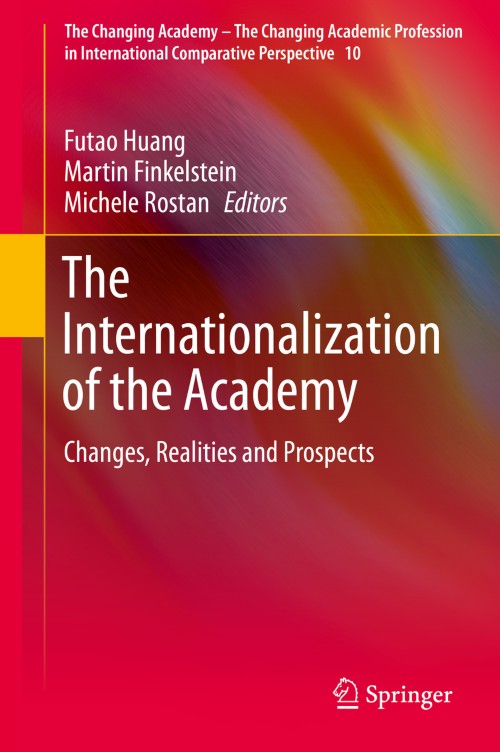
245 14|aThe Internationalization of the Academy|h[electronic resource] :|bChanges, Realities and Prospects /|cedited by Futao Huang, Martin Finkelstein, Michele Rostan.
250 |a1st ed. 2014.
264 1|aDordrecht :|bSpringer Netherlands :|bImprint: Springer,|c2014.
300 |aVIII, 302 p. 11 illus., 4 illus. in color.|bonline resource.
336 |atext|btxt|2rdacontent
337 |acomputer|bc|2rdamedia
338 |aonline resource|bcr|2rdacarrier
347 |atext file|bPDF|2rda
490 1 |aThe Changing Academy – The Changing Academic Profession in International Comparative Perspective,|x2543-0378 ;|v10
505 0 |aAcknowledgements -- 1. The Internationalization of the Academic Profession -- 2. Concepts and Methods -- 3. A Profile of CAP Participating Countries and a Global Overview of Academic Internationalization in 2007-2008 -- 4. Internationalization of the Academy: Rhetoric, Recent Trends and Prospects -- 5. The International Mobility of Academic Staff -- 6. The International Dimension of Teaching and Learning -- 7. The Internationalization of Research -- 8. Regionalization of Higher Education and the Academic Profession in Asia, Europe and North America -- 9. Gender and Faculty Internationalization -- 10. Internationalization and the New Generation of Academics -- 11. Patterns of Faculty Internationalization: A Predictive Model -- 12. The Internationalization of the Academy: Findings, Open Questions and Implications -- Appendix -- Notes on Contributors.
520 |aThis volume provides a nuanced empirical assessment of the extent to which the academic profession is internationalized at the beginning of the 21st century. It indicates which are the most internationalized academic activities, and focuses on specific topics such as physical mobility for study or professional purposes, teaching abroad or in another language, research collaboration with foreign colleagues, and publication and dissemination outside one’s native country or in another language. It places the main theme in the wider context of the history of higher education’s internationalization. It provides explanations on what drives and deters academics from international activity, and documents some of the consequences that internationalization has on academic work and productivity. This study is based on a survey of 25,000 academics working at higher education institutions in 18 countries and Hong Kong on five continents. Comparing data from the 1992 Carnegie International study to the 2007 CAP survey, relying on respondents’ perceptions of change, and comparing different academic generations, it offers valuable insights on changes in the internationalization of the academy.
650 0|aEducation, Higher.
650 0|aInternational education .
650 0|aComparative education.
650 0|aEducational sociology.
650 14|aHigher Education.
650 24|aInternational and Comparative Education.
650 24|aSociology of Education.
700 1 |aHuang, Futao.|eeditor.|4edt|4http://id.loc.gov/vocabulary/relators/edt
700 1 |aFinkelstein, Martin.|eeditor.|4edt|4http://id.loc.gov/vocabulary/relators/edt
700 1 |aRostan, Michele.|eeditor.|4edt|4http://id.loc.gov/vocabulary/relators/edt
710 2 |aSpringerLink (Online service)
773 0 |tSpringer Nature eBook
776 08|iPrinted edition:|z9789400772779
776 08|iPrinted edition:|z9789400772793
776 08|iPrinted edition:|z9789402407488
830 0|aThe Changing Academy – The Changing Academic Profession in International Comparative Perspective,|x2543-0378 ;|v10
856 40|uhttps://doi.org/10.1007/978-94-007-7278-6
912 |aZDB-2-SHU
912 |aZDB-2-SXED
950 |aHumanities, Social Sciences and Law (SpringerNature-11648)
950 |aEducation (R0) (SpringerNature-43721)