LEADER 04376nam a22005775i 4500
001 807599
003 TR_AnAIT
005 20260127004429
007 cr nn 008mamaa
008 130608s1984 xxu| s |||| 0|eng d
020 |a9781489903723|9978-1-4899-0372-3
024 7 |a10.1007/978-1-4899-0372-3|2doi
041 |aeng
049 |aTürk Tarih Kurumu Kütüphanesi
050 4|aBJ1-1725
072 7|aHPQ|2bicssc
072 7|aPHI005000|2bisacsh
072 7|aQDTQ|2thema
082 04|a170|223
090 |aDK/8892
100 1 |aMaynard, D.W.|eauthor.|4aut|4http://id.loc.gov/vocabulary/relators/aut
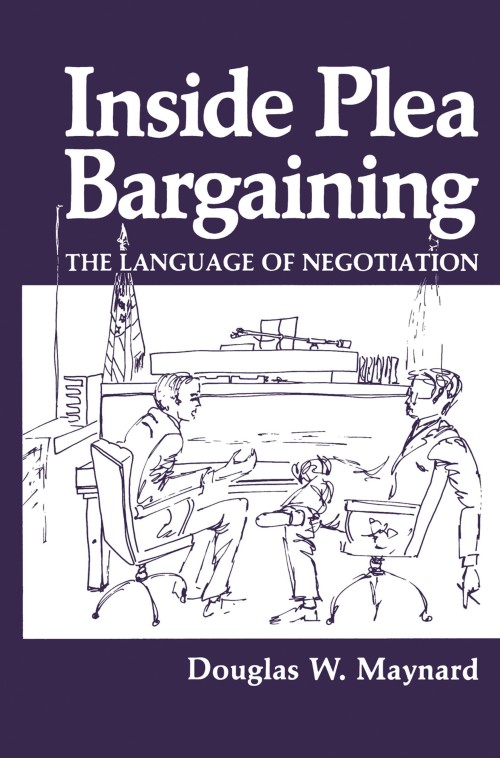
245 10|aInside Plea Bargaining|h[electronic resource] :|bThe Language of Negotiation /|cby D.W. Maynard.
250 |a1st ed. 1984.
264 1|aNew York, NY :|bSpringer US :|bImprint: Springer,|c1984.
300 |aXIII, 257 p.|bonline resource.
336 |atext|btxt|2rdacontent
337 |acomputer|bc|2rdamedia
338 |aonline resource|bcr|2rdacarrier
347 |atext file|bPDF|2rda
505 0 |a1. The Language of Negotiation -- 2. The Courtroom Context of Plea Bargaining -- 3. Frame Analysis of Plea Bargaining -- 4. The Structure of Bargaining Sequences -- 5. Routine and Adversarial Justice -- 6. Descriptions and Assessments of Defendants -- 7. Modeling Sentencing Decisions -- 8. A Discourse System for Negotiation -- 9. Inside Plea Bargaining -- Appendix 1. Adapted Transcribing Conventions -- Appendix 2. The Frank Bryan Case -- Appendix 3. The Maria Dominguez Case -- Appendix 4. The Lucinda Smith Case -- Appendix 5. The Donald Cleaver Case -- Appendix 6. The Cliff Washington Case -- References -- Author Index.
520 |aNegotiation is a ubiquitous part of social life. Some even say that social order itself is a negotiated phenomenon. Yet the study of negotiation as an actual discourse activity, occurring between people who have substantial interests and tasks in the real social world, is in its infancy. This is the more surprising because plea bargaining, as a specific form of negotiation, has recently been the center of an enormous amount of research attention. Much of the concern has been directed to basic ques tions of justice, such as how fair the process is, whether it is unduly coercive, and whether it accurately separates the guilty from the innocent. A study such as mine does not try to answer these sorts of questions. I believe that we are not in a position to answer them until we approach plea bargaining on its own complex terms. Previous studies that have attempted to provide a general picture of the process as a way to assess its degree of justness have neglected the specific skills by which prac titioners bargain and negotiate, the particular procedures through which various surface features such as character assessment are accomplished, and concrete ways in which justice is administered and, simultaneously, caseloads are managed.
532 8 |aAccessibility summary: This PDF is not accessible. It is based on scanned pages and does not support features such as screen reader compatibility or described non-text content (images, graphs etc). However, it likely supports searchable and selectable text based on OCR (Optical Character Recognition). Users with accessibility needs may not be able to use this content effectively. Please contact us at accessibilitysupport@springernature.com if you require assistance or an alternative format.
532 8 |aInaccessible, or known limited accessibility
532 8 |aNo reading system accessibility options actively disabled
532 8 |aPublisher contact for further accessibility information: accessibilitysupport@springernature.com
650 0|aEthics.
650 0|aLinguistics.
650 0|aLanguage and languages|xStyle.
650 0|aSociology.
650 14|aMoral Philosophy and Applied Ethics.
650 24|aLinguistics.
650 24|aStylistics.
650 24|aSociology.
710 2 |aSpringerLink (Online service)
773 0 |tSpringer Nature eBook
776 08|iPrinted edition:|z9780306415777
776 08|iPrinted edition:|z9781489903730
776 08|iPrinted edition:|z9781489903747
856 40|uhttps://doi.org/10.1007/978-1-4899-0372-3
912 |aZDB-2-SHU
912 |aZDB-2-SXPR
912 |aZDB-2-BAE
950 |aHumanities, Social Sciences and Law (SpringerNature-11648)
950 |aPhilosophy and Religion (R0) (SpringerNature-43725)